Abstract
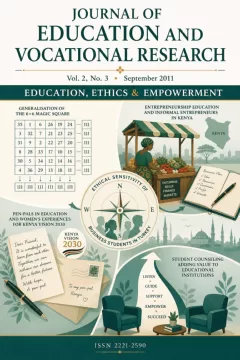
A magic square of order n is n×n matrix containing integers in such a way that each row and column add up to the same value. We generalize this notion to that of a 6×6 matrix with the help of a special geometrical figure without having much knowledge of algebra and another branch of mathematics.
Keywords
References
- Harold, M. S. (1978). An introduction to number theory. MIT Press, Cambridge, Mass.
- Joseph, H. S. (1986). The arithmetic of elliptic curves. Springer-Verlag, New York- Berlin.
- Brown, E. (2001). Magic squares, finite planes, and points of inflection on elliptic curves. College Math. J., 32(4), 260–267.
- Agnew, E. H. (1971). Two problems on magic squares. Mathematics Magazine , 44, 12–15.
- Hanson, K. D. (1979). The magic square in Albrecht D¨urer’s“Melencolia I”: Metaphysical symbol or mathematical pastime. Renaissance and Modern Studies , 23, 5–24.
- Ojha, B. & Kaul, B. L. (2011). Generalization of 4×4 magic square. International Journal of Applied Engineering Research, Dindigul , 1(4), 706-714.
- Ojha, B. & Kaul, B. L. (2011). Generalization of 5×5 magic square. Journal of Education and Vocational Research , 2(1), 18-23.
Downloads
No downloads have been recorded for this article yet. Figures appear here once readers begin downloading the full text.
How to Cite
Share this article
License
Copyright (c) 2011 Deo Brat Ojha (Author)

This work is licensed under a Creative Commons Attribution 4.0 International License.
Author (s) should affirm that the material has not been published previously. It has not been submitted and it is not under consideration by any other journal. At the same time author (s) need to execute a publication permission agreement to assume the responsibility of the submitted content and any omissions and errors therein. After submission of revised paper in the light of suggestions of the reviewers, the editorial team edits and formats manuscripts to bring uniformity and standardization in published material.
This work will be licensed under Creative Commons Attribution 4.0 International (CC BY 4.0) and under condition of the license, users are free to read, copy, remix, transform, redistribute, download, print, search or link to the full texts of articles and even build upon their work as long as they credit the author for the original work. Moreover, as per journal policy author (s) hold and retain copyrights without any restrictions.
Keywords
Section
Published
Submissions
Have research to publish? Journal of Education and Vocational Research welcomes submissions.
Make a Submission