Abstract
The purpose of this study is to establish the relationship between the effectiveness of the training programs and job performance as perceived by teachers in Malaysia. This study investigates the relationship between the level of effectiveness of training with respect to reaction, learning and behavior outcomes and job performance. 210 respondents from various government schools in Klang Valley had participated in this study through a self-administered survey. The results disclosed that all level of effectiveness have significant relationship with job performance. Therefore we can conclude that teachers indeed need and appreciate all the training programs designed by TED currently.
Keywords
References
- Al-Athari, A. & Zairi, M. (2002). An empirical study of the impact of knowledge management on organizational performance. Journal of Computer Information Systems, 42, 74-82.
- Allen, S. J. (2007). Adult Learning Theory and Leadership Development . Kravis Leadership Institute, Claremont McKenna College, 7, 26-37.
- Campbell, D. J. & Pritchard, R. (1976). Motivation theory in industrial and organizational psychology. In M.D. Dunnette (Ed.), Handbook of industrial and organizational psychology (63-130). Chicago: Rand McNally.
- Deci, E. L., Connell, J. P. & Ryan, R. M. (1989). Self-determination in a work organization. Journal of Applied Psychology , 74, 580-590.
- Gavin, T. (2001). 2001 Industry Report. Training , 38(10), 40–75.
- Hair, J. F. J., Bush, R. P. & Ortinau, D. J. (2006). Marketing research: Within a changing information environment, McGraw Hill International Edition.
- Herlina, W. (2011). The effectiveness of Indonesian English teachers training programs in improving confidence and motivation. International Journal of Instruction, 4(1).
- Huang, T. C. (2001). Education + Training. MCB University Press , 43(8/9), 437–444.
- Hubbard, A. (1995). A Price Tag on Training. Mortgage Banking , 55(5).
- Kirkpatrick, D. L. (1959). Techniques for evaluating training programs. Journal of the American Society of Training and Development, 13 , 3–9.
- Kirkpatrick, D. L. (1996). Invited reaction: Reaction to Holton article. Human Resource Development Quarterly, 7, 23–25.
- Kraiger, K., Ford, J. K. & Salas, E. (1993). Application of cognitive, skill-based, and affective theories of learning outcomes to new methods of training evaluation. Journal of Applied Psychology, 78, 311328.
- Mahoney, T. A., Jerdee, T. H. & Carroll, J. S. J. (1963). Development of managerial performance: A research approach. Cincinnati: Southwestern.
- Noe, R. A. (2002). Employee Training and Development (New York: McGraw-Hill Irwin).
- Noran, F. Y. & Habibah, E. (1999). Job motivation and job performance: Case of recipients for excellent service in a higher education institution. Malaysian Management Review, 4(2).
- Reeves, M. (1994). Evaluation of training. Petaling Jaya: Pelanduk Publications, 3243.
- Rowden, R. W. (2002). The relationship between workplace learning and job satisfaction in small and mid-sized businesses. Human Resource Development Quarterly , 13, 407-26.
- Rowden, R. W. & Conine, C. T. J. (2005). The impact of workplace learning and job satisfaction in small US commercial banks. Journal of workplace Learning , 17(4), 215-30.
- Tsai, P., Yen, C. Y., Huang, L. & Huang, I. (2007). A study on motivating employee is learning commitment in the post-downsizing era: job satisfaction perspective. Journal of World Business , 42(2), 157-69.
Downloads
No downloads have been recorded for this article yet. Figures appear here once readers begin downloading the full text.
How to Cite
Share this article
License
Copyright (c) 2012 Shirley Ken Tzu Ting, Cheah Yeh Ying, Nur Shazyani Binti Mohd Salleh (Author)

This work is licensed under a Creative Commons Attribution 4.0 International License.
Author (s) should affirm that the material has not been published previously. It has not been submitted and it is not under consideration by any other journal. At the same time author (s) need to execute a publication permission agreement to assume the responsibility of the submitted content and any omissions and errors therein. After submission of revised paper in the light of suggestions of the reviewers, the editorial team edits and formats manuscripts to bring uniformity and standardization in published material.
This work will be licensed under Creative Commons Attribution 4.0 International (CC BY 4.0) and under condition of the license, users are free to read, copy, remix, transform, redistribute, download, print, search or link to the full texts of articles and even build upon their work as long as they credit the author for the original work. Moreover, as per journal policy author (s) hold and retain copyrights without any restrictions.
Keywords
Section
Published in
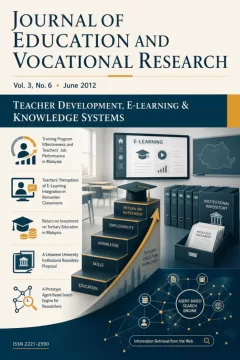 Vol. 3 No. 6 (2012)
Teacher Development, E-Learning & Knowledge Systems
View issue contents
Published
Submissions
Have research to publish? Journal of Education and Vocational Research welcomes submissions.
Make a Submission