Abstract
The development of the interactive, collaborative and dynamic e-learning methods is considered the primary mode of evolution of the Romanian and international educational systems. Most of the studies have revealed the widespread benefits of these technologies and exemplifying their applicability and their evolution within the education systems. However, few studies clearly identify the role that e-learning platforms have in the improvement of teaching - learning and how these technologies can be integrated into the classroom. This article proposes a new approach related to the integration of these systems while providing educational acts, starting by identifying and understanding the perceptions that teachers have regarding this type of innovative technology, explaining and interpreting the results of a qualitative research conducted within Romanian educational market. Teacher’s perception on the role of e-learning education is interpreted as a factor, which influences the quality of the use and the integration of these technologies in the Romanian educational environment, reaffirming the need for a coherent implementation of these instruments at a specific school level but also at general educational environment integration.
Keywords
- Education Search this journal for Education (opens in a new tab)
- e-learning Search this journal for e-learning (opens in a new tab)
- Innovation Search this journal for Innovation (opens in a new tab)
- Perception Search this journal for Perception (opens in a new tab)
- Integration Search this journal for Integration (opens in a new tab)
References
- Aristotel. (2001). Politica, Bucuresti, Antet Publishing House Calin, M. (2001). Filo Sofia Educaţiei, Bucureşti, Aramis Publishing House.
- Cojocaru, V. (2010).Teoriasime todologiatransferuluiinovational in invatamantul superior, PhD. Thesis Cope, C. & Ward, P. (2002). Integrating learning technology into classrooms: The importance of teachers’ perceptions. Educational Technology & Society, 5(1), 9.
- Durkheim, E. (2005). Education etsociologie, Paris, PUF European Commission. (2004). European Commission Report, 5 Http: //www.wikipedia.org/ accesat la 20. 03.2012
- Inglis, A., Ling, P. & Joosten, V. (2002). Delivering digitally, London: Kogan Page
- Kotler, P. H. & Keller, K. (2008). Management Marketingului, Bucureşti, Ed Teora
- Steyn, G. M. (2004). Harnessing the power of knowledge în higher Education. International Journal of Education , 204(2).
- Platon, G. (1994). Republica, Didactic and pedagogical Publishing House, Bucharest
- Prosser, M. & Trigwell, K. (1999). Understanding learning and teaching: the experience in higher education, Philadelphia, PA: Society for Research into Higher Education & Open University Press.
- Steel, J. & Hudson, A. (2001). Educational Technology în Learning and Teaching: The Perceptions and Experiences of Teaching Staff. Innovations in Education and Teaching International, 38(2), 103-137.
- Trigwell, K., Prosser, M. & Waterhouse, F. (1999). Relations between teachers’ approaches to teaching and students’ approaches to learning. Higher Education , 37, 57-70.
- Van-Weert, T. J. (2006). Education of the 21-st century: New professionalism in lifelong learning, knowledge development and knowledge sharing. IFIP Conference, Imagining the future for ICT and education, Aalesund, 217.
Downloads
No downloads have been recorded for this article yet. Figures appear here once readers begin downloading the full text.
How to Cite
Share this article
License
Copyright (c) 2012 Raluca Cristina Eftimie (Author)

This work is licensed under a Creative Commons Attribution 4.0 International License.
Author (s) should affirm that the material has not been published previously. It has not been submitted and it is not under consideration by any other journal. At the same time author (s) need to execute a publication permission agreement to assume the responsibility of the submitted content and any omissions and errors therein. After submission of revised paper in the light of suggestions of the reviewers, the editorial team edits and formats manuscripts to bring uniformity and standardization in published material.
This work will be licensed under Creative Commons Attribution 4.0 International (CC BY 4.0) and under condition of the license, users are free to read, copy, remix, transform, redistribute, download, print, search or link to the full texts of articles and even build upon their work as long as they credit the author for the original work. Moreover, as per journal policy author (s) hold and retain copyrights without any restrictions.
Keywords
- Education Search this journal for Education (opens in a new tab)
- e-learning Search this journal for e-learning (opens in a new tab)
- Innovation Search this journal for Innovation (opens in a new tab)
- Perception Search this journal for Perception (opens in a new tab)
- Integration Search this journal for Integration (opens in a new tab)
Section
Published in
 Vol. 3 No. 6 (2012)
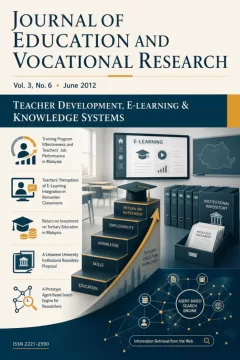
Teacher Development, E-Learning & Knowledge Systems
View issue contents
Published
Submissions
Have research to publish? Journal of Education and Vocational Research welcomes submissions.
Make a Submission