Abstract
This paper examines the rate of return on higher education to first degrees, master’s degrees, and PhDs in Malaysia using previously published data. The purposes of this research are to study and identify whether or not there is a direct link between tertiary education and wages. Barbara Ischinger, Director for Education, points out ‘‘Education has always been a critical investment for the future, for individuals, for economies and for societies at large.’’1 John F. Kennedy once said; ‘’Let us think of education as the means of developing our greatest abilities, because in each of us there is a private hope and dream which, fulfilled, can be translated into benefit for everyone and greater strength for our nation.’’2 A common belief existing in all societies suggests that tertiary education degree actually provides great pay-off to the beneficiary. According to the results of some recent surveys on this topic, students in general seem to agree with this common belief that they will have positive returns immediately after graduation.
Keywords
References
- Baum, S. & Payea, K. (2004). College Board: Education Pays 2004. The Benefits of Higher Education for Individuals and Society . www.collegeboard.com
- BBC World News. (2011). Gender pay gap widens to £10,500 for managers, CMI says .
- Blight, D. & West, L. (1999). Demand for Transnational Higher Education in the Asia Pacific. Presented at the Global Alliance for Transnational Education Conference, Access or Exclusion? Trade in Transnational Education Services, Melbourne, October 1999
- Commentary. (2010). On Issues of Higher Education and Research . The University of Auckland. July 10, 2010. Issue 6.
- Committee for Economic Development. (1998). America’s Basic Research: Prosperity through Discovery. Available online: http://ced.issuelab.org/research/listing /americas_basic_research_prosperity_through_discovery.
- Education at a glance, OECD. (2009). OECD indicators. 42, 137, 140, 152, 153, 161, 190, 192, 208, 212, 218, 223, 237, 241, 312, 313.
- Hatakenaka, S. (2004). Internationalism in Higher Education: A Review. Higher Education Policy Institute.
- Kelly, G. P. & Elliott, C. M. (1982). Women are Education in the Third World: Comparative Perspectives . State University of New York Press, Albany. ISBN 0-87395-619-2, 70.
- Samuelson, P. A. & Nordhaus, W. D. (2004). Factors of production , Capital, Human capital, and under Glossary of Terms. Economics, 18th edition.
- Scott, P. (1998). The Globalization of Higher Education Society for the Research into Higher Education and Open University Press, Buckingham/Philadelphia.
- Trostel, P. A. (2008). High returns: Public investment in higher education. Federal Reserve Bank of Boston. Spring 2008. Available online: www.bos.frb.org/commdev/c&b/2008/spring/Trostel_invest_in_higher_ed.pdf
- UNESCO. (2004). United Nations Human Development Program; UNESCO Institute of Statistics; UNESCO Institute for Statistics > U.S. (2004). Census Bureau, 2004, PINC–03. > 35 Message from the Prime Minister: National Higher Education Action Plan, 2007-2010, p.3
Downloads
No downloads have been recorded for this article yet. Figures appear here once readers begin downloading the full text.
How to Cite
Share this article
License
Copyright (c) 2012 John Taskinsoy (Author)

This work is licensed under a Creative Commons Attribution 4.0 International License.
Author (s) should affirm that the material has not been published previously. It has not been submitted and it is not under consideration by any other journal. At the same time author (s) need to execute a publication permission agreement to assume the responsibility of the submitted content and any omissions and errors therein. After submission of revised paper in the light of suggestions of the reviewers, the editorial team edits and formats manuscripts to bring uniformity and standardization in published material.
This work will be licensed under Creative Commons Attribution 4.0 International (CC BY 4.0) and under condition of the license, users are free to read, copy, remix, transform, redistribute, download, print, search or link to the full texts of articles and even build upon their work as long as they credit the author for the original work. Moreover, as per journal policy author (s) hold and retain copyrights without any restrictions.
Keywords
Section
Published in
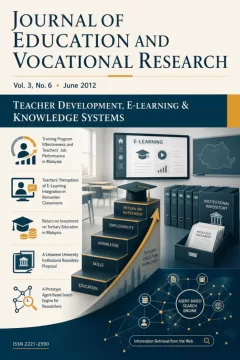 Vol. 3 No. 6 (2012)
Teacher Development, E-Learning & Knowledge Systems
View issue contents
Published
Submissions
Have research to publish? Journal of Education and Vocational Research welcomes submissions.
Make a Submission