Abstract
The global economic downturn has highlighted the damaging impact of financial illiteracy on individuals, families, communities and entire nations. The need to teach people how to spend, save, invest, borrow and manage money wisely has become more important than ever. It has also raised questions about what it takes to effectively engage people and change their financial behavior. This study is part of a larger study in Singapore schools to study the impact of an initiative to equip teacher’s with pedagogical skills and knowledge to integrate financial literacy messages in day-to-day lessons and foster a socially responsible attitude towards managing money to create a financially sustainable society. This study provides insights into how financial education can be integrated into classroom lessons in schools to deal with challenges that living in modern society presents.
Keywords
- Financial Education Search this journal for Financial Education (opens in a new tab)
- Managing Money Search this journal for Managing Money (opens in a new tab)
- Financial Literacy Search this journal for Financial Literacy (opens in a new tab)
- Pedagogy Search this journal for Pedagogy (opens in a new tab)
- Attitude Search this journal for Attitude (opens in a new tab)
References
- Adams, H. & Wallace, B. (1989). Developing the potential of children in disadvantaged communities: The TASC Project - Thinking Actively in a Social Context. Paper presented at the 8th World Conference on Gifted and Talented Children, Sydney, Australia.
- Jonassen, D. & Tessmer, M. (1996/1997). An outcomes-based taxonomy for instructional systems design, evaluation and research. Training Research Journal , 2, 11-46.
- Vygotsky, L. S. (1978). Mind and society: The development of higher psychological processes. Cambridge, MA: Harvard University Press.
- Warr, D. J. (2005). It was fu. However, we don’t usually talk about these things: Analyzing sociable interaction in focus groups. Qualitative Inquiry , 11, 200-224.
Downloads
No downloads have been recorded for this article yet. Figures appear here once readers begin downloading the full text.
How to Cite
Share this article
License
Copyright (c) 2012 Noi Keng KOH (Author)

This work is licensed under a Creative Commons Attribution 4.0 International License.
Author (s) should affirm that the material has not been published previously. It has not been submitted and it is not under consideration by any other journal. At the same time author (s) need to execute a publication permission agreement to assume the responsibility of the submitted content and any omissions and errors therein. After submission of revised paper in the light of suggestions of the reviewers, the editorial team edits and formats manuscripts to bring uniformity and standardization in published material.
This work will be licensed under Creative Commons Attribution 4.0 International (CC BY 4.0) and under condition of the license, users are free to read, copy, remix, transform, redistribute, download, print, search or link to the full texts of articles and even build upon their work as long as they credit the author for the original work. Moreover, as per journal policy author (s) hold and retain copyrights without any restrictions.
Keywords
- Financial Education Search this journal for Financial Education (opens in a new tab)
- Managing Money Search this journal for Managing Money (opens in a new tab)
- Financial Literacy Search this journal for Financial Literacy (opens in a new tab)
- Pedagogy Search this journal for Pedagogy (opens in a new tab)
- Attitude Search this journal for Attitude (opens in a new tab)
Section
Published in
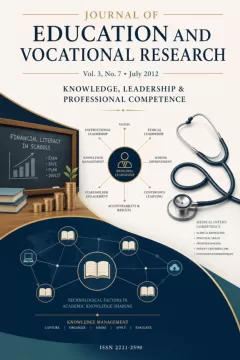 Vol. 3 No. 7 (2012)
Knowledge, Leadership & Professional Competence
View issue contents
Published
Submissions
Have research to publish? Journal of Education and Vocational Research welcomes submissions.
Make a Submission