Abstract
This study investigates the perception of Malaysian housemen on what the indicators of competence are in the medical practice. This derives from the need for the interns to have the requisite skill needed to make them competent in the post-medical school medical practice. A survey questionnaire was administered on all 2,046 housemen in all medical schools across Malaysia as at April 30, 2008 when data was collected. Data so obtained were subjected to statistical analysis based on N=1213 using both the structural equation modeling via SPSS AMOS 18 software. Nine skills were identified in all. These are interpersonal, IT, patient management, basic, holistic, science, ethics, coping, and clinical skills. While all the skills were found to be statistically significant, no factorial invariance was observed when the data is split into demographic divides.
Keywords
References
- Adewale, A. A. (2010). Localization of Microfinance as a Strategy to Alleviate Intergenerational Transmission of Poverty in Nigeria. An Unpublished Doctoral Thesis Submitted to the International Islamic university Malaysia.
- Aggarwal, R., Grantcharov, T. P. & Darzi, A. (2007). Framework for Systematic training and Assessment of Technical Skills. Journal of American College Surgeons, 1, 697-705.
- Alexander, B. (2007). Assessing Resident Competency in Laboratory Medicine. Clinics in Laboratory Medicine, 27, 269-281.
- Blunch, N. J. (2008). Introduction to Structural equation Modeling Using SPSS and AMOS. Singapore: Sage.
- Clay, A. S. (1999). The Medical Student as a Patient. Ann. Intern Med. , 131, 225-226.
- Dean, S. J., Barratt, A. L., Hendry, G. D. & Lyon, P. M. A. (2003). Preparedness for hospital practice among graduates of a problem-based, graduate entry medical program. Medical Education, 178, 163-178.
- Epstein, R. M. (2007). Assessment in Medical Education. The New England journal of Medicine, 356(4), 387396.
- Hair, J. F. Jr., Anderson, R. E., Tatham, R. L. & Black, W. C. (2006). Multivariate Data Analysis, (7th edn). Upper Saddle River, NJ: Prentice Hall.
- Hurwitz, B. & Vass, A. (2002).What is a good doctor, and how can you make one? BMJ , 325, 667-668.
- Janicik, R., Kalet, A. L., Schwartz, M. D., Zabar, S. & Lipkin, M. (2007). Using Bedside Rounds to teach Communication Skills in the Internal Medicine Clerkship. Medical Education Online (serial online), 12(1).
- Jones, A., McArdle, P. & O'Neill, P. (2002). Perceptions of how well graduates are prepared for the role of preregistration house officer: a comparison of outcomes from a traditional and an integrated PBL curriculum. Med Educ , 6, 16-25.
- Leach, D. C. (2002). Competence is a Habit. Journal of American Medical Association, 287(2), 243-244.
- Marple, B. F. (2007). Competency-Based Resident Education. Otolaryngologic Clinics of North America , 40, 1215-1225.
- McLaughlin, C. P. & Kaluzny, A. D. (1999). Continuous Quality Improvement in Health Care. Gaithesburg, U.S.: Aspen Publishers.
- Meyers, L. S., Gamst, G. & Guarino, A. J. (2006). Applied Multivariate Research . London: Sage Publications Inc.
- Mueler, R. O. & Hancock, G. R. (2008). Best Practices in Structural Equation Modeling in J. W. Osborne (Ed). Best Practices in Quantitative Methods. London: Sage Publications.
- Neeraj, K., Burkhalter, B. & Cooper, M. (2001). Measuring the Competence of Healthcare Providers. Operations Research Issue Paper, 2(1).
- Pallant, J. (2007). SPSS Survival Manual. Australia: Allen-Unwin.
- Primadasa, I. G., Shehab, D., Al-Jarallah, K. F. & Thabib, F. (2007). Confidence in Performing Core Clinical Skills: A Survey of Trainees Completing Housemenship in Kuwait. Bulletin of the Kuwait Institute for Medical Specialization, 6(68).
- Shapiro, J. (2008). Walking a mile in their patients’ shoes: empathy and othering in medical students’ education. Philosophy, Ethics and Humanities in Medicine, 3(10), 1-11.
- Sivalingam, N. (2004). Teaching and Learning of Professionalism in Medical Schools. Annals of Academic Medicine Singapore, 33, 706-710.
- Wass, V. (2005). Ensuring medical students are fit for purpose. British Medical Journal, 331, 791-792.
- Watmough, S., Taylor, D. & Garden, A. (2006). Educational supervisors’ evaluate the preparedness of graduates from a reformed UK curriculum to work as pre-registration house officers (PRHOs): a qualitative study. Medical Education, 40, 995-1001.
- While, A. E. (1994). Competence versus performance: Which is more important? Journal of Advanced Nursing, 29, 525–31.
- Woolf, K., Cave, J., McManus, C. & Dacre, J. E. (2007). It gives you an understanding you can’t get from any book.’ The relationship between medical students’ and doctors personal illness experiences and their performance: a qualitative and quantitative study. BMC Medical Education, 7(50), 1-9.
Downloads
No downloads have been recorded for this article yet. Figures appear here once readers begin downloading the full text.
How to Cite
Share this article
License
Copyright (c) 2012 Abideen Adeyemi Adewale, Noor Hazilah Abd. Manaf, Azura Omar (Author)

This work is licensed under a Creative Commons Attribution 4.0 International License.
Author (s) should affirm that the material has not been published previously. It has not been submitted and it is not under consideration by any other journal. At the same time author (s) need to execute a publication permission agreement to assume the responsibility of the submitted content and any omissions and errors therein. After submission of revised paper in the light of suggestions of the reviewers, the editorial team edits and formats manuscripts to bring uniformity and standardization in published material.
This work will be licensed under Creative Commons Attribution 4.0 International (CC BY 4.0) and under condition of the license, users are free to read, copy, remix, transform, redistribute, download, print, search or link to the full texts of articles and even build upon their work as long as they credit the author for the original work. Moreover, as per journal policy author (s) hold and retain copyrights without any restrictions.
Keywords
Section
Published in
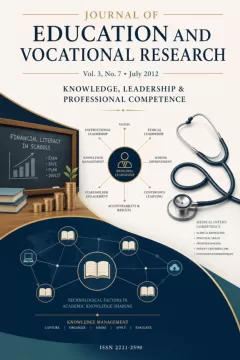 Vol. 3 No. 7 (2012)
Knowledge, Leadership & Professional Competence
View issue contents
Published
Submissions
Have research to publish? Journal of Education and Vocational Research welcomes submissions.
Make a Submission