Abstract
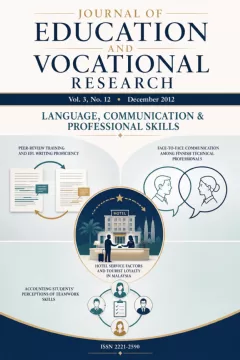
This study mainly research on soft skills pertaining Teamwork Skills. The main objective of this paper is to examine the relationship among all six dimensions of teamwork skills (coordination, decision making, leadership, interpersonal skills, adaptability and communication). Furthermore, the study is to investigate the different of perception toward teamwork skills (coordination, decision making, leadership, interpersonal skills, adaptability and communication) among final year accounting students. The study also shows main top important skills which are accounting knowledge, professionalism, oral communication, problem solving, time management, auditing, ability to memorize, work well with others, written communication, leadership ability, computers, economic, and the last is business law. In addition, the study shows the inter-correlation between six dimensions ranged from 0.836 to 0.943. The results also show a significant difference between female and male for leadership and adaptability. Finally, the findings are discussed to recommend in improving education curricular in university and educations institutional.
Keywords
- Teamwork Skills Search this journal for Teamwork Skills (opens in a new tab)
- Soft Skills Search this journal for Soft Skills (opens in a new tab)
- Accounting Search this journal for Accounting (opens in a new tab)
- Coordination Search this journal for Coordination (opens in a new tab)
- Decision Making Search this journal for Decision Making (opens in a new tab)
- Leadership Search this journal for Leadership (opens in a new tab)
- Interpersonal Skills Search this journal for Interpersonal Skills (opens in a new tab)
- Adaptability Search this journal for Adaptability (opens in a new tab)
- Communication Search this journal for Communication (opens in a new tab)
References
- Al-Alawneh, M. K. & Ashour, R. (2011). Assessing the Level of Employability Skills Among Graduates of Career and Technical Education Institutions in Jordan: An Educator Perspective. Journal of Institutional Research, 9(1), 90-98.
- Arthur, A., Arthur, Y., Coopers, L. & Deloitte, H. (1989). Capabilities for success in accounting professions (The white paper).
- Albrecht, W. S. & Sack, R. J. (2000). Accounting education: charting the course through a perilous future. Accounting Education Series , 1, 1-65.
- Bancino, R. & Zevalkink, C. (2007). Soft skills: the new curriculum for hard-core technical professionals. Techniques: Connecting Education and Careers, 85(2), 20-22.
- Brungardt, C. J. (2009). College Graduates’ Perceptions of Their Use of Teamwork Skills: Soft Skills Development in Fort Hays State University Leadership Education. Retrived from http://hdl.handle.net/2097/2224
- Burke, C. S., Volpe, C., Cannon-Bowers, J. A. & Salas, E. (1993, March). So what is teamwork anyway? A synthesis of the team process literature. Paper presented at the 39th annual meeting of the Southeastern Psychological Association, Atlanta, GA.
- Carver, T. L. & Stickley, A. (2012), Teamwork in First Year Law Units: Can It Work?
- Chen, H. (2002). Relationships of Teamwork Skills withPerformance Appraisals and Salary Information in a Taiwanese High Performance Work Organization. (Unpublished doctoral dissertation). University of Southern California, Los Angeles.
- Cohen, S. & Bailey, D. (1997). What makes teams work: Group effectiveness research from the hop floor to the executive suite. Journal of Management , 23(3), 239-290.
- Coll, R. K. & Eames, C. (2006). The international handbook for cooperative education. Boston, Mass: WACE. De-Vaus, D. (2002). Analyzing Social Science Data, 1st Edition, London: Sage Publication Ltd
- de Villiers, R. (2010). The incorporation of soft skills into accounting curricula: preparing accounting graduates for their unpredictable futures. Meditari Accountancy Research , 18(2),1 – 22
- Gammie, B., Gammie, E. & Cargill, E. (2002). Personal skills development in the accounting curriculum. Accounting Education, 11(1), 63-78.
- Graduate Employability in Asia. (2012). UNESCO Bangkok, Asia and Pacific Regional Bureau for Education, ISBN: 978-92-9223-395-2, Retrieved from http://unesdoc.unesco.org/images/0021/002157/215706e.pdf, Accessed on June 2012
- Gullivan, M., Truex III, D. & Kvasny, L. (2003). Changing patterns in IT skill sets: a content analysis of classified advertising. Databases for Advances in Information Systems, 35(3), 64-86.
- Hair, J. F. Jr., Black, W. C., Babin, B. J. & Anderson, R. E. (2010). Multivariate Data Analysis: A Global Perspective, 7th Ed., Saddle River, NJ. Prentice-Hall International.
- Hariati, A. (2009). The jobs are out there, Retrieved from http://thestar.com.my/news/story.asp?file=/2009/7/5/focus/4258655&sec=focus, Accessed on June 2012
- Hirschfeld, R., Jordan, M., Field, H., Giles, W. & Armenakis, A. (2006). Becoming team players: Team members’ mastery of teamwork knowledge as a predictor of team task proficiency and observed teamwork effectiveness. Journal of Applied Psychology , 91(2), 467-474.
- Hsieh, G. (2001). Types of Feedback in a Computer-Based Collaborative Problem-Solving Group Task. (Unpublished doctoral dissertation). University of Southern California, Los Angeles, USA.
- Jagdev Singh Sidhu. (2011). the scramble for skills, Retrieved from http://biz.thestar.com.my/news/story.asp?sec=business&file=/2011/2/12/business/8051679 Accessed on June 2012
- Kang Soon Chen. (2012). Look beyond your major, The Star, Retrieved from: http://thestar.com.my/education/story.asp?file=/2012/4/15/education/11064125&sec=education Accessed on June 2012
- Kavanagh, M. H. & Drennan, L. (2008). What skills and attributes does an accounting graduate need? Evidence from student perceptions and employer expectations. Accounting and Finance, 48, 279-300.
- Keddie, J. & Trotter, E. (1998). Promoting participation – breathing new life into the old technology of a traditional turorial: a teaching note. Accounting Education, 7(2), 171-181.
- Keller, S., Parker, C. M. & Chan, C. (2011), Employability Skills: Student Perceptions of an IS Final Year Capstone Subject. ITALICS , 10(2), 1473-7507.
- Kuehl, M. (2001). Revision of teamwork questionnaire for the United States Marine Corps aviation community. Unpublished doctoral dissertation, University of Southern California, Los Angeles.
- Marshall, L. (2003). The Relationship Between Efficacy, Teamwork Skills, Effort and Patient Satisfaction. (Unpublished doctoral dissertation). University of Southern California, Los Angeles, USA.
- McIntyre, R. M. & Salas, E. (1995). Measuring and managing for team performance: Emerging principles from complex environments. In R. Guzzo & E. Salas (Eds.), Team effectiveness and decision making in organizations (9-45). San Francisco: Jossey-Bass.
- Morgan, B. B., Salas, E. & Glickman, A. S. (1993). An analysis of team evolution and maturation. Journal of General Psychology , 120, 277-291.
- Murphy, G. A. & Calway, B. A. (2008). Skilling the workforce: a tertiary education response to enrich professional development. Tertiary Education and Management, 14(2), 95-109.
- O’Neil, H. F., Chung, K. W. & Brown, R. S. (1997). Review of workforce readiness theoretical frameworks. In H.F. O’Neil, Jr. (Ed.), Workforce Readiness: Competencies and assessment (411-413). Mahwah, NJ: Lawrence Erlbaum Associates.
- Oliver, K. M., Russell, C., Gilli, L. M., Hughes, R. A., Schuder, T., Brown, J. L. & Townes, W. (1997). Skills for workplace success in Maryland: Beyond workplace readiness. In H.F. O’Neil, Jr., (Ed.), Workplace readiness: Competencies and assessment. Mahwah, NJ: Lawrence Erlbaum Associates.
- Page, D. & Donelan, J. (2003). Team-building tools for students. Journal of Education for Business, 78(3), 125128.
- Parham, A. G., Noland, T. G. & Kelly, J. A. (2012). Accounting Majors’ Perceptions Of Future Career Skills: An Exploratory Analysis. American Journal Of Business Education, 5(1),29-36.
- Riley, D. R., Horman, M. J. & Messner, J. I. (2008). Embedding leadership development in construction engineering and management education. Forum: Journal of Professional Issues in Engineering and Practice, April:143-151.
- Roscoe, J. T. (1975). Fundamental Research Statistics for the Behavioral Sciences, 2nd Ed. New York: Holt, Rinehart and Winston
- Sekaran, U. (2000). Research Methods for Business, A Skill Building Approach, (4th Ed.). New York: John Wiley & Sons, Inc.
- Stout, R. J., Cannon-Bowers, J. A. & Salas, E. (1996). The role of shared mental models in developing team situational awareness: Implications for training. Training Research Journal, 2, 85-116.
- Stainbank, L. J. (2009). Working in teams: improving the team experience. Meditari Accountancy Research, 17(1), 69_80.
- Weber, M. R., Finely, D. A., Crawford, A. & Rivera, D. J. (2009). An exploratory study identifying soft skill competencies in entry-level managers. Tourism and Hospitality Research, 9(4), 353-361.
- Weng, A. (2000). A teamwork skills questionnaire: A reliability and validity study of the Chinese version. Unpublished doctoral dissertation, University of Southern California: Los Angeles.
- Weisz, M. & Smith, S. (2005). Critical changes for successful cooperative education. Paper presented at the meeting of the HERDSA, Sydney.
- Young, J. (1997). Comparative international study of co-operative education employers: the value of employing co-op students. Cape Town: WACE
Downloads
No downloads have been recorded for this article yet. Figures appear here once readers begin downloading the full text.
How to Cite
Share this article
License
Copyright (c) 2012 Azleen Ilias, Mohd Zulkeflee Abd Razak, Nek Kamal Yeop Yunus, Siti Fara Fadila Abd Razak (Author)

This work is licensed under a Creative Commons Attribution 4.0 International License.
Author (s) should affirm that the material has not been published previously. It has not been submitted and it is not under consideration by any other journal. At the same time author (s) need to execute a publication permission agreement to assume the responsibility of the submitted content and any omissions and errors therein. After submission of revised paper in the light of suggestions of the reviewers, the editorial team edits and formats manuscripts to bring uniformity and standardization in published material.
This work will be licensed under Creative Commons Attribution 4.0 International (CC BY 4.0) and under condition of the license, users are free to read, copy, remix, transform, redistribute, download, print, search or link to the full texts of articles and even build upon their work as long as they credit the author for the original work. Moreover, as per journal policy author (s) hold and retain copyrights without any restrictions.
Keywords
- Teamwork Skills Search this journal for Teamwork Skills (opens in a new tab)
- Soft Skills Search this journal for Soft Skills (opens in a new tab)
- Accounting Search this journal for Accounting (opens in a new tab)
- Coordination Search this journal for Coordination (opens in a new tab)
- Decision Making Search this journal for Decision Making (opens in a new tab)
- Leadership Search this journal for Leadership (opens in a new tab)
- Interpersonal Skills Search this journal for Interpersonal Skills (opens in a new tab)
- Adaptability Search this journal for Adaptability (opens in a new tab)
- Communication Search this journal for Communication (opens in a new tab)
Section
Published
Submissions
Have research to publish? Journal of Education and Vocational Research welcomes submissions.
Make a Submission