Abstract
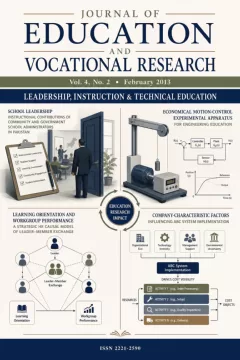
Research objectives were to determine a systematic framework and to blend a causal model of learning orientation, quality of leader-member exchange, goal orientation, and workgroup performance of pharmaceutical company employees in Thailand. The study reported the responses of 583 operational employees from 39 pharmaceutical companies operating in different parts of Thailand. Data were analyzed with descriptive statistics using SPSS (version 11.5) and path analysis using LISREL (version 8). Research findings indicated that dimensions of learning orientation, quality of leader-member exchange, and goal orientation have mediated positive effect on workgroup performance. Goal orientation positively mediates the relationships between learning orientation and workgroup performance and between quality of leader-member exchange and workgroup performance. Furthermore, learning orientation is positively correlated with the quality of leader-member exchange.
Keywords
- Causal Model Search this journal for Causal Model (opens in a new tab)
- Goal Orientation Search this journal for Goal Orientation (opens in a new tab)
- Learning Orientation Search this journal for Learning Orientation (opens in a new tab)
- Quality of Leader-Member Exchange Search this journal for Quality of Leader-Member Exchange (opens in a new tab)
- Workgroup Performance Search this journal for Workgroup Performance (opens in a new tab)
References
- Ames, C. & Archer, J. (1988). Achievement goals in the classroom: Students’ learning strategies and processes. Journal of Educational Psychology , 80(3), 260-267.
- Baker, W. E. & Sinkula, J. M. (1999). The synergistic effect of market orientation and learning orientation on organizational performance. Journal of the Academy of Marketing Science , 27(4), 411-427.
- Barron, K. E. & Harackiewicz, J. M. (2000). Achievement goals and optimal motivation: A multiple goals approach. In C. Sansone & J. Harackiewicz (Eds.). Intrinsic and Extrinsic Motivation: The Search for Optimal Motivation and Performance. San Diego: Academic Press.
- Basu, R. & Green, S. R. (1997). Leader-member exchange and transformational leadership: An empirical examination of innovative behaviors in leader-member dyads. Journal of Applied Social Psychology , 27(6), 477–499.
- Bateman, T. S. & Organ, D. W. (1983). Job satisfaction and the good soldier: The relationship between affect and employee citizenship. Academy of Management Journal , 26(4), 587-595.
- Button, S. B., Mathieu, J. E. & Zajac, D. M. (1996). Goal orientation in organizational research: A conceptual and empirical foundation. Organizational Behavior & Human Decision Processes , 67(1), 26-48.
- Calantone, R. J., Cavusgil, S. T. & Zhao, Y. (2002). Learning orientation, firm innovation capability and firm performance. Industrial Marketing Management , 31(6), 515-524.
- Day, G. (1994). The capabilities of market-driven organizations. Journal of Marketing , 58(4), 37-52.
- DelVecchio, S. K. (1998). The quality of salesperson-manager relationship: The effect of latitude, loyalty and competence. Journal of Personal Selling and Sales Management , 18(1), 31-47.
- Duda, J. L. (2001). Achievement goal research in sport: Pushing the boundaries and clarifying some misunderstandings. In G. Roberts (Ed.). Advances in Motivation in Sport and Exercise. Champaign: Human Kinetics Books.
- Duncan, R. B. & Weiss, A. (1978). Organizational learning: Implications for organizational design. In B. Staw (Ed.). Research in Organizational Behavior. Greenwich: JAI Press.
- Dunegan, K. J., Duchon, D. & Uhl-Bien, M. (1992). Examining the link between leader-member exchange and subordinate performance: The role of task analyzability and variety as moderators. Journal of Management , 18(1), 59-76.
- Dweck, C. S. (1999). Self-theories: Their role in motivation, personality, and development. Ann Arbor: Psychology Press, Taylor & Francis Group.
- Dweck, C. S. & Leggett, E. L. (1988). A social-cognitive approach to motivation and Personality. Psychology Review , 95(2), 256-273.
- Elliot, A. J. & Church, M. A. (1997). A hierarchical model of approach and avoidance achievement motivation. Journal of Personality and Social Psychology , 72(1), 218–232.
- Elliot, A. J. & McGregor, H. A. (2001). A 2 x 2 achievement goal framework. Journal of Personality and Social Psychology , 80(3), 501–519.
- Flaherty, K. E. & Pappas, J. M. (2000). The role of trust in salesperson-sales manager relationships. Journal of Personal Selling and Sales Management , 20(4), 271-278.
- Galer, G. & Van der Heijden, K. (1992). The learning organization: How planners create organizational learning. Marketing Intelligence and Planning , 10(6), 5-12.
- Garvin, D. A. (1993). Building a learning organization. Harvard Business Review , 71(4), 78-91.
- Gerstner, C. R. & Day, D. V. (1997). Meta-analytic review of leader-member exchange theory: Correlates and construct issues. Journal of Applied Psychology , 82(6), 827–844.
- Gibson, C. B., Zellmer-Bruhn, M. E. & Schwab, D. P. (2003). Team effectiveness in multinational organizations: Evaluation across contexts. Group & Organization Management , 28(4), 444-474.
- Graen, G. B. & Scandura, T. A. (1987). Toward a psychology of dyadic organizing. In L. Cummings & B. Staw (Eds.). Research in Organizational Behavior. Greenwich: JAI Press.
- Graen, G. B. & Uhl-Bien, M. (1995). Relationship-based approach to leadership: Development of leader member exchange (LMX) theory of leadership over 25 years: Applying a multi-level multidomain perspective. Leadership Quarterly , 6(2), 219–247.
- Graen, G. B., Wakabayashi, M., Graen, M. R. & Graen, M. G. (1990). International generalizability of American hypotheses about Japanese management progress: A strong inference investigation. Leadership Quarterly , 1, 1-23.
- Harackiewicz, J. M., Barron, K. E., Carter, S. M., Lehto, A. T. & Elliot, A. J. (1997). Predictors and consequences of achievement goals in the college classroom: Maintaining interest and making the grade. Journal of Personality and Social Psychology , 73(6), 1284–1295.
- Howell, J. M. & Hall-Merenda, K. E. (1999). The ties that bind: The impact of leader-member exchange, transformational and transactional leadership, and distance on predicting follower performance. Journal of Applied Psychology , 84(5), 680–694.
- Joreskog, K. G. & Sorbom, D. (1983). LISREL 8: User’s Reference Guide. Chicago: Scientific Software International.
- Liden, R. C. & Graen, G. (1980). Generalizability of the vertical dyad linkage model of Leadership. Academy of Management Journal , 23(1), 451-465.
- Liden, R. C., Sparrowe, R. T. & Wayne, S. J. (1997). Leader-member exchange theory: The past and potential for the future. Research in Personnel and Human Resource Management , 15, 47-119.
- Lindley, E. & Wheeler, F. P. (2000). The learning square: Four domains that impact on Strategy. British Journal of Management , 11(4), 357-364.
- Mills, D. O. & Freisen, B. (1992). The learning organization. European Management Journal , 10(2), 146156.
- Pemberton, J. D. & Stonehouse, G. H. (2000). Organizational learning and knowledge assets – an essential partnership. The Learning Organization , 7(4), 184-193.
- Phillips, J. M. & Gully, S. M. (1997). Role of goal orientation, ability, need for achievement, and locus of control in the self-efficacy and goal-setting process. Journal of Applied Psychology , 82(5), 792– 802.
- Pintrich, P. R. (2000). The role of goal orientation in self regulated learning. In M. Boekaerts, P. Pintrich, & M. Zeidner (Eds.). Handbook of Self-Regulation. San Diego: Academic Press.
- Scott, S. G. & Bruce, R. A. (1994). Determinants of innovative behavior: A path model of individual innovation in the workplace. Academy of Management Journal , 37(3), 580–607.
- Senge, P. M. (1990). The Fifth Discipline: The Art and Practice of the Learning Organization. New York: Doubleday Currency.
- Senge, P. M. (1992). Mental models. Planning Review , 20(2), 4-10.
- Sinkula, J. M. (1994). Market information processing and organizational learning. Journal of Marketing , 58(1), 35-45.
- Sinkula, J. M., Baker, W. E. & Noordewier, T. (1997). A framework for market-based organizational learning: Linking values, knowledge and behavior. Journal of the Academy of Marketing Science , 25(4), 305-318.
- Slater, S. F. & Narver, J. C. (1995). Market orientation and the learning organization. Journal of Marketing , 59(4), 63-74.
- Sparrowe, R. T. & Liden, R. C. (1997). Process and structure in leader-member exchange. Academy of Management Review , 22(2), 522-552.
- Strutton, D., Pelton, L. E. & Lumpkin, J. R. (1993). The relationship between psychological climate and salesperson-sales manager trust in sales organizations. Journal of Personal Selling and Sales Management , 13(3), 1-14.
- Sujan, H., Weitz, B. A. & Kumar, N. (1994). Learning orientation, working smart and effective selling. Journal of Marketing , 58(3), 39-52.
- Tanner, J. F. Jr. & Castleberry, S. B. (1990). Vertical exchange quality and performance: Studying the role of the sales manager. Journal of Personal Selling and Sales Management , 10(2), 17-28.
- Tobin, D. R. (1993). Re-Educating the Corporation: Foundations for the Learning Organization. Brattleboro: Oliver Wright.
- VandeWalle, D. & Cummings, L. I. (1997). A test of the influence of goal orientation on the feedback seeking process. Journal of Applied Psychology , 82(3), 390-400.
- Van Yperen, N. W. & Janssen, O. (2002). Feeling fatigued and dissatisfied or feeling fatigued but satisfied? Employees’ goal orientations and their responses to high job demands. Academy of Management Journal , 45(6), 1161–1171.
- Wageman, R., Hackman, J. R. & Lehman, E. V. (2005). Team diagnostic survey: Development of an instrument. Journal of Applied Behavioral Science , 41(4), 373-398.
- Wayne, S. J., Shore, L. M. & Liden, R. C. (1997). Perceived organizational support and leader-member exchange: A social exchange perspective. Academy of Management Journal , 40(1), 82-111.
- Yamane, T. (1970). Statistics – An Introductory Analysis. Tokyo: John Weatherhill.
- Yukl, G. (1994). Leadership in Organizations. Englewood Cliffs: Prentice-Hall.
Downloads
No downloads have been recorded for this article yet. Figures appear here once readers begin downloading the full text.
How to Cite
Share this article
License
Copyright (c) 2013 Kijpokin Kasemsap (Author)

This work is licensed under a Creative Commons Attribution 4.0 International License.
Author (s) should affirm that the material has not been published previously. It has not been submitted and it is not under consideration by any other journal. At the same time author (s) need to execute a publication permission agreement to assume the responsibility of the submitted content and any omissions and errors therein. After submission of revised paper in the light of suggestions of the reviewers, the editorial team edits and formats manuscripts to bring uniformity and standardization in published material.
This work will be licensed under Creative Commons Attribution 4.0 International (CC BY 4.0) and under condition of the license, users are free to read, copy, remix, transform, redistribute, download, print, search or link to the full texts of articles and even build upon their work as long as they credit the author for the original work. Moreover, as per journal policy author (s) hold and retain copyrights without any restrictions.
Keywords
- Causal Model Search this journal for Causal Model (opens in a new tab)
- Goal Orientation Search this journal for Goal Orientation (opens in a new tab)
- Learning Orientation Search this journal for Learning Orientation (opens in a new tab)
- Quality of Leader-Member Exchange Search this journal for Quality of Leader-Member Exchange (opens in a new tab)
- Workgroup Performance Search this journal for Workgroup Performance (opens in a new tab)
Section
Published
Submissions
Have research to publish? Journal of Education and Vocational Research welcomes submissions.
Make a Submission