Abstract
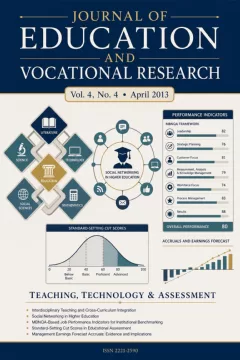
Recently, standard-setting cut scores and assessment techniques became of major concerns for many organizational institutions worldwide. A cut score separates one performance level from another. It differentiates between those who pass and those who fail. They may vary according to the recommendations of policy makers and stakeholders. Passing scores were suggested by many methods on numerous types of tests: certification tests and educational tests. Most of these standard setting methods rely on panelists’ subjectivity in ordering items by level of difficulty. This paper presents a simple approach to assessments by minimizing considerably panelists’ subjectivity. Items are classified in levels of difficulties rather than in an increasing order in most of the standard methods. This novel approach respond to three main criteria: practicality, wide range of applicability and maximum agreement with the empirical data. Provisional and operational cut scores were derived and discussed.
Keywords
- Educational Assessments Search this journal for Educational Assessments (opens in a new tab)
- Cut Scores Search this journal for Cut Scores (opens in a new tab)
- Standard-Setting Search this journal for Standard-Setting (opens in a new tab)
- Assessment Techniques Search this journal for Assessment Techniques (opens in a new tab)
- Performance Level Search this journal for Performance Level (opens in a new tab)
- Modular Arithmetic Search this journal for Modular Arithmetic (opens in a new tab)
References
- Akin, M. S. (2012). An analysis of the competion for university entrance test. Journal of Developing Areas , 46(1), 55-70.
- Atanas, J. (2012). Measuring Students’ Performance with Data Mining. Journal of Education and Vocational Research , 3(5), 132-137.
- Evangelauf, J. (1990). College Board to Revise Entrance Exam; Says New Version Will Be More Useful. (cover story). Chronicle of Higher Education , 37(10), A1-A34.
- Hein, S. F. & Skaggs, G. E. (2009). A Qualitative Investigation of Panelists' Experiences of Standard setting Using Two Variations of the Bookmark Method. Applied Measurement in Education , 22(3), 207-228.
- Herbert, M. (2010). ACT Sets New Goals for College Readiness. District Administration , 46(1), 10-10.
- Karantonis, A. & Sireci, S. G. (2006). The Bookmark Standard setting Method: A Literature Review. Educational Measurement: Issues and Practice , 25(1), 4-12.
- Konečný, T. J. J. N. (2012). Alternative models of entrance exams and access to higher education: the case of the Czech Republic. Higher Education , 63(2), 219-235.
- Lin, J. (2006). The Bookmark Procedure for Setting Cut-Scores and Finalizing Performance Standards: Strengths and Weaknesses. Alberta Journal of Educational Research , 52(1), 36-52.
- Manning, D. (2008). Identifying students’ mathematical skills from a multiple-choice diagnostic test using an iterative technique to minimise false positives. Computers & Education , 51(3).
- NAPO. (2011). Interpreting CEPA Scores. NAPO technical report.
- Norcini, J. S. J. A. (1997). The credibility and comparability of standards. Applied Measurement in Education , 10, 39-59.
- Samuels, C. A. (2008). N.Y.C. Entrance Exam Questioned. Education Week , 28(10), 5-5.
- Skaggs, G., Hein, S. F. & Awuor, R. (2007). Setting Passing Scores on Passage-Based Tests: A Comparison of
- Traditional and Single-Passage Bookmark Methods. Applied Measurement in Education , 20(4), 405-426.
- Skaggs, G. & Tessema, A. (2001). Item disordinality with the bookmark standard setting procedure. Paper
- presented at the Annual Meeting of the National Council on Measurement in Education,Seattle, WA. Zagier, A. S. (2011). ACT Scores Show College Readiness Problems Persist. Community College Week , 24(2), 3- 3.
Downloads
No downloads have been recorded for this article yet. Figures appear here once readers begin downloading the full text.
How to Cite
Share this article
License
Copyright (c) 2013 Jean Pierre Atanas (Author)

This work is licensed under a Creative Commons Attribution 4.0 International License.
Author (s) should affirm that the material has not been published previously. It has not been submitted and it is not under consideration by any other journal. At the same time author (s) need to execute a publication permission agreement to assume the responsibility of the submitted content and any omissions and errors therein. After submission of revised paper in the light of suggestions of the reviewers, the editorial team edits and formats manuscripts to bring uniformity and standardization in published material.
This work will be licensed under Creative Commons Attribution 4.0 International (CC BY 4.0) and under condition of the license, users are free to read, copy, remix, transform, redistribute, download, print, search or link to the full texts of articles and even build upon their work as long as they credit the author for the original work. Moreover, as per journal policy author (s) hold and retain copyrights without any restrictions.
Keywords
- Educational Assessments Search this journal for Educational Assessments (opens in a new tab)
- Cut Scores Search this journal for Cut Scores (opens in a new tab)
- Standard-Setting Search this journal for Standard-Setting (opens in a new tab)
- Assessment Techniques Search this journal for Assessment Techniques (opens in a new tab)
- Performance Level Search this journal for Performance Level (opens in a new tab)
- Modular Arithmetic Search this journal for Modular Arithmetic (opens in a new tab)
Section
Published
Submissions
Have research to publish? Journal of Education and Vocational Research welcomes submissions.
Make a Submission