Abstract
The paper seeks to look into the subject of vocational and technical education in Nigeria the issues involved, challenges encountered and how it can get better. The purpose is to unveil education as an instrument for transformation, productivity and motivator for the betterment of individual who has passed through it. In this paper vocational and technical education can be seen as that aspect of education use to gear the preparation of skilled manpower towards nation’s development. Major constraints to vocational education such as nation’s growth and vocational technical education, job scarcity and severance of Nigerian youths, implication of technology on vocational education training, parental attitudes toward vocational education, vocational for secondary schools, vocational technology elucidation for present needs and redundancy expiration & engagement with vocational technical education were discussed. The paper concluded that Nigerians should give vocational technical education leverage in her educational system and some recommendations were proffered.
Keywords
References
- Adeyemi, A. A. (1997). Role of Women in Vocational Education for Economic Development. Bichi Journal of Education , 1(2), 73-75.
- Aghenta, J. A. (1985). Analysis of Education and Employment of Vocational and Technical Schools Graduates Human Resources. Development Approach in Ehiametalor and Adesina (Ed), Trend in Vocational Education in Nigeria. Benin Education Research Association, pp. 54-71.
- Atsumbe, B. N., Emmanuel, R., Igwe, C. O. & Atsumbe, J. (2012). Repositioning Vocational and Technical Education for Effective Manpower Production in Nigeria. IOSR Journal of Mechanical and Civil Engineering (IOSRJMCE) , 1(4), 01-06.
- Atsumbe, B. N. (2010). Technology Education a Veritable Tool for Poverty Alleviation. A Paper Presented at the 1st Faculty of Science National Conference of University of Abuja. FCT.18th – 20th January.
- Cinterfor, I. (2006). Vocational Training and Employment Promotion. Cinterfor: Inter American Research and Documentation Centre in Vocational Training.
- Ekpenyong, L. E. (2005). Foundations of Technical and Vocational Education. Evolution and Practice. Benin: Ambik Press Limited.
- Enemali, J. D. (2006). Strategies for Effective Management of technical colleges in Northern Nigeria. Spectrum Journal , 2(2), 13 -19.
- Eze, T. I. & Okorafor, O. A. (2012).Trends in Technical, Vocational Education and Training for Improving the Nigerian Workforce. Ebonyi Vocational and Technology Education Journal , 1(1), 107-115.
- Khan, N. R. & Ghouri, A. M. (2012 ). Human Resource Practices and Supply Chain Management in Pakistan: Empirical Findings from Small and Medium Sized Firms. Germany: LAP LAMBERT Academic Publishing.
- Lange, F. & Topel, R. (2001). The Social Value of Education and Human Capital. Retrieved from http://www.econ.yale.edu/∼f188/Handbook Chapter.pdf
- Michael, A. (2002). Development in the Field of Vocational Education & Training (VET) System of Brussels. Member States. European Center for the Development of Vocational Training.
- Mortaki, S. (2012). The Contribution of Vocational Education and Training in the Preservation and Diffusion of Cultural Heritage in Greece: The Case of the Specialty Guardian of Museums and Archaeological Sites. International Journal of Humanities and Social Science , 2(24) 51.
- Nathaniel, T. (2002). Science and Technology in the Development of Agriculture in Daily Sketch 21-02-02.
- Olitan, S. O. (1994). Domestication of the Technical Teacher Training Program & Its Implications for Sustainable Economic Development. Journal of Technical Teachers education , 1(2), 10-14.
- Okocha, M. (2009). Parental Attitudes towards Vocational Education. Implications for Counseling. Edo Journal of Counseling . Delta Steel Company Technical High School, Ovwian Aladja, Delta State, 2(1).
- Okoro, O. M. (1993). Principles and Methods in Vocational and Technical Education. Nsukka University Trust Publication.
- Pudding, L. C. (1994). Youth & vocational Technical Education in Nigeria. Studies in Technical Teachers Education (STTED). Journal of Federal College of Education , 1, 56-60.
- Republic of Kenya, (1984). Ministry of Education, Science and Technology: 8-4-4 System of Education. Nairobi: Government Printer.
- Ruberti, M. (1993). Guidelines for Community Action in the Field of Education and training, European Commission Working Paper, Unpublished.
- Swanson, R. A. & Holton, E. F. (2001). Foundations of Human Resource Development, San Francisco: BerrettKoehler.
- Teboho, M. (2000). Nigeria Education Sector Analysis: An Analytical Synthesis of Performance and Main Issues. New Youth University: New York, NY.
Downloads
No downloads have been recorded for this article yet. Figures appear here once readers begin downloading the full text.
How to Cite
Share this article
License
Copyright (c) 2013 Ubom, A.E.B, Haruna, O.I., Aregbesola, B.G. (Author)

This work is licensed under a Creative Commons Attribution 4.0 International License.
Author (s) should affirm that the material has not been published previously. It has not been submitted and it is not under consideration by any other journal. At the same time author (s) need to execute a publication permission agreement to assume the responsibility of the submitted content and any omissions and errors therein. After submission of revised paper in the light of suggestions of the reviewers, the editorial team edits and formats manuscripts to bring uniformity and standardization in published material.
This work will be licensed under Creative Commons Attribution 4.0 International (CC BY 4.0) and under condition of the license, users are free to read, copy, remix, transform, redistribute, download, print, search or link to the full texts of articles and even build upon their work as long as they credit the author for the original work. Moreover, as per journal policy author (s) hold and retain copyrights without any restrictions.
Keywords
Section
Published in
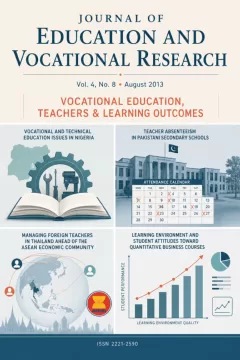 Vol. 4 No. 8 (2013)
Vocational Education, Teachers & Learning Outcomes
View issue contents
Published
Submissions
Have research to publish? Journal of Education and Vocational Research welcomes submissions.
Make a Submission