Abstract
The major objective of the study was to compare the different reasons of absenteeism between private and public school teachers at secondary level in district Bahawalnagar, Punjab, Pakistan. Sample of 160 participants was selected.80 participants were from government schools and 80 were from private schools. A questionnaire was used as a research tool. For the analysis of data percentages were find out. It was find out that government teachers avail more leaves than private teacher. Job security, lenient attitude of principle, different functions in the family, transport problems and illness are the main reasons of the teachers’ absenteeism from school. Teacher of private schools avail less leaves because they feel insecure and are unsatisfied with their jobs and working environment.
Keywords
- Teacher Absenteeism Search this journal for Teacher Absenteeism (opens in a new tab)
- Government Schools Search this journal for Government Schools (opens in a new tab)
- Private Schools Search this journal for Private Schools (opens in a new tab)
- Secondary Level Search this journal for Secondary Level (opens in a new tab)
- Pakistan Search this journal for Pakistan (opens in a new tab)
References
- Ali, M. & Reed, T. (1994). A school and parental survey of book provision issues in NWFP. International Book Development, Ltd.
- Bajwa, A. (2011). Out of School Children in Sindh: Looking at Access & Equity Annual Status of Education Report: ASER Pakistan facilitated by SAFED.
- Bundy, D. (2002). Education and HIV/AIDS: A window of hope. Washington DC: World Bank Group.
- Chaudhury, N., Hammer, J., Kremer, M., Muralidharan, K. & Rogers, F. H. (2004). Roll call: Teacher absence in Bangladesh. Harvard University and World Bank
- Christine Harris, V. K. (2009). Teacher Absenteeism and Teacher Accountability (USAID Paper): USAID Ed Strategy Development.
- Ehrenberg, R. G., Ehrenberg, R. A., Rees, D. I. & Ehrenberg, E. L. (1991). School district leave policies, teacher absenteeism, and student achievement. Journal of Human Resources, 26, 72-105.
- Ghuman, S. & Lloyd, C. (2010). Teacher absence as a factor in gender inequalities in access to primary schooling in rural Pakistan. Comparative Education Review, 54(4), 539-554.
- Hackett, R. S. (2009). Teacher Absenteeism. School of Education, UWI, St. Augustine, http://hdl.handle.net/2139/8983
- Hasnain, Z. (2008). The Politics of Service Delivery in Pakistan: Political Parties and the Incentives for Patronage, 1988-1999. The Pakistan Development Review , 2, 129-151.
- Kremer, M., Chaudhury, N., Rogers, F. H., Muralidharan, K. & Hammer, J. (2005). Teacher absence in India: A snapshot. Journal of the European Economic Association, 3(2‐3), 658-667.
- Mooij, J. & Narayan, K. (2010). Solutions to Teacher Absenteeism in Rural Government Primary Schools in India: A Comparison of Management Approaches. The Open Education Journal, 3, 63-71.
- Obeng-Denteh, W., Asiamah Yeboah, E., Sam, C. & Esi Monkah, J. (2012). The impact of student and teacher absenteeism on student performance at the junior high school: the case of the kumasi-metro school district. Continental Journal of Education Research, 4(1).
- PROBE, T. (1980). The (1999): Public Report on Basic Education in India: New Delhi: Oxford University Press.
- Rao, G., & Narasimha, L. (1999). Teachers absenteeism in primary school: a field study in select districts of Madhya Pradesh and Uttar Pradesh. New Delhi: District Primary Education Programme.
- Sathar, Z. A. & Lloyd, C. B. (2000). Investments in Children's Education and Family-Building Behavior in Pakistan: Findings from Rural NWFP and Punjab. Economic Development and Cultural Change, 53(3). doi: 10.1086/427042
- Unit, E. S. (2001). Expanding and Improving Upper Primary Education in India.
- Woods, R. C. & Montagno, R. V. (1997). Determining the negative effect of teacher attendance on student achievement. Education-Indianapolis, 118, 307-316. URL: http://www.businessdictionary.com/definition/absenteeism.html.
Downloads
No downloads have been recorded for this article yet. Figures appear here once readers begin downloading the full text.
How to Cite
Share this article
License
Copyright (c) 2013 Misbah Akhtar (Author)

This work is licensed under a Creative Commons Attribution 4.0 International License.
Author (s) should affirm that the material has not been published previously. It has not been submitted and it is not under consideration by any other journal. At the same time author (s) need to execute a publication permission agreement to assume the responsibility of the submitted content and any omissions and errors therein. After submission of revised paper in the light of suggestions of the reviewers, the editorial team edits and formats manuscripts to bring uniformity and standardization in published material.
This work will be licensed under Creative Commons Attribution 4.0 International (CC BY 4.0) and under condition of the license, users are free to read, copy, remix, transform, redistribute, download, print, search or link to the full texts of articles and even build upon their work as long as they credit the author for the original work. Moreover, as per journal policy author (s) hold and retain copyrights without any restrictions.
Keywords
- Teacher Absenteeism Search this journal for Teacher Absenteeism (opens in a new tab)
- Government Schools Search this journal for Government Schools (opens in a new tab)
- Private Schools Search this journal for Private Schools (opens in a new tab)
- Secondary Level Search this journal for Secondary Level (opens in a new tab)
- Pakistan Search this journal for Pakistan (opens in a new tab)
Section
Published in
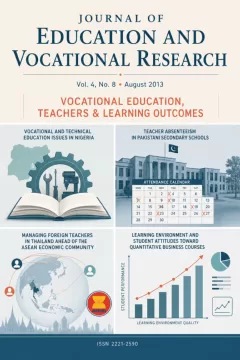 Vol. 4 No. 8 (2013)
Vocational Education, Teachers & Learning Outcomes
View issue contents
Published
Submissions
Have research to publish? Journal of Education and Vocational Research welcomes submissions.
Make a Submission