Abstract
This study examines the persistent poor performance in quantitative course units amongst undergraduate business students, using the case of Makerere University Business School. The data were collected from 346 third year students using a face-to-face administered questionnaire survey; and analysed using descriptive statistics, correlation and hierarchical regression analyses. The findings indicate that while learning environment and students’ attitude are positively associated with performance in quantitative courses, students’ attitude towards quantitative courses causes more variations in performance. Paucity of studies on performance in quantitative business courses deprived the study of the opportunity to cross validate the findings. Future studies should be conducted to confirm the results. Management of universities should consider learning environment and students’ attitude when determining possible changes to enhance students’ performance in quantitative courses. This study extends the predominantly mathematics studies to other business quantitative courses at university level.
Keywords
References
- Afe, J. O. (2001). Reflections on Becoming a Teacher and the Challenges of Teacher Education. Inaugural Lecture Series 64. Benin City: University of Benin, Nigeria.
- Anderson, J. (2005). The relationship between student perceptions of team dynamics and simulation game outcomes: an individual-level analysis. Journal of Education for Business, 9, 85-90.
- Arbaugh, J. (2000). An exploratory study of the effects of gender on student learning and class participation in an Internet-based MBA course. Management Learning, 31(4), 503-519.
- Ajzen, I. (1991). The Theory of Planned Behaviour. Organizational Behaviour and Human Decision Processes, 50 , 179-211.
- Barnard, W. M. (2004). Parent involvement in elementary school and educational attainment educational attainment. Children and Youth Services Review. Children and Youth Services Review , 26, 39-62.
- Beswick, K. (2006). Changes in pre-service teachers’ attitudes and beliefs: the net impact of two mathematics education units and intervening experiences. School Science and Mathematics, 106(1) , 36-47.
- Beswick, K. (2007). Teachers' beliefs that matter in secondary mathematics classrooms. Educational Studies in Mathematics , 65(1), 95.
- Darling-Hammond, L. (2000) New Standards and old equalities: School reform and the education of African American students. The Journal of Negro Education, 69(4), 263-287.
- Felder, R. M., Felder, G. N. & Dietz, E. J. (2002). The effects of personality type on engineering student performance and attitudes. Journal of Engineering Education , 87(18), 469-480
- Fishbein, M. & Ajzen, I. (1975). Belief, attitude, intention, and behavior: An introduction to theory and research. Reading, MA: Addison-Wesley.
- Fishbein, M. & Ajzen, I. (2010). Predicting and changing behavior: The reasoned action approach. New York: Psychology Press.
- Fisher, K. (2000). Building Better Outcomes. The Impact of School Infrastructure on Student Outcomes and Behaviour. Schools Issues Digest, Department of Education, Training and Youth Affairs, Australian Government.
- Goldhaber, D. (2002). The mystery of good teaching: Surveying the evidence on student achievement and teachers’ characteristics. Education Next , 2(1), 50-55 . The Hoover Institution.
- Hanushek, E. (1971). Teacher Characteristics and Gains in Student Achievement: Estimation Using Micro Data. The American Economic Review, 61(2), 280-288. Accessed on 20/05/2010, http://www.jstor.org/stable/1817003.
- Hanushek, E. (2010). The economic value of teacher quality. The Economics of Education Review , 30(3).
- Higgins, E. T. (1997). Beyond pleasure and pain. American Psychologist , 52, 1280–1300.
- Kingdon, G. G. (2006). Teacher characteristics and student performance in India: A pupil fixed effects approach. GPRG-WPS-059, http://www.gprg.org/
- Krejcie, R. & Morgan, D. (1970). Determining sample size for research activities. Educational and Psychological Measurements, 30, 607-610.
- Maliki, A. E., Ngban, A. N., & Ibu, J. E. (2009). Analysis of Students’ Performance in Junior Secondary School mathematics examination in Bayelsa State of Nigeria. Student Communication Science , 3(2), 131-134.
- Martins, P. & Walker, I. (2006). Student Achievement and University Classes: Effects of Attendance, Size, Peers, and Teachers. IZA, Discussion paper no 2490.
- Mohidin R., Jaidi, F., Sang, L. T. & Osman, Z. (2009). Effective teaching methods and lecturer characteristics a study on accounting students at Universiti Malaysia Sabah. European Journal of Social Sciences, 8(1), 21- 29.
- Olatoye, R. A. (2002). A Causal Model of School Factors as Determinants of Science Achievement in Lagos State Secondary Schools. An Unpublished Ph.D. Thesis, Univeristy of Ibadan, Ibadan.
- Patriciah, W. W. & Johnson, M. C. (2007). Effects of Mastery Learning Approach on Secondary School Students’ Physics Achievement. Eurasia Journal of Mathematics, Science and Technology Education, 4(3), 293302.
- Pearce, K., Lungren, M. & Wince, A. (1999). The effects of curriculum practices on first graders’ attitudes, activity preference, and achievements in mathematics. Education, 119(1), 82-90.
- Popham, W. (2005). Students’ attitudes count. Educational Leadership, 2, 84-85.
- Pokay, P. & Blumenfeld, P. C. (1990). Predicting achievement early and late in the semester: The role of motivation and use of learning strategies. Journal of Educational Psychology , 82, 41–50.
- Roberts. G. A. (2007). The effect of extracurricular activity participation in the relationship between parent involvement and academic performance in a sample of third grade children. Retrieved from http://www.lib.utexas.edu/etd/d/2007/robertsg11186/robertsg 11186.pdf
- Rockoff, J. E. (2003) .The Evidence of Individual Teachers on Student Achievement: Evidence from Panel Data. Report published by the Kennedy School of Government, Harvard University, ED 475274.
- Sanders, W. L. (2000). Value-added assessment from student achievement data: opportunities and hurdles. Journal of Personnel Evaluation in Education, 14(4), 329-39.
- Schwartz, W. & Hanson, K. (1992). Equal Mathematics Education for Female Students. (Report No. 78). Newton, MA: Education Development Center, Inc., Center for Equity and Cultural Diversity. ERIC/CUE Digest, 78.
- Shafiq, M., Farooq, M. S., Chaudhry, A. H. & Berhanu, G. (2011). Factors Affecting Students’ Quality of Academic Performance: A Case of Secondary School Level. Journal of Quality and Technology Management, 7(2).
- Stage, F. K. (2000). Making a difference in the classroom. About Campus, July/August, 29 – 31.
- Sternberg, R. J. & Kaufman, J. C. (1998). Human abilities. Annual Review of Psychology, 49, 479-502.
- Swan, K., Shea, P., Fredericksen, E., Pickett, A., Pelz, W. & Maher, G. (2000). Building knowledge building communities: Consistency, contact and communication in the virtual classroom. Journal of Educational Computing Research , 23, 359–383.
- Thurstone, L. L. (1928). Attitudes Can Be Measured. The American Journal of Sociology, 33(3), 529-554.
- Townsend, M., Moore, D., Tuck, B. & Wilton, K. (1998). Self-concept and anxiety in university students studying social science statistics within a co-operative learning structure. Educational Psychology, 18(1), 1-14.
- Trei, L. (2005). Student success linked to certification. Stanford Report, April 20, 2005.
- Uusimaki, L. & Nason, R. (2004). Causes underlying pre-service teachers’ negative beliefs and anxieties about mathematics. Proceedings of the 28th Conference of the International Group for the Psychology of Mathematics Education , 4, 369-376.
- Urquiola, M. & Verhoogen, E. (2009). Class-size caps, sorting, and the regression discontinuity design. American Economic Review , 99(1).
- Walberg, H. J. (1999). Productive teaching In H. C. Waxman & H. J. Walberg (Eds.), New directions for teaching practice research (75–104).
- Wentzel, K. R. (1998). Social Relationship and Motivation in middle School. The Role of Parents, Teachers and Peers. British Journal of Education Psychology, 68(2), 35-43.
- Wilkins, M. & Brand, D. R. (2004). Change in pre-service teachers’ beliefs: An evaluation of a mathematics course. Science and Mathematics , 104, 226-232.
- Wolf, S. J. & Fraser, B. J. (2007). Learning environment, attitudes and achievement among middle-school science students using inquiry-based laboratory activities. Research in Science Education, (in press).
- Yoder, J. D. & Hachevar, C. M. (2005). Encouraging active learning can improve students’ performance on examinations. Teaching of Psychology , 32(2).
Downloads
No downloads have been recorded for this article yet. Figures appear here once readers begin downloading the full text.
How to Cite
Share this article
License
Copyright (c) 2013 Freddie Semukono, Laura A. Orobia, Alice Arinaitwe (Author)

This work is licensed under a Creative Commons Attribution 4.0 International License.
Author (s) should affirm that the material has not been published previously. It has not been submitted and it is not under consideration by any other journal. At the same time author (s) need to execute a publication permission agreement to assume the responsibility of the submitted content and any omissions and errors therein. After submission of revised paper in the light of suggestions of the reviewers, the editorial team edits and formats manuscripts to bring uniformity and standardization in published material.
This work will be licensed under Creative Commons Attribution 4.0 International (CC BY 4.0) and under condition of the license, users are free to read, copy, remix, transform, redistribute, download, print, search or link to the full texts of articles and even build upon their work as long as they credit the author for the original work. Moreover, as per journal policy author (s) hold and retain copyrights without any restrictions.
Keywords
Section
Published in
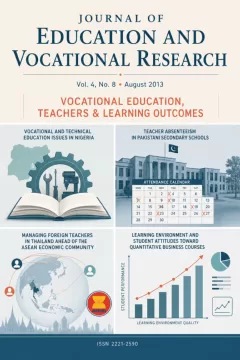 Vol. 4 No. 8 (2013)
Vocational Education, Teachers & Learning Outcomes
View issue contents
Published
Submissions
Have research to publish? Journal of Education and Vocational Research welcomes submissions.
Make a Submission