Abstract
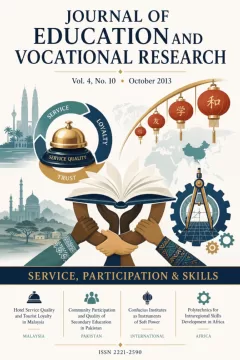
The Chinese Confucius Institutes, which have become common around the world and particularly in Asia, have followed the examples of the British Council, Alliance Française and the Goethe Institute. Yet by following the earlier examples, Confucius Institutes have the benefit of late development and can learn from the experiences of earlier approaches. This paper studies and analyses the overseas educations institutions of China, Britain, France and Germany to identify similarities and dissimilarities and then draws conclusions from this. It is shown that Confucius Institutes are a representative of the overseas soft power approach of the Chinese government and have multiple intentions and purposes.
Keywords
- Alliance Française Search this journal for Alliance Française (opens in a new tab)
- British Council Search this journal for British Council (opens in a new tab)
- Confucius Institute Search this journal for Confucius Institute (opens in a new tab)
- Goethe Institute Search this journal for Goethe Institute (opens in a new tab)
- Soft Power Search this journal for Soft Power (opens in a new tab)
References
- Ammon, U. (2009). The Federal Republic of Germany’s Policy of Spreading German. International Journal of the Sociology of Language , 95(1), 33-50.
- Axelrod, R. (1984). The Evolution of Cooperation (New York, NY: Basic Books, 1984).
- Brennan, E. (2012). Rising Tides of Conflict in South China Sea. Asia Times Online (March 3rd , 2012), available at: http://www.atimes.com/atimes/China/NC03Ad01.html.
- British Council, Timeline. (2012). available at: http://www.britishcouncil.org/organisation/history/timeline.
- Burley, A. M. S. (1993). International Law and International Relations Theory: A Dual Agenda. American Journal of International Law , 87, 205-39.
- Carmody, P. R. & Owusu, F. Y. (2007). Competing Hegemons? Chinese versus American Geo-Economic Strategies in Africa. Political Geography , 26(50), 504-24.
- Coombs, D. (1988). Spreading the Word: The Library Work of the British Council (London and New York, NY: Mansell, 1988).
- Welle, D. (2011). Goethe-Institute looks back on 60 years of cultural exchange, August 29, 2011.
- Donaldson, F. L. (1984). The British Council: The First Fifty Years (London: J. Cape, 1984).
- Ferguson, N. (2006). Think Again: Power. Foreign Policy , 134, 21.
- Germain, R. D. & Kenny, M. (1998). Engaging Gramsci: International Relations Theory and the New Gramscians. Review of International Studies , 24(1), 3-21.
- Germany.info. (2012). Record Number of German-Learners at Goethe-Institutes Worldwide (2012), Germany.info (December 14th ), available at: http://www.germany.info/Vertretung/usa/en/pr/KWash/2012/12/14Goethe.html?archive =1994800.
- Gil, J. (2008). The Promotion of Chinese Language Learning and China’s Soft Power. Asian Social Science , 4(10), 116-22
- Gil, J. (2009). China’s Confucius Institute Project: Language and Soft Power in World Politics. The Global Studies Journal , 2(1), 59-72.
- Gill, B. & Huang, Y. (2006). Sources and Limits of Chinese ‘Soft Power. Survival , 48(2), 17-36.
- Glaser, T. & Murphy, L. (2009). Chinese Soft Power and its Implications for the United States; Competition and Cooperation in the Developing World, Center for Strategic and International Studies, WDC.
- Harding, L. (2008). Russia Arrests Two Men in British Council Spying Row, The Guardian (March 20th , 2008), available at: http://www.theguardian.com/world/2008/mar/20/russia.arrests.
- Hartig, F. (2010).Cultural diplomacy with Chinese characteristics: The case of Confucius Institutes in Australia. Communication, Politics and Culture , 45, 256-76.
- Huq, R. (2001). Rap à la Française : Hip-Hop as Youth Culture in Contemporary Post-Colonial France,” in Council of Europe, Transitions of Youth Citizenship in Europe: Culture, Subculture and Identity (Strasbourg: Council of Europe Publishing, 2001), pp.41-60.
- Katzenstein, P. J. (1976). International Relations and Domestic Structures: Foreign Economic Policies of Advanced Industrial States. International Organization , 30(1), 1-46.
- Kleine-Ahlbrandt, S. & Small, A. (2008). China’s New Dictatorship Diplomacy: Is Beijing Parting with Pariahs? Foreign Affairs , 87(1), 38-56.
- Kurlantzick, J. (2007). Charm Offensive: How China’s soft Power Is Transforming the World, New Haven and London: Yale University Press.
- Lai, D. (2012). The Agony of Learning: The PLA’s Transformation in Military Affairs, in Roy Kamphausen, David Lai & Travis Tanner, eds., Learning by Doing: The PLA Trains at Home and Abroad (Carlisle, PA: Strategic Studies Institute, 2012), pp.337-80.
- Lauerman, J. (2011). Mandarin Chinese Most Important Business Language after English,” Bloomberg (August 31st , 2011), available at: http://www.bloomberg.com/news/2011-08-30/mandarinchinese-most-useful-business-language-after-english-1-.html.
- Li, H. C., Mirmirani, S. & Ilacqua, J. A. (2009). Confucius Institutes: Distributed Leadership and Knowledge Sharing in a Worldwide Network. The Learning Organization , 16(6), 469-82.
- Lien, D. D., Oh, C. H. & Travis, S. W. (2012). Confucius Institute Effects on China's Trade and FDI: Isn't it Delightful When Folks Afar Study Hanyu? International Review of Economics & Finance, 21(1).
- López, R. A. (2005). Trade and Growth: Reconciling the Macroeconomic and Microeconomic Evidence. Journal of Economic Surveys , 19(4), 623-48.
- Madhur, S., Wignaraja, G. & Darjes, P. (2009). Roads for Asian Integration: Measuring ADB’s Contribution to the Asian Highway Network, ADB Working Paper Series on Regional Economic Integration, No.37 (November, 2009), available at: http://www.adb.org/sites/default/files/pub/2009/WP37-Roads-Asian-Integration.pdf.
- McCartan, B. (2011). Cambodia Shrugs off Aid Curb. Asia Times Online, available at: http://www.atimes.com/atimes/Southeast_Asia/MH23Ae02.html.
- Mingjiang, L. (2009). Domestic Sources of China’s Soft Power Approach. China Security , 5(2), 37.
- Morgenthau, H. (1958). Dilemmas of Politics (Chicago, IL: University of Chicago Press, 1958).
- Niebuhr, R. (1977). Christian Realism and Political Problems (Fairfield, NJ: A.M. Kelley, 1977).
- Nye, J. S. (2004). The Decline of America’s Soft Power: Why Washington Should Worry. Foreign Affairs , 83, 16.
- Nye, J. S. (2004). Soft Power: The Means to Success in World Politics, New York: Public Affairs.
- Nye, J. S. (2008). Public Diplomacy and Soft Power. The Annals of the American Academy of Political and Social Science , 616(1), 94-109.
- Paradise, J. F. (2009). China and International Harmony: The Role of Confucius Institutes in Bolstering Beijing’s Soft Power. Asian Survey , 49(4), 647-69.
- Picarelli, J. T. (2006). The Turbulent Nexus of Transnational Organized Crime and Terrorism: A Theory of Malevolent International Relations. Global Crime , 6(1), 1-24.
- Snidal, D. (1991). Relative Gains and the Pattern of International Cooperation. The American Political Science Review , 85(3), 701-26.
- Sölter, A. A. (2008). The Renaissance of Soft Power: Rediscovering Cultural Diplomacy in Transatlantic Perspective, Cultural Diplomacy (2008), available at: http://www.culturaldiplomacy.org/canadameetsgermany/content/articles/programarchive/2008/Renaissance_of_Soft_Power.pdf.
- Starkey, H. (2007). Language Education, Identities and Citizenship: Developing the Cosmopolitan Perspective. Language and Intercultural Communication , 7(1), 56-71.
- Starr, D. (2009). Chinese Language Education in Europe: the Confucius Institutes. European Journal of Education , 44(1), 78–79.
- Storey, I. (2012). Southeast Asia and the Rise of China: The Search for Security (Abingdon and New York, NY: Routledge, 2012).
- Thompson, J. (2010). Forgotten Voices of Burma: The Second World War’s Forgotten Conflict (London: Ebury Press, 2010).
- Turner, M. (2007). Scramble for Africa, The Guardian (May 2nd , 2007), available at: http://www.theguardian.com/environment/2007/may/02/society.conservationandendangered species1.
- Vuving, A. L. (2009). Paper presented at the panel Soft Power and Smart Power, American Political Science Association annual meeting, Toronto.
- Waltz, K. N. (1967). International Structure, National Force, and the Balance of World Power. Journal of International Affairs , 21(2), 215-31.
- Wang, G. W. (1999). China and Southeast Asia: Myths, Threats and Culture, EAI Occasional Paper No.13 (East Asian Institute, National University of Singapore, 1999).
- Wendt, A. E. (1987). The Agent-Structure Problem in International Relations Theory. International Organization , 41(3), 335-70.
- Zhao, H. & Huang, J. (2010). China’s Policy of Chinese as a Foreign Language and the Use of Overseas Confucius Institutes. Educational Research for Policy and Practice , 9(2), 127-42.
Downloads
No downloads have been recorded for this article yet. Figures appear here once readers begin downloading the full text.
How to Cite
Share this article
License
Copyright (c) 2013 Sirirat Ngamsang, John Walsh (Author)

This work is licensed under a Creative Commons Attribution 4.0 International License.
Author (s) should affirm that the material has not been published previously. It has not been submitted and it is not under consideration by any other journal. At the same time author (s) need to execute a publication permission agreement to assume the responsibility of the submitted content and any omissions and errors therein. After submission of revised paper in the light of suggestions of the reviewers, the editorial team edits and formats manuscripts to bring uniformity and standardization in published material.
This work will be licensed under Creative Commons Attribution 4.0 International (CC BY 4.0) and under condition of the license, users are free to read, copy, remix, transform, redistribute, download, print, search or link to the full texts of articles and even build upon their work as long as they credit the author for the original work. Moreover, as per journal policy author (s) hold and retain copyrights without any restrictions.
Keywords
- Alliance Française Search this journal for Alliance Française (opens in a new tab)
- British Council Search this journal for British Council (opens in a new tab)
- Confucius Institute Search this journal for Confucius Institute (opens in a new tab)
- Goethe Institute Search this journal for Goethe Institute (opens in a new tab)
- Soft Power Search this journal for Soft Power (opens in a new tab)
Section
Published
Submissions
Have research to publish? Journal of Education and Vocational Research welcomes submissions.
Make a Submission