Abstract
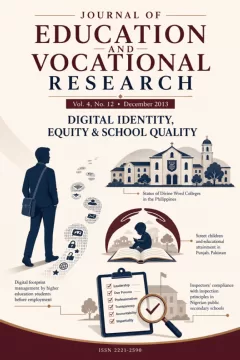
Public secondary school education is rapidly growing in Nigeria, requiring huge investments by government. To justify the level of investments and improve the quality of education in the secondary schools, there is need for proper monitoring and evaluation through inspection. This paper examines the extent to which inspectors complied with inspection principles of independence, impartiality, transparency and mutual respect in public secondary schools in Ekiti state, Nigeria. This is with the view to improving the quality of education in the state. A multi-stage sampling technique was used to select 147 respondents, comprising 120 teachers, 12 principals, and 15 inspectors. Data were collected using survey questionnaires complemented with interview guide. Data were analysed with the use of frequency counts, percentage and means. Results showed that 46.7% of the inspectors indicated compliance with the inspection principles of independence, 40% with impartiality and transparency, and 53.3% with mutual respect. On the average, about 47% of the inspectors indicated compliance with all the inspection principles. The study concluded that inspectors’ compliance with inspection principles is low and therefore, intensifying their compliance with inspection principles is imperative to improving the standard of education in public secondary schools.
Keywords
- Inspectors Search this journal for Inspectors (opens in a new tab)
- Inspection Search this journal for Inspection (opens in a new tab)
- Principles Search this journal for Principles (opens in a new tab)
- Compliance Search this journal for Compliance (opens in a new tab)
- Public Secondary Schools Search this journal for Public Secondary Schools (opens in a new tab)
References
- Abolade, J. O. (2007). Whole school education. Paper presented at the induction and re-orientation workshop for Federal and state inspectors of education, Akure.
- Adelabu, M. A. (2003). Motivation and communication strategies and their application in primary school supervision, in Ajayi, A. and Olayisade A. (eds.) Education quality assurance: Ekiti State SPEB initiative, Gabesther educational publishing company, Ibadan.
- Aghenta, J. A. (2006). Human resource development and planning in Nigeria. Second Faculty of Education distinguished lecture series, University of Benin, Benin City, Nigeria.
- Alade, M. (2008). Current issues in educational reforms: Ekiti State experience. In Contemporary Issues in Educational Management, Ibadan: Macmillan Nigeria Publishers Limited.
- Asika, N. (1991). Research methodology in the behavioural sciences, Longman, Nigeria.
- Bamisaye, E. A. (1998). Job satisfaction among secondary school teachers in Osun state. Nigerian Journal of Educational Administration , 56, 239-250
- Dean, J. (1995). What teachers and head teachers think about inspection? Cambridge Journal of Education , 25(1), 45-52.
- FME. (2006). National conference on the continual decline in the standards of education in schools, Vol. 1&II, Federal Ministry of Education Lagos: NERDC Press.
- Gleim, J. A. & Gleim, R. R. (2003). Cronbach Alpha and Spearman-Brown coefficient of reliability explanations. Paper presented at the Midwest research-to-practice conference in adult, continuing, and community education, The Ohio State University, Columbus, OH, October 8-10, 2003.
- Gujarati, D. N. (2006). Basic econometrics , 4th edition, Tata McGraw-Hill Publishing Company Limited, New York.
- Kpolovie, P. J., Ololube, N. P. & Ekwebelem, A. B. I. (2011).Appraising the performance of secondary school students on the WAEC and NECO SSCE from 2004 to 2006. International Journal of Scientific Research in Education , 4(2), 105-114.
- Likert, R. (1932). A technique for the measurement of attitudes. Archives of Psychology , 140, 55
- Maranga, J. S. (1986). Analysis of school inspectors’ perception of teacher-inspector relationship. Kenya Journal of Education , 3(1), 30-52.
- Marshall, C. (2008). Raising educational standards for children with additional Needs. British Journal of Special Education , 35(2), 69-77.
- Nworgu, B. G. (2006). Educational research basic issues and methodology. Ibadan, Nigeria: Wisdom Publishers.
- Obilade, S. O. (1992). Supervisory behaviour as perceived by secondary school teachers in Nigeria. School Leadership and Management , 12(2), 237-243.
- Ochuba, V. O. (2010). Improving the quality of education in Nigeria through effective inspection of schools. Education.FindArticles.com. Accessed: 18 February, 2010.
- Ogunu, M. A. (2002). The role of school inspectors in the implementation of the universal basic education (UBE) in Nigeria. In Ajayi, T. et al., (Eds.). Planning and administration of universal basic education (UBE) in Nigeria, Ijebu-Ode: Lucky Odoni (Nigeria) enterprises.
- Onyidoh, H. (2007). The decline of the education system in Nigeria. Online education. Available: Helium http:/ www. Helium.Com.
- Wilcox, B. (2000). Making school inspection visits more effective: the English experience. International Institute for Educational Planning/UNESCO, Paris.
Downloads
No downloads have been recorded for this article yet. Figures appear here once readers begin downloading the full text.
How to Cite
Share this article
License
Copyright (c) 2013 Bamire F. B., T. L. Adepoju (Author)

This work is licensed under a Creative Commons Attribution 4.0 International License.
Author (s) should affirm that the material has not been published previously. It has not been submitted and it is not under consideration by any other journal. At the same time author (s) need to execute a publication permission agreement to assume the responsibility of the submitted content and any omissions and errors therein. After submission of revised paper in the light of suggestions of the reviewers, the editorial team edits and formats manuscripts to bring uniformity and standardization in published material.
This work will be licensed under Creative Commons Attribution 4.0 International (CC BY 4.0) and under condition of the license, users are free to read, copy, remix, transform, redistribute, download, print, search or link to the full texts of articles and even build upon their work as long as they credit the author for the original work. Moreover, as per journal policy author (s) hold and retain copyrights without any restrictions.
Keywords
- Inspectors Search this journal for Inspectors (opens in a new tab)
- Inspection Search this journal for Inspection (opens in a new tab)
- Principles Search this journal for Principles (opens in a new tab)
- Compliance Search this journal for Compliance (opens in a new tab)
- Public Secondary Schools Search this journal for Public Secondary Schools (opens in a new tab)
Section
Published
Submissions
Have research to publish? Journal of Education and Vocational Research welcomes submissions.
Make a Submission