Abstract
This research aims to determine the factors affecting knowledge sharing behavior among academics in United Arab Emirates universities and identify the effect of university type on academics’ behavior. The research adopted Ajzen’s amended Theory of Planned Behavior. Employing an online survey, data were collected from academics in public and private universities using a questionnaire. The model was tested using Partial Least Squares structural equation modeling. The results found a significant difference in academics’ knowledge sharing behavior between public and private universities. Results also revealed that intention is the main determinant of knowledge sharing behavior, and that attitude, subjective norms, and self-efficacy have significant influence on intention while controllability has no influence on it. The significance of this research lies in that it is one of the first to use the amended theory and the only research to address knowledge sharing behavior in higher education in the Arab World. This research provides useful basis for higher education institutions to create a knowledge sharing culture and helps academics to enhance their performance.
Keywords
- Knowledge Sharing Behavior Search this journal for Knowledge Sharing Behavior (opens in a new tab)
- Theory of Planned Behavior Search this journal for Theory of Planned Behavior (opens in a new tab)
- United Arab Emirates Search this journal for United Arab Emirates (opens in a new tab)
- Academics Search this journal for Academics (opens in a new tab)
- Universities Search this journal for Universities (opens in a new tab)
References
- Abdi, H. (2003). Partial Least Squares (PLS) Regression, Lewis-Beck M, Bryman A, Futing T (Eds.), Encyclopedia of Social Sciences Research Methods. Thousand Oaks, California, 1-7.
- Ahmad, N. & Daghfous, A. (2010). Knowledge sharing through inter-organizational knowledge networks: Challenges and opportunities in the United Arab Emirates. European Business Review, 22(2), 153174.
- Ajzen, I. (1985). From intentions to actions: A theory of planned behavior. In J. Kuhl & J. Beckman (eds.), Action control: From cognition to behavior (pp. 11-39). Berlin: Springer-Verlag.
- Ajzen, I. (1991). The theory of planned behavior. Organizational behavior and human decision processes , 50, 179-211.
- Ajzen, I. (2002). Perceived behavioral control, self-efficacy, locus of control, and the theory of planned behavior. Journal of Applied Social Psychology, 32 (4), 665-683.
- Ajzen, I. (2006). Constructing a theory of planned behavior questionnaire. Retrieved December 1, 2012. http://people.umass.edu/aizen/pdf/tpb.measurement.pdf
- Alajmi, B. M. (2010). The intention to share: Psychological investigation of knowledge sharing behavior in online communities. Retrieved February 1, 2012. http://tappedin.org/tappedin/web/papers/2011/Bibi-IntentionToShare2011.pdf
- Alajmi, B. M. (2011). The intention to share: Professionals’ knowledge sharing behaviors in online communities. Doctoral thesis, The State University of New Jersey. Retrieved February 1, 2012. www.tappedin.org/publications/2011/Bibi-IntentionToShare2011.pdf
- Alavi, M. & Leidner, D. (2001). Knowledge management and knowledge management systems: Conceptual foundations and research issues. MIS Quarterly, 25(1), 107- 136.
- Al-Nahyan, N. B. M. (2012). Executive focus: Government commitment and investment in education, research initiatives, and improving the quality of education. Retrieved June 6, 2012. http://www.theprospectgroup.com/executivefocus/profile/h-h-sheikh-nahyan-bin-mubarak-alnahyan-minister-of-higher-education-and-scientific-research-uae-2/8578
- Alrawi, K. & Jaber, K. H. (2007). Virtual classrooms and the flexibility of e-learning in the Gulf universities. Journal of knowledge Management Practice, 8(3).
- Aulawi, H., Sudirman, I., Suryadi, K. & Govindaraju, R. (2009). Knowledge sharing behavior, antecedents and their impact on the individual innovation capability. Journal of Applied Sciences Research, 5(12), 2238-2245.
- Babalhaveji, F. & Kermani, Z. J. (2011). Knowledge sharing behavior influences: A case of library and information science faculties in Iran. Malaysian Journal of Library & Information Science, 16(1), 1- 14.
- Basu, B. & Sengupta, K. (2007). Accessing Success Factors of Knowledge Management Initiatives of Academic Institutions – a Case of an Indian Business School. Retrieved January 6, 2013. www.ejkm.com/issue/download.html?idArticle=111
- Bock, G. W. & Kim, Y. G. (2002). Breaking the myths of rewards: An exploratory study of attitude about knowledge sharing. In PACIS Proceedings.
- Bock, G. W., Zmud, R. W., Kim, Y. G. & Lee, J. N. (2005). Behavioral intention formation in knowledge sharing: Examining the roles of extrinsic motivators, social-psychological forces, and organizational climate. MIS Quarterly, 29(1), 87-111.
- Bordia, P., Irmer, B. E., Garden, M., Phair, K. & Abusah, D. (2004). Knowledge sharing in response to a supportive work environment: evidence from an Australian engineering firm.
- Boumarafi, B. M. (2006). Knowledge management and performance in business organizations: an exploratory study in United Arab Emirates. Retrieved January 17, 2011. www.ipac.kacst.edu.sa/eDoc/2007/165431_1.pdf
- Chatzoglue, P. D. & Vraimaki, E. (2009). Knowledge sharing behavior of bank employees in Greece. Business Process Management Journal, 15(2), 245-266.
- Chen, I. Y., Chen, N. S. & Kinshuk, K. (2009). Examining the factors influencing participants’ knowledge sharing behavior in virtual learning communities. Educational Technology & Society, 12(1), 134148.
- Cheng, M. Y., Ho, J. S. & Lau, P. M. (2009). Knowledge sharing in academic institutions: A study of Multimedia University Malaysia. Electronic Journal of Knowledge Management, 7(3), 313-324.
- Chennamaneni, A. (2006). Determinants of knowledge sharing behaviors: Developing and testing an integrated theoretical model. Doctoral dissertation. The University of Texas at Arlington.
- Chin, W. W. (1998). The partial least squares approach for structural equation modeling, modern methods for business research. London: Lawrence.
- Constant, D., Kiesler, S. & Sproull, L. (1994). What’s mine is ours, or is it? A study of attitudes about information sharing. Information Systems Research, 5(4) 400-421.
- Egger, U. K. (2013). Cross-organizational knowledge sharing.
- Ellahi, A. A. & Mushtaq, R. (2011). Probing factors affecting knowledge sharing behavior of Pakistani bloggers. Electronic Journal on Information Systems in Developing Countries, 45(6), 1-14.
- Fornell, C. & Larcker, D. (1981). Evaluating structural equation models with unobservable variables and measurement error. Journal of Marketing Research , 18, 39–50.
- Fullwood, R., Rowley, J. & Delbridge, R. (2013). Knowledge sharing amongst academics in UK universities. Journal of Knowledge Management, 17(1), 123-136.
- Gay, L. & Airasian, P. (2003). Educational research: Competencies for analysis and applications. Upper Saddle River, NJ. : Pearson Education.
- Gera, R. (2012). Bridging the gap in knowledge transfer between academia and practitioners. International Journal of Educational Management, 26(3), 252-273
- Hair, J. F., Ringle, C. M. & Sarstedt, M. (2011). PLS-SEM: Indeed a silver bullet. Journal of Marketing Theory and Practice, 19(2), 139–151
- Hansmann, K. W. & Ringle, C. M. (2004). SmartPLS manual, institute for operations management and organizations. Universität Hamburg, Germany.
- He-feng, X. (2009). The determinations of employee’s knowledge sharing behavior: An empirical study based on the theory of planned behavior. Paper presented at International Conference on Management Science & Engineering (16th) September 14-16, 2009, Moscow. Retrieved February 17, 2012. http://ieeexplore.ieee.org/stamp/stamp.jsp?tp=&arnumber=5318075
- Henderson, K. (2005). The knowledge sharing approach of the United Nations Development Program. Knowledge Management for Development Journal, 1(2), 19-30.
- Hsu, I. (2008). Knowledge sharing practices as facilitating factor for improving organizational performance through human capital: A preliminary study. Experts Systems with Applications , 35, 1316-1326.
- Hsu, M. H., Ju, T. L., Yen, C. H. & Chang, C. M. (2007). Knowledge sharing behavior in virtual communities: The relationship between trust, self-efficacy, and outcome expectations. International Journal of Human-Computer Studies , 65, 153–169.
- Hung, S. Y., Lai, H. M. & Chou, Y. C. (2010). The determinants of knowledge sharing intention in professional virtual communities: An integrative model. Paper presented at the 14th Pacific Asia Conference in Information Systems, July 9-12, 2010, Taipei, Taiwan.
- Kamal, K. J., Singh S. M. & Kaur, S. G. (2007). Knowledge sharing among academic staff: A case study of business schools in Klang Valley, Malaysia. JASA , 2, 23-28.
- Ketvirtis, S. (2011). Knowledge sharing: Leveraging trust and leadership to increase team performance. Retrieved March 16, 2013, http://www.sesp.northwestern.edu/msloc/knowledgelens/stories/2012/knowledge-sharing-leveraging-trust-and-leadership-to-increase-teamperformance.html
- Kenett, R. S. & Rahav, E. (2006). Bootstrap Analysis of Designed Experiments. Quality and Reliability Engineering International, 22(6), 659 - 667.
- Keyes, J. (2008). Identifying the Barriers to Knowledge Sharing in Knowledge Intensive Organizations. Doctoral dissertation, North Central University.
- Kijsanayotin, B., Pannarunothai, S. & Speedie, S. M. (2009). Factors influencing health information technology adoption in Thailand’s community health centers: Applying the UTAUT model. International journal of medical informatics, 78(6), 404–16. doi: 10.1016/j.ijmedinf.2008.12.005
- Kraft, P., Rise, J., Sutton, S. & Roysamb, E. (2005). Perceived difficulty in the theory of planned behavior: Perceived behavioral control or affective attitude? British Journal of Social Psychology , 44, 479496.
- Lin, H. F. (2007). Effects of extrinsic and intrinsic motivation on employee knowledge sharing intentions. Journal of Information Science, 33(2), 135-149.
- Lin, H. F. & Lee, G. G. (2004). Perceptions of senior managers toward knowledge sharing behavior. Journal of Management Decision, 42(1), 108-125.
- Ling, C. W., Sandhu, M. S. & Kamal, K. J. (2009). Knowledge sharing in an American multinational company based in Malaysia. Journal of Workplace Learning, 21(2), 125-142.
- Madden, T. J., Ellen, P. S. & Ajzen, I. (1992). A comparison of the theory of planned behavior and the theory of reasoned action. Personality and Social Psychology Bulletin, 18(1), 3-9.
- Mazzarol, T. & Soutar, G. N. (2002). The Global market for higher education: Sustainable competitive strategies for the new millennium. Cheltenham, UK: Edward Elgar Publishing Ltd.
- Metcalfe, A. S. (2006). Knowledge management and higher education: A critical analysis. Hershey, PA: Information Science Publishing.
- Mirghani, M., O’Sullivan, K. J. & Ribiere, V. (2008). A paradigm shift in the Arab region knowledge evolution. Journal of Knowledge Management, 12(5), 107-120.
- Moshabbaki, A. & Jaha'nyan, S. (2009). A Trust-based model for knowledge sharing in ERP adopting organizations. Journal of Knowledge Management Practice, 10(1). Retrieved January 23, 2012. http://www.tlainc.com/articl176.htm
- Nonaka, I. & Takeuchi, H. (1995). The knowledge-creating company: How Japanese companies create the dynamics of innovation. Oxford: Oxford University Press.
- Patel, M. & Ragsdell, G. (2011). To share or not to share: An ethical dilemma for UK academics? Journal of Knowledge Management Practice, 12(2).
- Riege, A. (2005). Three-dozen knowledge-sharing barriers managers should consider. Journal of Knowledge Management, 9(3), 18-35.
- Rijlaarsdam, R. (2007). The interaction effect of source and motives on fairness perceptions in the context of revenue management in the airline industry. Master thesis, Unverisiteit Maastricht
- Robertson, S. (2002). A tale of two knowledge-sharing systems. Journal of Knowledge Management, 6(3), 295-308.
- Rowley, J., Seba, I. & Delbridge, R. (2012). Knowledge sharing in the Dubai Police Force. Journal of Knowledge Management, 16(1), 1-24.
- Ryu, S., Ho, S. H. & Han, I. (2003). Knowledge sharing behavior of physicians in hospitals. Expert Systems with Application , 25, 113-122.
- Sallis, E. & Jones, G. (2002). Knowledge Management in Education: Enhancing learning and education. London: Kogan Page.
- Sandhawalia, B. S. & Dalcher, D. (2011). Effective knowledge sharing for competitive advantage. Journal of Knowledge Management, 15(2).
- Schilling, D. R. (2013). Knowledge doubling every 12 months, soon to be every 12 hours. Retrieved November 21, 2013. http://www.industrytap.com/knowledge-doubling-every-12-months-soonto-be-every-12-hours/3950
- Seba, I., Rowley, J. & Lambert, S. (2012). Factors affecting attitudes and intentions towards knowledge sharing in the Dubai Police Force. International Journal of Information Management , 1120, 1-9. Retrieved January 27, 2012. www.sciencedirect.com/science/article/pii/S0268401211001563
- Sharma, A. (2010). Enabling knowledge management of organizational memory for groups through shared topic maps. Master dissertation. Iowa State University.
- Singer, P. & Hurley, J. E. (2005). The Importance of Knowledge Management Today. ALA-APA Library Worklife Home, 2(6), 1-3.
- Skok, W. & Tahir, S. (2010). Developing a knowledge management strategy for the Arab World. Electronic Journal on Information Systems in Developing Countries, 41(7), 1-11.
- So, J. & Bolloju, N. (2005). Explaining the intentions to share and reuse knowledge in the context of IT service operations. Journal of Knowledge Management, 9(6), 30-41.
- Sohail, S. & Daud, S. (2009). Knowledge sharing in higher education institutions: Perspectives from Malaysia. The Journal of Information and Knowledge Management Systems, 39(2), 125-142.
- Srivastava, A., Bartol, K. M. & Locke, E. A. (2006). Empowering leadership in management teams: Effects on knowledge sharing, efficacy, and performance. Academy of Management Journal, 49(6), 12391251.
- Syed, S. A., Zaini, A., Noormala, A. I. & Zahariah, M. Z. (2009). Assessing knowledge sharing behavior among employees in SMEs: An empirical study. International Business Research, 2(2), 115- 122.
- Tan, C. N., Lye, Y. H., Ng, T. H. & Lim, Y. S. (2010). Motivational factors in influencing knowledge sharing among banks in Malaysia. International Research Journal of Finance and Economics , 44, 191-201.
- Tavousi, M., Hidarnia, A. R., Montazeri, A., Hijizadeh, E., Taremain, F. & Ghofranipour, F. (2009). Are perceived behavioral control and self-efficacy distinct constructs? European Journal of Scientific Research, 30(1), 146-152.
- Taylor, S. & Todd, P. A. (1995). Understanding information technology usage: a test of competing models. Information Systems Research, 6(2), 144-76.
- Tohidinia, Z. & Mosakhani, M. (2010). Knowledge sharing behavior and its predictors. Industrial Management & Data Systems, 110(4), 611-631.
- Trafimow, D., Sheeran, P., Conner, M. & FInaly, K. A. (2002). Evidence that perceived behavioral control is a multidimensional construct: Perceived control and perceived difficulty. British Journal of Social Psychology , 41, 101-121.
- Wang, S. & Noe, R. (2010). Knowledge sharing: A review and directions for future research. Human Resource Management Review , 20, 115–131.
- Wasko, M. M. & Faraj, S. (2005). Why should I share? Examining social capital and knowledge contribution in electronic networks of practice. MIS Quarterly, 29(1), 35-57.
- Weir, D. & Hutchings, K. (2005). Cultural embeddedness and contextual Constraints: Knowledge Sharing in Chinese and Arab Cultures. Knowledge and Process Management, 12(2), 88-98.
- Xiao, Y. C. & Jin, Y. H. (2010). The hierarchical linear modeling of shared mental model on virtual team effectiveness. Kybernetes, 39(8), 1322-1329.
- Ye, S., Chen, H. & Jin, X. (2006). An empirical study of what drives users to share knowledge in virtual communities, in J. Lang, F. Lin & J. Wang (Eds.), Knowledge science, engineering and management: First international conference, KSEM 2006, Springer-Verlag Berlin Heidelberg, (pp. 563–575).
Downloads
No downloads have been recorded for this article yet. Figures appear here once readers begin downloading the full text.
How to Cite
Share this article
License
Copyright (c) 2014 Roslina Othman, Huda Skaik (Author)

This work is licensed under a Creative Commons Attribution 4.0 International License.
Author (s) should affirm that the material has not been published previously. It has not been submitted and it is not under consideration by any other journal. At the same time author (s) need to execute a publication permission agreement to assume the responsibility of the submitted content and any omissions and errors therein. After submission of revised paper in the light of suggestions of the reviewers, the editorial team edits and formats manuscripts to bring uniformity and standardization in published material.
This work will be licensed under Creative Commons Attribution 4.0 International (CC BY 4.0) and under condition of the license, users are free to read, copy, remix, transform, redistribute, download, print, search or link to the full texts of articles and even build upon their work as long as they credit the author for the original work. Moreover, as per journal policy author (s) hold and retain copyrights without any restrictions.
Keywords
- Knowledge Sharing Behavior Search this journal for Knowledge Sharing Behavior (opens in a new tab)
- Theory of Planned Behavior Search this journal for Theory of Planned Behavior (opens in a new tab)
- United Arab Emirates Search this journal for United Arab Emirates (opens in a new tab)
- Academics Search this journal for Academics (opens in a new tab)
- Universities Search this journal for Universities (opens in a new tab)
Section
Published in
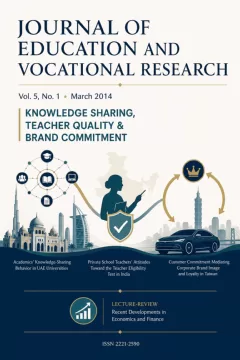 Vol. 5 No. 1 (2014)
Knowledge Sharing, Teacher Quality & Brand Commitment
View issue contents
Published
Submissions
Have research to publish? Journal of Education and Vocational Research welcomes submissions.
Make a Submission