Abstract
Over the years, accounting students and lecturers have been grappling with the challenges of achieving better results arising from the traditional approach of teaching which is passive, and lecture and lecturer – centred. This has not been very effective as the traditional course delivery mode or approach is being adopted. As the world is becoming a global village, it demands/requires new and improved methods to enhance students needed skills, competencies and knowledge expected of them by employers and modern day technologically equipped offices. The paper focuses on information and web based technologies in teaching accounting courses and their usefulness in improving students learning. The mean, standard deviation and t – test was used to analyse the data e generated in the study. The findings show that Information and Web Based Technologies would be relevant and bring about individualized student learning, enhance understanding, better skill and competencies acquisition and ensure accurate record retrieval for the global world and would be the basis for curriculum review and retraining of teachers for better course delivery based on Information and Web Based Technologies.
Keywords
- Information Technology Search this journal for Information Technology (opens in a new tab)
- Web Based Technology Search this journal for Web Based Technology (opens in a new tab)
- Course Delivery Search this journal for Course Delivery (opens in a new tab)
- Active Learning Search this journal for Active Learning (opens in a new tab)
References
- Absel-Azim M. H. (2006). The use of technology to improve the delivery of advanced accounting courses in the United Arab Emirates University. Journal of College Teaching and Learning , 3(3), 1-4.
- AI Hashim, D., Sankaram, S. & Weiss, E. (2003) the high-tech global accounting classroom in the 21st century. Journal of American Academy of Business , 3(1), 21 – 30 Neo.
- Akpotohwo, F. C. & Ugeh, C. H. (2007). Student rating educational quality provided by different delivery modes in business and information technology education programme. Business education journal , 6(1), 221.
- Al-Soraiey-Alqahtani-Awadh, A. Y. (2010). The effectiveness of using e-learning, blended learning and traditional learning on students’ achievement and attitudes in a course on Islamic culture: An experimental study. Durham theses, Dusham University. Available at Durham E-thesis Online http://e-theses.dat.ac.uk/817
- AlCPA. (1999). fostering changes in curriculum and teaching methods. Journal of accounting (online) of available htt://www.aicpa.
- Amahi, F. U. O & Uge, B. O. (2004). Introduction to Financial Accounting a simplified approach, Agbor Bridgeo Press.
- Ashraf, M. (2004). A critical look at the use of group projects as a pedagogical tool. Journal of Education for Business , 79(1), 213 0 216.
- Bruff, C., Dean, A. & Nolan, J. (2004). Quality assessment of learning and satisfaction in web-based and lecture courses. Journal of Education Computing Research , 28(3), 198-191.
- David, J. S., McGracken, H. & Reckers, P. M. J. (2003). Integrating technology and business process analysis into introductory accounting courses. Issues in Accounting Education , 18(4), 417 – 477
- Idea group Inc. (2006). Using IT in accounting education Journal of cases a information Technology 8 (3) 71-87 July- September, URL – htt://www.idea.group.come
- Iheonunekwu, S., Onyinye, E. & Nweze, P. U. (2008). Reforming the delivery system in business education through information and communication technology (ICT). ABEN Book of Reading , 1(8) 121-126.
- Khan, B. (2005). Managing e-learning strategies: design, delivery, implementation and evaluation. Hershey, IA, USA: Idea group Inc.
- Oliver E. C. & Chapman, R. J. (1993). Data processing and information technology London: DP publications Limited
- Painham, J. (2001). Lifelong learning a model for increasing the participation on non-traditional adult learner.
- Schenes, R., Leinhardt, G., Smith, J. & Cho, K. (2005). Replacing lecture with web-based courses materials. Journal of Educational computing Research, 32(1), 1 – 26.
- Smith, A. D. & Rupp, W. T. (2004). Management Implications of Computers based online/face – to – face business education; A case study. Online Information review , 28(2), 100–109.
Downloads
No downloads have been recorded for this article yet. Figures appear here once readers begin downloading the full text.
How to Cite
Share this article
License
Copyright (c) 2014 Amahi, Fidelis Uchechukwu (Author)

This work is licensed under a Creative Commons Attribution 4.0 International License.
Author (s) should affirm that the material has not been published previously. It has not been submitted and it is not under consideration by any other journal. At the same time author (s) need to execute a publication permission agreement to assume the responsibility of the submitted content and any omissions and errors therein. After submission of revised paper in the light of suggestions of the reviewers, the editorial team edits and formats manuscripts to bring uniformity and standardization in published material.
This work will be licensed under Creative Commons Attribution 4.0 International (CC BY 4.0) and under condition of the license, users are free to read, copy, remix, transform, redistribute, download, print, search or link to the full texts of articles and even build upon their work as long as they credit the author for the original work. Moreover, as per journal policy author (s) hold and retain copyrights without any restrictions.
Keywords
- Information Technology Search this journal for Information Technology (opens in a new tab)
- Web Based Technology Search this journal for Web Based Technology (opens in a new tab)
- Course Delivery Search this journal for Course Delivery (opens in a new tab)
- Active Learning Search this journal for Active Learning (opens in a new tab)
Section
Published in
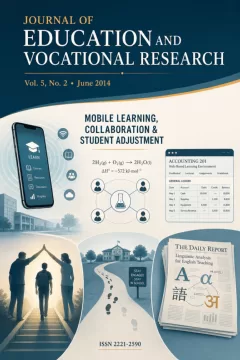 Vol. 5 No. 2 (2014)
Mobile Learning, Collaboration & Student Adjustment
View issue contents
Published
Submissions
Have research to publish? Journal of Education and Vocational Research welcomes submissions.
Make a Submission