Abstract
The study was designed to foster the implementation of collaborative learning in stoichiometry among secondary school students. It was hypothesized that students who were exposed to collaborative learning will not perform significantly better than those exposed to lecture method. The design of the study was a pretest – posttest non-equivalent control group design. Two hundred and eighty seven Senior Secondary class 2 students from Special Science Schools in Anambra State, Nigeria participated in the study. The reliability of the instrument, Stoichiometry Achievement Test (SAT) was established using split-half reliability coefficient. Analysis of covariance (ANCOVA) was used to test the null hypothesis after obtaining the mean of the pretest and posttest scores. The results revealed that collaborative learning significantly enhanced students’ performance in stoichiometry, as students who were exposed to collaborative learning outperformed those exposed to lecture method. Based on the findings of the study educational practices in Nigeria were urged to promote and implement collaborative learning and decrease on the structure of transmission model.
Keywords
References
- Adeboyel, A. O. (1999). Interesting relationships between mathematics and science. Journal of Mathematics and science, 1(2), 22-29.
- Arasasington, R., Taagepera, M., Poter, F., Martorell, I. & Lonjers, S. (2004). Assessing the effect of web-based learning on student understanding of stoichiometry using knowledge space theory. Journal of Chemical Education, 82, 1251-1262.
- Badru, A. K. (2004). Student performance in mathematics as correlate of their performance in chemistry. 45th Annual Conference Proceedings of Science Teachers Association of Nigeria.
- Bamidele, E. F. & Oloyede, E. O. (2013).Comparative effectiveness of hierarchical flowchart and spider concept
- mapping strategies on students’ performance in chemistry. World Journal of Education , 3(1), 66-76 Bruffee, K. A. (1984). Collaborative learning and the conversation of mankind.
- College Bruffee, K. A. (2009). Conjoined intelligence: Reading, writing, talk. Unpublished
- Callahan, R. E. (1962). Education and the Cult of Efficiency. Chicago: Univ. Chicago Press
- Chandrasegaran, A. L., Treagust, D. F., Waldrip, B. G. & Chandrasegarian, A. (2009). Students’ dilemmas in reaction stoichiometry problem solving: deducing the limiting reagent in chemical reactions. Chemistry Education Research and Practice, 10, 14-23
- Cross, K. P. (2000). Collaborative learning 101. The Cross Papers Number 4. Mission Viejo, CA: League for Innovation in the Community College. English, 46(7), 635-652.
- Evans, K. L., Yaron, D. & Leinhardt, G. (2008). Learning Stoichiometry: A Comparison of Text and Multimedia Formats. Chemistry Education Research and Practice , 9(3), 208-218.
- Fach, M., De Boer, T. & Parchmann, I. (2007). Results of an interview study as basis for the development of stepped supporting tools for stoichiometric problems . Chemistry Education Research and Practice , 8(1), 13-31
- Furio, C. O., Azcona, R. & Guisasola, J. (2002). The learning and teaching of the concepts amount of substance and mole: A review of the literature. Chemistry Education Research and Practice , 3, 277- 292
- Gamson, Z. F. (1994). Collaborative learning comes of age . Change, 26(5), 44-50.
- Gauchon, L. & Meheut, M. (2007). Learning about stoichiometry: from students, preconceptions to the concept of limiting reactant. Chemistry Education Research and Practice , 8(4), 362-375
- Hofstein, A. & Lunetta, V. N. (1982). The role of the laboratory in teaching: Neglected aspects of research. Rev. Educ. , 52, 201-217
- Holt, M. D. (1988). Collaborative learning from 1911-1986: A socio-historical analysis (Doctoral dissertation). Retrieved from ProQuest Dissertations and Theses database. (AAT8901334)
- Hopko, D. R. (2003). Confirmatory factor analysis of the math anxiety rating scale-revised. Educational and Psychological Measurement, 63(1), 33-46
- Kelly, W. P. & Tomhave, W. K. (1985). A study of maths anxiety/math avoidance in pre-service elementary teachers. Arithmetic Teacher , 32(5), 51-53
- Krammer, P. H. (2000). Recurrent Difficulties Solving Quantitative Problems. Journal of Chemistry Education, 59(6), 509-512.
- Lave, J. & Wenger E. (1999). Situated Learning : Legitimate Peripheral Participation. Cambridge: Cambridge Univ. Press manuscript, Department of English, Brooklyn College of City University, New York, NY. .
- Nwosu, A. A. (2004). Teachers’ awareness of creativity related behaviors science classroom. Journal of Sc ience Teachers’ Association of Nigeria , 39(1&2), 22-26
- Opara, M. F. (2013). Application of the learning theories in teaching chemistry: Implication for global competitiveness. International Journal of Scientific and Engineering Research, 4(10), 1224-1243
- Parker, B. P. (1983). Mc Graw Hill Encyclopedia of Chemistry. Mc Graw Hill Book Company, New York
- Prince, M. (2004). Does active learning work? A review of the research. Journal of Engineering Education¸93(3), 223-231.
- Rogoff, B. (2003) . The Cultural Nature of Human Development. New York: Oxford University Press.
- Rogoff, B., Matusov, E. & White, C. (1996). Models of teaching and learning: participation in a community of learners. In Handbook of Education and Human Development: New Models of Learning, Teaching, and Schooling, ed. D Olson, N Torrance, pp. 388–414. London : Blackwell
- Salman, M. F., Olawoye, F. A. & Yahaya, L. A. (2011). Education reforms in Nigeria : Implications for girl child participation in science, technology and mathematics (STM). Education Research Journal , 1(1), 1-8.
- Sfard, A. (1998). On two metaphors of learning and the dangers of choosing just one. Educational Researcher , 27(2), 4-13.
- Silverman, S. L. & Casazza, M. E. (2000). Learning and development. San Francisco, CA: Jossey-Bass
- Stuart, V. (2000). Maths curse or math anxiety? Teaching Children Mathematics , 6, 330 – 335
- Udosoro, U. J. (2011).The Effects of gender and mathematics ability on academic performance of students in chemistry. African Research Review: An International Multidisciplinary Journal, Ethiopia , 5(4), 201213
- Vygostky, L. S. (1975). Mind in Society : The development of higher mental processes. Cambridge M. A: Harvard University Press.
- Wenzel, T. J. (1998). Cooperative group learning in undergraduate analytical chemistry. Analytical Chemistry , 70, 790A-795A
- Wenzel, T. J. (2000). Cooperative Student Activities as Learning Devices. Analytical Chemistry , 72, 293A-296A Wenzel, T. J. (2007). Peer- Assessment and Self- Assessment of Group Activities. Journal of Chemical Education , 84, 182-186
- West African Examinations Council Senior Certificate Examinations May/June (2002 – 2012) ,Chief Examiners’ Report
- Woolfolk, A. & Margetts, K. (2013). Educational Psychology .3rd Ed NSW Pearson Australia. 95-100’ 323
Downloads
No downloads have been recorded for this article yet. Figures appear here once readers begin downloading the full text.
How to Cite
Share this article
License
Copyright (c) 2014 Mary Felicia Opara (Author)

This work is licensed under a Creative Commons Attribution 4.0 International License.
Author (s) should affirm that the material has not been published previously. It has not been submitted and it is not under consideration by any other journal. At the same time author (s) need to execute a publication permission agreement to assume the responsibility of the submitted content and any omissions and errors therein. After submission of revised paper in the light of suggestions of the reviewers, the editorial team edits and formats manuscripts to bring uniformity and standardization in published material.
This work will be licensed under Creative Commons Attribution 4.0 International (CC BY 4.0) and under condition of the license, users are free to read, copy, remix, transform, redistribute, download, print, search or link to the full texts of articles and even build upon their work as long as they credit the author for the original work. Moreover, as per journal policy author (s) hold and retain copyrights without any restrictions.
Keywords
Section
Published in
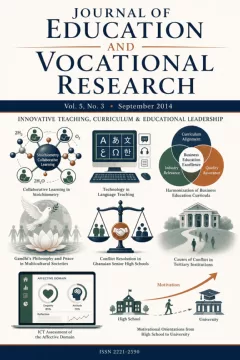 Vol. 5 No. 3 (2014)
Innovative Teaching, Curriculum & Educational Leadership
View issue contents
Published
Submissions
Have research to publish? Journal of Education and Vocational Research welcomes submissions.
Make a Submission