Abstract
Cultural barriers2 in terms of castes, religions and politics have been a major obstacle to most Hindus especially in inter-multicultural countries like India or Mauritius with serious impacts on peace. And any international organisation, especially the UNESCO3 , would disprove it. However, are interculturality and peace4 related and if yes5 to what extent? In a contextual approach, this paper deals with cultural barriers to peace reflecting the revival of the doctrine of Indian avatars focusing on to what extent human rights may also include the doctrine of Mahatma Gandhi to achieve peace in a multicultural society6 ? Cultural barriers to peace in a multicultural country like Mauritius had already been encountered in India by Mahatma Gandhi. Castes, religion, creed and colour and political appurtenance have undermined peace in India and we may be influenced of the work and philosophy of Mahatma Gandhi to inspire our political leaders, citizens and other religious groups to overcome the same barriers in the same way he did that is non-violence. However, Mahatma Gandhi has never been a political leader per se but a religious man instead. Through a contextual approach and without taboo, the co-authors try to reflect on the subject matter with particular reference to the Mauritian case study, to what extent Gandhi’s philosophy is useful and omnipresent today and to what extent it can shed light in our fragile inter-multicultural society to avoid tensions among the different and existing social, religious and political groups.
Keywords
References
- Ambedkhar. (1943). Ranade, Gandhi and Jinnah; What Congress and Gandhi have done to the untouchables, p.187, Thacker & Co. Ltd, Bombay.
- Arlette Renaud-Boué. (Brasov mai 2005). Association DEFY ( http://rolrena.club.fr)
- Carman, J. B. (1988). Duties and Rights in Hindu Society, in Human Rights and The world’s Religions, (ed.) Leroy S. Rouner, 113-28, notre Dame, Indiana: University og Notre Dame Press. S.
- Gandhi, K. (1950). Hindu Dharma (ed.) BharatanKumarappa, Ahmedabad; Navajivan Publishing House, pp.231-2
- Jesudasen, Y. (2006). Voices of Freedom Movement, Biographies, p.37, 83 p., Sura Books (Pvt) LTD
- Lauren, P. G. (1998). The Evolution of International Human Rights: Visions Seen, Philadelphia: University of Pennsylvania Press.
- Radhakrishnan, The Hindu View of life, New York: The Macmillan Company, 1927, Lecture IV, p.114
- P.NagarajaRao, The Four Values in Indian Philosophy and Culture, Mysore: University of Mysore, 1970, pp.211
- Nanda, B. R. (1958). Mahatma Gandhi – a biography, Oxford India Paperbacks, p.344, Chapter 38, 542 p.
- K.M. Panikkar, Hindu Society at the Crossroads, Bombay: Asia Publishing House, 1961, pp.48-9
- Swami Vivekananda, Calcutta: Advaita Ashram, 1970, Mayavati Memorial Edition, Vol. 5, p.15
- Tendulkar, D. G. (1951). Mahatma-life of Mohandas Karamchand Gandhi, Mahatma in eight volumes, publications Division, 338 p.
- Traer Robert. (1991). Faith in human rights, Washington DC: Georgetown University Press.
Downloads
No downloads have been recorded for this article yet. Figures appear here once readers begin downloading the full text.
How to Cite
Share this article
License
Copyright (c) 2014 Rajendra Parsad GUNPUTH, Vikas Gandhi (Author)

This work is licensed under a Creative Commons Attribution 4.0 International License.
Author (s) should affirm that the material has not been published previously. It has not been submitted and it is not under consideration by any other journal. At the same time author (s) need to execute a publication permission agreement to assume the responsibility of the submitted content and any omissions and errors therein. After submission of revised paper in the light of suggestions of the reviewers, the editorial team edits and formats manuscripts to bring uniformity and standardization in published material.
This work will be licensed under Creative Commons Attribution 4.0 International (CC BY 4.0) and under condition of the license, users are free to read, copy, remix, transform, redistribute, download, print, search or link to the full texts of articles and even build upon their work as long as they credit the author for the original work. Moreover, as per journal policy author (s) hold and retain copyrights without any restrictions.
Keywords
Section
Published in
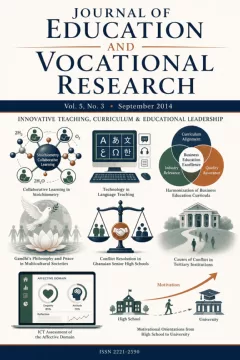 Vol. 5 No. 3 (2014)
Innovative Teaching, Curriculum & Educational Leadership
View issue contents
Published
Submissions
Have research to publish? Journal of Education and Vocational Research welcomes submissions.
Make a Submission