Abstract
The study explored the various causes of conflicts in organizations. The objectives of the study was to find out the nature, types and factors that lead to staff related conflicts in organizations especially tertiary educational institutions. To achieve the objectives, researchers employed the case study approach using Takoradi Polytechnic as the case study. It also involved the use of interview and questionnaire as the data collection instruments for the study. Researchers used the purposive and simple random sampling techniques to select the respondents. A sample size of 276 out of 736 of the population was selected for the study. This constitutes (36%) of the population. The sample was made up of 109 junior staff, 96 senior staff and 71 senior members. These three groups of staff from different departments were randomly and purposively invited to participate in the study. The study would be of immense benefit to management of institutions especially educational institutions since it would inform them of possible conflict that could arise. It would also inform policy formulation and staff training and development programs. It was discovered after the study that there were various conflicts in the organization which could be grouped into intra-personal, interpersonal and inter-group conflicts. These were as a result of the competing for limited resources, power struggle, differences in behavior among others. It recommends the education of staff through workshops and seminars on the differences that leads to conflicts, provision of resources and infrastructure that could mitigate the competition of resources among others.
Keywords
- Conflicts Search this journal for Conflicts (opens in a new tab)
- Takoradi Search this journal for Takoradi (opens in a new tab)
- Polytechnic Search this journal for Polytechnic (opens in a new tab)
- Staff Search this journal for Staff (opens in a new tab)
- Causes Search this journal for Causes (opens in a new tab)
References
- Bagshaw, M. (1998). Conflict management and mediation: Key leadership skills for the millennium. Industrial and commercial training , 30 (6), 206-208.
- Barker, J., Tjosuold, D. & Andrews, R. J. (1988). Conflict approaches of effective project managers: A filed study in a matrix organization . Journal of Management Studies , 2, 167-176.
- Certo, S. C. (2000). Supervision: Concepts and skill building . (3rd Ed.). Boston: McGraw Hill Inc.
- Dahrendorf, R. (1989). Class and class conflict in industrial society. Stanford, CA: Stanford University Press.
- Esquival, M. A. & Kleiner, B. H. (1997). The importance of conflict in work team effectiveness. Team Performance Management, 3(2), 89-96.
- French, R. M. (2000). The community a comparative perspective (3rd Ed.). Illinois: F.E. Peacock Publishers Inc. Hellriegel, D., Solocum, J. W. & Woodman, R. W. (1998). Organizational behavior. Cincinnati, OH: Southwestern College Publishing.
- Kinard, J. (1988). Management. Massachusetts: D.C. Health and Company.
- Kreitner, R. & Kinicki, A. (2004). Organizational behavior (6th Ed.). New York: McGraw-Hill Irwin.
- Kreitner, R. (1998). Management. California: Houghton Mifflin Company.
- Likert, R. & Likert, J. (1976 ). New ways of managing conflict. New York: McGraw-Hill.
- McShane, L. S. & Glinow, M. A. U. (2000). Organizational Behavior, New York: McGraw-Hill Companies.
- Mullins, J. L. (2005). Management and Organizational Behavior. New York: Prentice Hall.
- Nelson, L. D. & Quick J. C. (2000). Organizational Behavior: Foundations, realities and Challenges (3rd Ed.). New Jersey: South Western College Publishing.
- Oppong, M. K. (1999). Conflict management behaviors’ of headmasters in senior secondary schools in Kwehu. Unpublished master thesis, University of Cape Coast, Cape Coast.
- Pondy, L. (1969). Varieties of Organizational Conflict Administrative . Science Quarterly , 14, 499-505.
- Rao, M. G., Rao, U. S. P. & Narayana, P. S. (1987 ). Organizational Behavior: Text and cases. New Delhi: Konaark Publishers.
- Sawyer, A. (1997). Dynamics of Conflict Management in Liberia. Accra: An Institute of Economic Affairs Publication.
- Schnake, M. E. (1987). Principles of supervision. Dubugne, Iowa: W.C. Brown Publisher.
- Stoner, J. A. (1978). Management. New Jersey: Prentice-Hall Inc.
- Wright, P. M. & Noe, R. A. (1996). Management of organizations. Boston: McGraw-Hill.
Downloads
No downloads have been recorded for this article yet. Figures appear here once readers begin downloading the full text.
How to Cite
Share this article
License
Copyright (c) 2014 Sarah Morrison, Jeffrey Mingle, Samuel Sundong (Author)

This work is licensed under a Creative Commons Attribution 4.0 International License.
Author (s) should affirm that the material has not been published previously. It has not been submitted and it is not under consideration by any other journal. At the same time author (s) need to execute a publication permission agreement to assume the responsibility of the submitted content and any omissions and errors therein. After submission of revised paper in the light of suggestions of the reviewers, the editorial team edits and formats manuscripts to bring uniformity and standardization in published material.
This work will be licensed under Creative Commons Attribution 4.0 International (CC BY 4.0) and under condition of the license, users are free to read, copy, remix, transform, redistribute, download, print, search or link to the full texts of articles and even build upon their work as long as they credit the author for the original work. Moreover, as per journal policy author (s) hold and retain copyrights without any restrictions.
Keywords
- Conflicts Search this journal for Conflicts (opens in a new tab)
- Takoradi Search this journal for Takoradi (opens in a new tab)
- Polytechnic Search this journal for Polytechnic (opens in a new tab)
- Staff Search this journal for Staff (opens in a new tab)
- Causes Search this journal for Causes (opens in a new tab)
Section
Published in
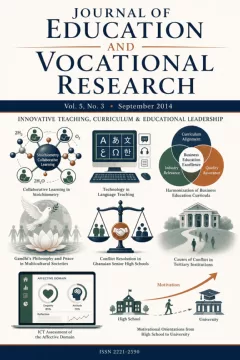 Vol. 5 No. 3 (2014)
Innovative Teaching, Curriculum & Educational Leadership
View issue contents
Published
Submissions
Have research to publish? Journal of Education and Vocational Research welcomes submissions.
Make a Submission