Abstract
ICT is becoming an inevitable tool in education nowadays. For any academic activities to be effective, the use of ICT is imperative. There are also a lot of benefits and improvement that ICT has brought to the field of education. These benefits and development cut across all spheres of education, such as the aspect of content, instruction and evaluation. In area of evaluation, the cognitive and psychomotor aspects of evaluation are mostly developed, based on the fact that both can be easily accessed through ICT. However, in the aspect of affective domain, the level of assessment is low and not absolutely reliable because it deals with the feelings, interest and values that learner attached to the subject matter. Hence, this study aimed at finding an effective way that ICT can be used to assess students’ affective domain in the process of evaluation. In order to get in-depth understanding of the subject matter, the study employs qualitative design by using semi-structured interview to elicit information from specialists in the field of communication technology. Findings from the study indicate that the use of ICT to evaluate student affective domain requires an illustrious, diligent, and enthusiastic ICT literate teacher. Equally, there is a need to develop software that will focus more on the evaluation of students’ affective domain. Meanwhile, this area that will develop students’ soft skills is greatly needed to produce good citizens, employees, and government of their individual community.
Keywords
- Affective Search this journal for Affective (opens in a new tab)
- Measurement Search this journal for Measurement (opens in a new tab)
- ICT Search this journal for ICT (opens in a new tab)
- Cognitive Domains Search this journal for Cognitive Domains (opens in a new tab)
- Assessment Search this journal for Assessment (opens in a new tab)
References
- Adkins, B. & Caldwell, D. (2004) Firm or subgroup culture: where does fitting in matter most ? Journal Organizational Behaviour, 25, 969-978.
- Bloom, B. S., Engelhart, M. D., Furst, E. J., Hill, W. H. & Krathwohl, D. R. (1956). Taxonomy of Educational objectives: the classification of educational goals; Handbook I: Cognitive Domain New York, Longmans, Green, 1956.
- Cairncross, F. & Pöysti, K. (2003). ICTs for education and building human capital. International Telecom Union. Available at http://www.itu.int/osg/spu/visions/
- Creswell , J. W. (2005). Educational research: Planning, conducting, and evaluating quantitative and qualitative research (3rd edn).
- Fuller, U. & Keim, B. (2007). Should we assess our students' attitudes? In Proc. Seventh Baltic Sea Conference on Computing Education Research (Koli Calling 2007), Koli National Park, Finland. CRPIT, 88. Lister, R. and Simon, Eds. ACS. 187-190.
- Gorman, G. E. & Clayton, P. (2005). Qualitative research for the information professional A practical handbook Facet Publishing, 7 Ridgmount Street London WC1E 7AE.
- Goyal, M. & Murthy, S. (2010). Probing students’ affective domain in an ict-enriched course. Institute of Technology Bombay Mumbai India.
- Grace, J. & Charles, K. (2003). A short review of information and communication technology and basic education in LDCs – what is useful, what is sustainable? International Journal of Educational Development , 23, 627-636.
- Halverson, R. & Shapiro, R. B. (2012). Technologies for Education and Technologies for Learners: How Information Technologies are (and Should Be) Changing Schools. Wisconsin Center for Educational Research (WCER), Working Paper 2012-6.
- Hanus, J., Hamilton, S. & Russel, J. S. (2008). The Cognitive and Affective Domain in Assessing the Life-Long Learning Objective United State Military Academy America society for Engineering Education
- Krathwohl, D. R., Bloom, B. S. & Masia, B. B. (1964). Taxonomy of Educational Objectives: The Classification of Educational Goals. Handbook 11: Affective Domain David Mckay Company Inc.
- Martin, C. (2004). ICT in Education: Possibilities and Challenges. UOC www.UOC.edu
- Merriam, S. B. (2009). Qualitative Research: A Guide to Design and Implementation. Jossey-Bass A Wiley Imprint 989 Market Street, San Francisco, U. S. A.
- Mikre, F. (2011). The Roles of Information Communication Technologies in Education. Ethiopian Journal of Education and Science , 6(2), 1998-8909.
- Mills, G. E. (2000). Action Research: A guide for the teacher researcher. Upper Saddle River, N. J: Merrill/Prentice Hall
- Naace Magazine. (2012). ICT in Education is important! Naace PO Box 611 Nottingham NG 118TN http://www.naace.co.uk/Privacy.
- Namibia Training Authority. (2006). ICT Skills for Educators A SSESS AND E VALUATE.
- Olatunji, M. O. (2013) Teaching and Assessing of Affective Characteristics: A Critical Missing Link in Online Education. International journal on New Trends in Education and their Implication , 4(1), 1309-6249
- Ogbomo M. A. & Ogbomo E. F. (2008). Importance of Information and Communication Technologies (ICTs) in Making a Healthy Information Society: A Case Study of Ethiopia East Local Government Area of Delta State, Nigeria Library Philosophy and Practice, Delta State Abraka Nigeria.
- Popham, W. J. (2011). Transformative Assessment in Action: An Inside Look at Applying the Process. ASCD 1703 N. Beauregard St. Alexandria, VA 22311-1714 USA.
- Rice-Lively, M. L. (2004). A Qualitative Research for Information Professional: A practical Hand book by G. E. Gorman Book.
- Saldana, J. (2009). The Coding Manual for Qualitative Research, Sage Publication London. Trucano, Michael. (200). Knowledge Maps: ICTs in Education. Washington, DC: info. Dev / World Bank.
- UNESCO. (2002). Information and Communication Technologies in teacher Education: A planning Guide> Division of Higher Education, 7, Place De Fontenoy, 75352 Paris 07 SP France.
- Watters, J. J., Christensen, C., Arcodia, C., Ryan, Y. & Weeks, S. (1998). Action Research in Practice: Partnership for Social Justice in Education. (pp. 250-279) London and New Routledge.
Downloads
No downloads have been recorded for this article yet. Figures appear here once readers begin downloading the full text.
How to Cite
Share this article
License
Copyright (c) 2014 Ismail Abdulfatai, Nik Ahmad Hisham Ismail, Husein Osman Abdullahi (Author)

This work is licensed under a Creative Commons Attribution 4.0 International License.
Author (s) should affirm that the material has not been published previously. It has not been submitted and it is not under consideration by any other journal. At the same time author (s) need to execute a publication permission agreement to assume the responsibility of the submitted content and any omissions and errors therein. After submission of revised paper in the light of suggestions of the reviewers, the editorial team edits and formats manuscripts to bring uniformity and standardization in published material.
This work will be licensed under Creative Commons Attribution 4.0 International (CC BY 4.0) and under condition of the license, users are free to read, copy, remix, transform, redistribute, download, print, search or link to the full texts of articles and even build upon their work as long as they credit the author for the original work. Moreover, as per journal policy author (s) hold and retain copyrights without any restrictions.
Keywords
- Affective Search this journal for Affective (opens in a new tab)
- Measurement Search this journal for Measurement (opens in a new tab)
- ICT Search this journal for ICT (opens in a new tab)
- Cognitive Domains Search this journal for Cognitive Domains (opens in a new tab)
- Assessment Search this journal for Assessment (opens in a new tab)
Section
Published in
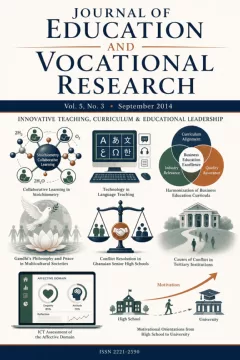 Vol. 5 No. 3 (2014)
Innovative Teaching, Curriculum & Educational Leadership
View issue contents
Published
Submissions
Have research to publish? Journal of Education and Vocational Research welcomes submissions.
Make a Submission