Abstract
Learning strategies and motivational orientations are important issues that have attracted the attention of many researchers in recent decades. Thus this research was done with the aim of investigation the use of students’ motivational orientations compared with them high school. The type of research is applied, descriptive. Students of University of Sistan and Baluchestan the number of 19750 was considered as target population and with use of Krejcie and Morgan (1970) sample size table 375 students were considered as sample. The main components of motivational orientations were measured with using Taylor-Sims (2011) Motivational Strategies Questionnaire (MSQ). Data was examined with using Paired Sample t-test, Friedman test for prioritize the variables, Analysis Variance and Independentsample t-test. The findings indicated that generally students use less motivational orientation than them high school course and this amount wasn’t desirable. The girls more utilized these skills in comparison with boys. Among different educational groups in just a few components was a significant difference. In rate of using of motivational orientations weren't significant differences between educational levels and age.
Keywords
References
- Anderman, E. M. & Young, A. J. (1994). Motivation and strategy use in science: Individual differences and classroom effects. Journal of Research in Science Teaching, 31(8), 811– 831.
- Cano, F. (2006). An in depth analysis of the learning and study strategies inventory (LASSI). Educational and Psychological Measurement, 66(6), 1023-1038.
- Cubukcu, F. (2007). Cross-cultural differences in learning strategies and study skills. Porta Linguarum, 8(1), 99-116.
- Downing, K. & Shin, W. K. (2007). Gender differences in cognitive functioning, City University of Hong Kong, Hong Kong S.A.R. Institute of Textiles and Clothing, Hong Kong Polytechnic University.
- Irannezhad, M. & Sasangohar, P. (1996). Organization and management, from theory to act, Iran Banking Institute,N3,Tehran.
- Jalali, A. & Arefi, M. (2009). Comparison of Autonomy and Gifted Students and Normal Students and Predicted roles of the academic performance of students in Shiraz. Journal of Research in Educational Sciences, 4(2), 42-54
- Krejcie, R.V. & Morgan, D. W. (1970). Determining Sample Size for Research Activities. Educational and Psychological Measurement, 30(3), 607-610
- Kovach, K. & Wilgosh, L. R. (1999). Learning and Study Strategies, and Performance anxiety in postsecondary Students with Learning disabilities: A Preliminary Study. J. P. Das Developmental Disabilities Centre.
- Linn, M. C. & Hyde, J. S. (1989). Gender, mathematics and science. Educational Researcher , 18(1), 17-19.
- Pintrich, P. R. & DeGroot, E. V. (1990). Motivational and self- regulated learning components of classroom academic performance. Journa l of Educational psychology , 82(1), 33-40.
- Robbins, E. (2012). Organizational behavior, Concepts, Theories and Applications. Translator: Parsaeyan, A & Arabi. M. Office of Cultural Research Publications.
- Samadi, M. (2012). Relationship between motivational orientations and learning strategies In explanation of academic success. Journal of Learning Strategies , 5(2), 105
- Seif, A. (2011). Modern breeding psychology: Learning and Teaching Psychology. Tehran: Doran Publication, Twelfth Edition.
- Serin, O., Serinb, N. B. & Sahinc, F. S. (2009). Factors affecting the trainee teachers. World Conference on Educational Sciences, Procedia Social and Behavioral Sciences, 1127-1136.
- Sheikholeslami, R. & Khayyer, M. (2006). Examination the relationship between motivational beliefs and the use of English learning strategies among students. Journal of Psychology , 10(1), 25-34
- Shih, C. C., Chiang, D. A., Lai, S. W. & Huc, Y. W. (2009).Applying hybrid data mining techniques to webbased self-assessment system of Study and Learning Strategies Inventory. Expert Systems with Applications, 36(3), 5523-5532.
- Solso, R. L. (2001). Cognitive Psychology . (6th edition). Boston, MA. Allyn and Bacon
- Spector P. E. & Fox, S. (2003). An Emotion-Centered Model of Voluntary Work 112.
- Taylor-Sims, M. A. (2011). Differences in Motivation and Cognitive Learning Strategy Use from High School to College and Impact on First-Semester College Grade Point Average. Auburn, Alabama.
- Wang, M., Haertel , G. D. & Walberg, H. J. (1990) . What influences Learning? A Content analysis of review literature. Journal of Educational Research , 84(1),30-43.
- Weinstein, C. E., Ridley, D. S., Dahl, T. & Weber, E. S. (1989). Helping Students develop strategies for effective learning. Educational Leadership , 46(4), 17-19.
- Wongswadlwat, J. (2003). The effects of learning and study strategies on academic achievement. Thai Journal of Development Administration , 43(3), 207-237.
Downloads
No downloads have been recorded for this article yet. Figures appear here once readers begin downloading the full text.
How to Cite
Share this article
License
Copyright (c) 2014 Vali Mehdinezhad, Saeedeh Rajabi Hafezi (Author)

This work is licensed under a Creative Commons Attribution 4.0 International License.
Author (s) should affirm that the material has not been published previously. It has not been submitted and it is not under consideration by any other journal. At the same time author (s) need to execute a publication permission agreement to assume the responsibility of the submitted content and any omissions and errors therein. After submission of revised paper in the light of suggestions of the reviewers, the editorial team edits and formats manuscripts to bring uniformity and standardization in published material.
This work will be licensed under Creative Commons Attribution 4.0 International (CC BY 4.0) and under condition of the license, users are free to read, copy, remix, transform, redistribute, download, print, search or link to the full texts of articles and even build upon their work as long as they credit the author for the original work. Moreover, as per journal policy author (s) hold and retain copyrights without any restrictions.
Keywords
Section
Published in
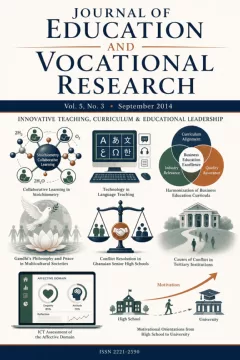 Vol. 5 No. 3 (2014)
Innovative Teaching, Curriculum & Educational Leadership
View issue contents
Published
Submissions
Have research to publish? Journal of Education and Vocational Research welcomes submissions.
Make a Submission