Abstract
The main reason for someone to participate in an Open and Distance Education program is either the acquisition of professional skills on a given object, or the development of his existing skills and consequently their improvement. By carrying out Advisory Group Meetings (AGM) on specific issues related to the trainees, a deepening of their theoretical background and the practical aspects of their training takes place, which they all seek. In this paper we present in a concise way the course of such a meeting according to the extent that it may have, in which the theory is being associated with practice.
Keywords
References
- Keegan, D. (2001). Basic principles of Open and Distance Education. Athens: Metaichmio.
- Kokkos, A. (1998). The preparation of the Advisory Group Meetings. in: A. Kokkos, & A. Lionarakis. Open and distance learning: Relationship between teachers and students. Volume II. (pp. 125-154). Patra: Hellenic Open University.
- Kokkos, A. (1998). The opening of the first Advisory Group Meeting. in: A. Kokkos, & A. Lionarakis. Open and distance learning: Relationship between teachers and students. Volume II. (pp. 155-186). Patra: Hellenic Open University.
- Kokkos, A. (1998). Principles of Adult Learning. in: A. Kokkos, & A. Lionarakis. Open and distance learning: Relationship between teachers and students. Volume II. (pp. 19-51). Patra: Hellenic Open University.
- Kokkos, A. (2005). Adult Education Methodology: Theoretical Framework and Learning Conditions. Volume A. Patra: Hellenic Open University.
- Polemi-Todoulou, M. (2005). Adult Education Methodology: The Development of the Group in Adult Education. Volume III. Patra: Hellenic Open University.
- Rogers, A. (1998). Adult Education. Athens: Metaichmio.
Downloads
No downloads have been recorded for this article yet. Figures appear here once readers begin downloading the full text.
How to Cite
Share this article
License
Copyright (c) 2016 Georgios Giannoukos, Ioannis Stergiou, Vasilios Hioctour, Sotiria Kallianta (Author)

This work is licensed under a Creative Commons Attribution 4.0 International License.
Author (s) should affirm that the material has not been published previously. It has not been submitted and it is not under consideration by any other journal. At the same time author (s) need to execute a publication permission agreement to assume the responsibility of the submitted content and any omissions and errors therein. After submission of revised paper in the light of suggestions of the reviewers, the editorial team edits and formats manuscripts to bring uniformity and standardization in published material.
This work will be licensed under Creative Commons Attribution 4.0 International (CC BY 4.0) and under condition of the license, users are free to read, copy, remix, transform, redistribute, download, print, search or link to the full texts of articles and even build upon their work as long as they credit the author for the original work. Moreover, as per journal policy author (s) hold and retain copyrights without any restrictions.
Keywords
Section
Published in
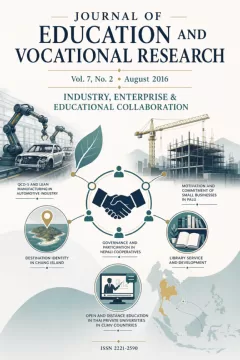 Vol. 7 No. 2 (2016)
Industry, Enterprise & Educational Collaboration
View issue contents
Published
Submissions
Have research to publish? Journal of Education and Vocational Research welcomes submissions.
Make a Submission