Abstract
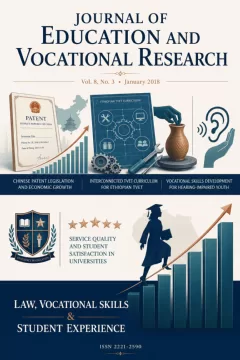
The study sought to investigate the prospects of equipping hearing impaired youths in peri-urban Masvingo District with skills for employment and self-employment in view of the economic crisis in Zimbabwe. The study used the Human Capital Theory as the theoretical framework. A case study research design was used. Data was collected through semi-structured interviews of eight purposefully selected hearing impaired vocational graduates as well as four key informant interviews with lecturers at the special school. Observations were also done to augment data from the interviews. Thematic analysis was used in analysing the data. The study revealed that the hearing-impaired graduates acquired technical and vocational and skills at the special school. However, despite the high skill levels, they were not being utilised for their livelihoods. Instead of utilising their technical and vocational skills, most of the graduates were engaged in self initiated micro-entrepreneurial activities such as street vending. The major challenges to employment and self-employment included lack of capital, communication barriers and lack of representation and clear policy. The study recommends the realignment of vocational skills with the reality in which hearing impaired graduates experience daily to focus more on entrepreneurship and community development in view of a weak economy which makes employment and self-employment difficult to achieve.
Keywords
- Vocational Skills Search this journal for Vocational Skills (opens in a new tab)
- Hearing Impaired Youth Search this journal for Hearing Impaired Youth (opens in a new tab)
- Employment Search this journal for Employment (opens in a new tab)
- Self-Employment Search this journal for Self-Employment (opens in a new tab)
- Economic Crisis Search this journal for Economic Crisis (opens in a new tab)
References
- Aldridge, J. (2014). Working with vulnerable groups in social research: dilemmas by default and design. Qualitative Research, 14(1), 112-130.
- Barnes, C. & Mercer, G. (2005). Disability, work, and welfare: challenging the social exclusion of disabled people. Work, employment and society, 19(3), 527-545.
- Bennell, P., Bendera, S., Kanyenze, G., Kimambo, E., Kiwia, S., Mbiriyakura, T.& Parsalaw, W. (1999). Vocational Education and Training in Tanzania and Zimbabwe in the Context of Economic Reform. Education Research Paper: ERIC.
- Billet, S. (2011). Vocational Education Purposes, Traditions and Prospects. New York: Springer.
- Braun, V., & Clarke, V. (2006). Using thematic analysis in psychology. Qualitative Research in Psychology, 3(2), 77-101.
- Chitiyo, M.& Wheeler, J. (2004). The Development of Special Education Services in Zimbabwe. International Journal of Special Education, 19(2), 46-52.
- Choruma, T. (2007). The forgotten tribe: People with disabilities in Zimbabwe: CIIR.
- Chun, J., Connor, A., Kosciulek, J. F., Landon, T.& Park, J. (2016). Career Development for Youth with Disabilities in South Korea: The Intersection of Culture, Theory, and Policy. Global Education Review, 3(3), 57-74.
- Creswell, J. W. (2013). Research design: Qualitative, quantitative, and mixed methods approaches: Sage publications.
- Dacre Pool, L.& Sewell, P. (2007). The key to employability: developing a practical model of graduate employability. Education+ Training, 49(4), 277-289.
- Denscombe, M. (2014). The good research guide: for small-scale social research projects: McGraw-Hill Education (UK).
- Eide, A.& Ingstad, B. (2017). Disability and poverty: A global challenge: Policy Press.
- Groves, R. (2009). Fast-track Land Reform And The Decline Of Zimbabwe's Political And Economic Stability.
- Guba, E. G.& Lincoln, Y. S. (1994). Competing paradigms in qualitative research. Handbook of qualitative research, 2(163-194), 105.
- Guilbert, L., Bernaud, J. L., Gouvernet, B. & Rossier, J. (2016). Employability: review and research prospects. International Journal for Educational and Vocational Guidance, 16(1), 69-89.
- Gyamfi, N., Mprah, W. K., Edusei, A. K. E., Dogbe, J. A.& Owusu, I. (2016). Relevance of vocational training programme for persons with disabilities in the Ashanti Region of Ghana. Journal of Disability Studies, 1(2), 69-76.
- Hall, S. A. (2009). The social inclusion of people with disabilities: a qualitative meta-analysis. Journal of ethnographic & qualitative research, 3(3).
- Harvey, M. W. (1998). The relationship of postsecondary transitional outcomes and participation in secondary vocational technical education among students with disabilities. Pennsylvania State University.
- Harvey, M. W. (2001). The efficacy of vocational education for students with disabilities concerning post-school employment outcomes: A review of the literature.
- Hillage, J.& Pollard, E. (1998). Employability: developing a frame work for policy analysis. London: Department of Education and Employment.
- Hlatywayo, L.& Ncube, A. C. (2014). Employing Deaf Persons: A Zimbabwean Employers Perspective. International Journal of Innovative Research and Development, 3(10).
- Kanyenze, G., Kondo, T., Chitambira, P.& Martens, J. (2011). Beyond the enclave: Towards a pro- poor and inclusive development strategy for Zimbabwe. Harare: Weaver Press.
- Kaserera, J. (2012). Assessing the impact of mainstream vocational training in developing capabilities of people with and without disabilities. A case of Danhiko Training Institution in Harare, Zimbabwe. Institute of Social Studies, The Hague, Netherlands.
- Kett, M. (2012). Skills development for youth living with disabilities in four developing countries. Background paper for EFA Global Monitoring Report.
- King, K.& McGrath, S. (2002). Globalisation, enterprise and knowledge: Education, training and development in Africa.
- Mabhanda, W. (2016). Industrial Attachment challenges: Lessons drawn from Gweru Polytechnic College in Zimbabwe. International Journal of Business and Management Invention, 5(9), 37-42.
- Mabhena, C. (2010). Visible hectres, vanishing livelihoods: A case of the Fast Track Land Reform Programme in southern Matebeleland- Zimbabwe. (PhD), Fort- Hare, South Africa.
- McGrath, S., Akoojee, S., Gewer, A., Mabizela, M., Mbele, M.& Roberts, C. (2006). An examination of the vocational education and training reform debate in Southern Africa. Compare, 36(1), 85-103.
- McGrath, S., Akoojee, S., Gewer, A.& Roberts, J. (2006). An examination of the vocational education and training reform debate in Southern Africa. Compare, 36(1), 85-103.
- McGrath, S., Needham, S., Papier, J., Wedekind, V.& van der Merwe, T. (2010b). Employability in the College Sector: A Comparative Study of England and South Africa. Final Report of the Learning to Support Employability Project. School of Education, University of Nottingham.
- Miles, M. B.& Huberman, A. M. (1994 ). Qualitative data analysis: A sourcebook of new methods Thousand Oaks, CA: Sage.
- Ministry of Higher and Tertiary Education. (2005). Technical and Vocational Education and Training policy review framework (pp. 1-58).
- Moll, I. (2004). Curriculum responsiveness: The anatomy of a concept. In H. Griesel (Ed.), Curriculum Responsiveness: Case Studies in Higher Education. Pretoria: SAUVCA.
- Mpofu, E.& Harley, D. A. (2002). Disability and rehabilitation in Zimbabwe: lessons and implications for rehabilitation practice in the US. Journal of rehabilitation, 68(4), 26.
- Mpofu, E., Kasayira, J., Mhaka, M., Chireshe, R.& Maunganidze, L. (2007). Inclusive education in Zimbabwe. Responding to the challenges of inclusive education in Southern Africa, 66-79.
- Musengi, M., Ndofirepi, A.& Shumba, A. (2012). Rethinking education of deaf children in Zimbabwe: Challenges and opportunities for teacher education. Journal of deaf studies and deaf education, 18(1), 62-74.
- Nafukho, F. M., Hairston, N.& Brooks, K. (2004). Human capital theory: Implications for human resource development. Human Resource Development International, 7(4), 545-551.
- Nyazema, N. Z. (2010). The zimbabwe crisis and the provision of social services health and education. Journal of Developing Societies, 26(2), 233-261.
- Nyombi, C.& Kibandama, A. (2016). Access to Employment for Persons with Disabilities in Uganda. Retrieved 17 October 2017, from Cornell University ILR School http://digitalcommons.ilr.cornell.edu/gladnetcollect/569
- Nziramasanga, C. T. (1999). Report of the Presidential Commission of Inquiry into Education and Training. Harare: Government Printers.
- Olaniyan, D.& Okemakinde, T. (2008). Human capital theory: Implications for educational development. Pakistan Journal of Social Sciences, 5(5), 479-483.
- Peresuh, M.& Barcham, L. (1998). Special education provision in Zimbabwe. British Journal of Special Education, 25(2), 75-80.
- Riddell, S., Baron, S.& Wilson, A. (2001). The learning society and people with learning difficulties: Policy Press.
- Rule, P.& John, V. (2011). Your guide to Case study research. Johannesburg: Van Schaik Publishers.
- Tobin, G. A. & Begley, C. M. (2004). Methodological rigour within a qualitative framework. Journal of advanced nursing, 48(4), 388-396.
- UNESCO. (2016). UNESCO- TVET Strategy 2016 - 2021. Bonn, Germany: UNESCO.
- Vaz, G. (2012). Integrating Vocational Education with Academic Education in Commonwealth Open School: Commonwealth of Learning (COL).
- Vurayai, S.& Muwaniki, C. (2016). Zimbabwe's economic crises and the state of proffessionalism among rural secondary school teachers. Dzimbabwe Journal of Multidisciplinary Research, 1(1), 64-74.
- Wagner, M. (1991). Youth with disabilities: How are they doing? The first comprehensive report from the National Longitudinal Transition Study of Special Education Students.
- Wedekind, V.& Mutereko, S. (2016). Employability and curriculum responsiveness in post-school education and training.
- Working Experience Group. (2002). Work Related Learning Report. Nottingham.
- World Health Organization. (2015). WHO global disability action plan 2014-2021: Better health for all people with disability: World Health Organization.
- Yin, R. K. (2013). Case study research: Design and methods: Sage publications.
Downloads
No downloads have been recorded for this article yet. Figures appear here once readers begin downloading the full text.
How to Cite
Share this article
License
Copyright (c) 2018 Chenjerai Muwaniki, Patricia Muvirimi (Author)

This work is licensed under a Creative Commons Attribution 4.0 International License.
Author (s) should affirm that the material has not been published previously. It has not been submitted and it is not under consideration by any other journal. At the same time author (s) need to execute a publication permission agreement to assume the responsibility of the submitted content and any omissions and errors therein. After submission of revised paper in the light of suggestions of the reviewers, the editorial team edits and formats manuscripts to bring uniformity and standardization in published material.
This work will be licensed under Creative Commons Attribution 4.0 International (CC BY 4.0) and under condition of the license, users are free to read, copy, remix, transform, redistribute, download, print, search or link to the full texts of articles and even build upon their work as long as they credit the author for the original work. Moreover, as per journal policy author (s) hold and retain copyrights without any restrictions.
Keywords
- Vocational Skills Search this journal for Vocational Skills (opens in a new tab)
- Hearing Impaired Youth Search this journal for Hearing Impaired Youth (opens in a new tab)
- Employment Search this journal for Employment (opens in a new tab)
- Self-Employment Search this journal for Self-Employment (opens in a new tab)
- Economic Crisis Search this journal for Economic Crisis (opens in a new tab)
Section
Published
Submissions
Have research to publish? Journal of Education and Vocational Research welcomes submissions.
Make a Submission