Abstract
‘Blitar Kartika Rukmi’ is one of Indonesian bridal traditional make-up. To master this kind of makeup, participants need to complete their study from LKP Imam Mandiri which is one of the non-formal vocational institutions. Blitar Kartika rukmi is a kind of make-up taken from Blitar society local wisdom. This research aimed to find the relationship between the Blitar Kartika Rukmi bridal make-up and the successfulness of the participant as Kartika Rukmi bridal make-up artists. The research method used phenomenology study since the participant graduate from this training had succeed in doing the entrepreneurship. The finding of the research showed the participant who took part in the training, very understood about the philosophy value of Blitar Kartika Rukmi bridal make-up and applied it in doing the entrepreneurship. The make-up artists had gain successful as an entrepreneur and in other field of business.
Keywords
References
- ACCI. (2002). Employability skills – an employer perspective: Getting what employers want out of the too hard basket. Kingston: ACCI.
- Berdrow, I. & Evers, F. T. (2014). Competence: Bases for Employee Effectiveness. Dalam N. E. Chalofsky, T. S. Rocco, & M. L. Morris, Handbook of Human Resource Development, 201-227.
- Bonache, J., & Brewster, C. (2001). Knowledge Transfer and the Management of Expatriation. Thunderbird International Business Review, 43(1), 45–168.
- Braxton, J. M., Milem, J. F. & Sullivan, A. S. (2000). The Influence of Active Learning on the College Student Departure Process. The Journal of Higher Education, 569-590.
- Crasovan, M. & Sava, S. (2012). Validation of Competencies as Part of Career Counselling. Thessaloniki: IREA.
- Fischer, M. (2002). Work experience as an element of work process knowledge. Dalam N. Boreham, R. Samurçay, & M. Fischer, Work Process Knowledge (hal. 119-133). New York: Routledge.
- Izzo, J. (2001). The Shift in The Work Ethic and Implications for Employers. Employment Relations Today, 5361.
- Kanhadilok, P. & Watts, M. (2013). Western Science and Local Thai Wisdom: Using Museum Toys to Develop Bi-Gnosis. Canadian Journal of Science, Mathematics and Technology Education, 33-48.
- Kasworm, C. E. & Marienau, C. A. (1997). Principles for Assessment of Adult Learning. New Directions for Adult and Continuing Education, 5-16.
- Kilbrink, N. & Bjurulf, V. (2013). Transfer of knowledge in technical vocational education: a narrative study in Swedish upper secondary school. Int J Technol Des Educ, 23, 519–535.
- Michael, J. (2006). Where’s the evidence that active learning works? Adv Physiol Educ, 159–167.
- Mündel, K. & Schugurensky, D. (2008). Community-Based Learning and Civic Engagement: Informal Learning among Adult Volunteers in Community Organizations. New Directions for Adult and Continuing Education, 49-60.
- Pavlova, M. (2009). Technology and Vocational Education for Sustainable Development : Empowering Individuals for the Future. (M. Pavlova, Penyunt.) Netherlands: Springer Netherlands.
- Poell, R. F. & Krogt, F. J. (2016). Employee Strategies in Organising Professional Development. Dalam S. Billett, D. Dymock, & S. Choy, Supporting Learning Across Working Life: Models, Processes and Practices (hal. 29). Switzerland: Springer.
- Rhodes, J., Hung, R., Lok, P., Lien, B. Y. H, & Wu, C. M. (2008). Factors influencing organizational knowledge transfer: implication for corporate performance. Journal of Knowledge Management, 84-100.
- Singh, M. (2015). Global Perspectives on Recognising Non-formal and Informal Learning: Why Recognition Matters. New York: Springer.
- Sveiby, K. E. (1996). Transfer of Knowledge and the Information Processing Professions. European Management Journal, 379-388.
- UNESCO. (1999). Final report. Second International Conference on Technical and Vocational Education. Paris: UNESCO.
- UNESCO. (2001). Revised Recommendation concerning Technical and Vocational Education 2001. Paris: UNESCO.
- Yang, J. (2015). Recognition, Validation and Accreditation of Non-formal and Informal Learning in UNESCO Member States. Hamburg: UNESCO Institute for Lifelong Learning.
Downloads
No downloads have been recorded for this article yet. Figures appear here once readers begin downloading the full text.
How to Cite
Share this article
License
Copyright (c) 2018 Anik Wahyuingsing, Supriono, Hardika, Umi Hidayati (Author)

This work is licensed under a Creative Commons Attribution 4.0 International License.
Author (s) should affirm that the material has not been published previously. It has not been submitted and it is not under consideration by any other journal. At the same time author (s) need to execute a publication permission agreement to assume the responsibility of the submitted content and any omissions and errors therein. After submission of revised paper in the light of suggestions of the reviewers, the editorial team edits and formats manuscripts to bring uniformity and standardization in published material.
This work will be licensed under Creative Commons Attribution 4.0 International (CC BY 4.0) and under condition of the license, users are free to read, copy, remix, transform, redistribute, download, print, search or link to the full texts of articles and even build upon their work as long as they credit the author for the original work. Moreover, as per journal policy author (s) hold and retain copyrights without any restrictions.
Keywords
Section
Published in
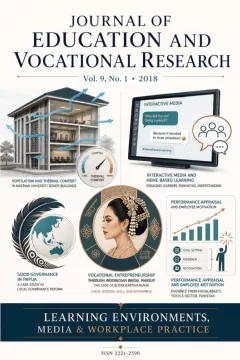 Vol. 9 No. 1 (2018)
Learning Environments, Media & Workplace Practice
View issue contents
Published
Submissions
Have research to publish? Journal of Education and Vocational Research welcomes submissions.
Make a Submission