Abstract
Employee performance is the strength of the organization. This study relates to the assessment of the relationship between employee performance evaluations to assess the moderate role of motivation. The current research was conducted in Faisalabad's textile industry. A sample of 204 respondents was drawn using a convenient sampling technique. In addition, the primary information was collected through a questionnaire. For data analysis, SPSS (version-20) software applied percentage, mean, standard deviation, regression and correlation coefficient methods. The result is achievable in a positive relationship between the outcome of the conversion and the employee's earnings. Another variable is motivation, because the moderator has a positive effect between the two relationships. The textile industry can use the evaluation rule as a deliberate approach by integrating it into its business policy and HR practice and improving the employee's performance in the organization.
Keywords
- Performance Appraisal Search this journal for Performance Appraisal (opens in a new tab)
- Employee's Performance Search this journal for Employee's Performance (opens in a new tab)
- Motivation Search this journal for Motivation (opens in a new tab)
- Regression Search this journal for Regression (opens in a new tab)
- Correlation Search this journal for Correlation (opens in a new tab)
References
- Ali, S. B., Mahdi, A., & Malihe, J. (2012). The effect of employees' performance appraisal procedure on their intrinsic motivation. International Journal of Academic Research in Business and Social Sciences, 2 (12), 161.
- Asiabar, A. S., Biglar, M., Manesh, P. A., & Moslehi, S. (2013). Job Satisfaction And Development Of A Human Resource Management Policy. STRATEGIC MANAGERIAL , 27.
- Barrick, M. R., & Mount, M. K. (1991). The big five personality dimensions and job performance: a meta‐analysis. Personnel Psychology, 44 (1), 1-26.
- Boachie-Mensah, F., & Dogbe, O. D. (2011). Performance-Based pay as a motivational tool for achieving organisational performance: an exploratory case study. International Journal of Business and Management, 6 (12), 270.
- Bowen, D. E., & Ostroff, C. (2004). Understanding HRM-firm performance linkages: The role of the “strength” of the HRM system. Academy of Management Review, 29 (2), 203-221.
- Campbell, D. J., Campbell, K. M., & Chia, H.-B. (1998). Merit pay, performance appraisal, and individual motivation: An analysis and alternative. Human Resource Management (1986-1998), 37 (2), 131.
- Cawley, B. D., Keeping, L. M., & Levy, P. E. (1998). Participation in the performance appraisal process and employee reactions: A meta-analytic review of field investigations. Journal of Applied Psychology, 83 (4), 615.
- Combs, J., Liu, Y., Hall, A., & Ketchen, D. (2006). How much do high‐performance work practices matter? A meta‐analysis of their effects on organizational performance. Personnel Psychology, 59 (3), 501-528.
- DeNisi, A. S., & Pritchard, R. D. (2006). Performance appraisal, performance management and improving individual performance: A motivational framework. management and Organization Review, 2 (2), 253277.
- DiSanza, J. R., & Legge, N. J. (2016). Business and professional communication: Plans, processes, and performance : Pearson.
- Elicker, J. D., Levy, P. E., & Hall, R. J. (2006). The role of leader-member exchange in the performance appraisal process. Journal of management, 32 (4), 531-551.
- Grubb, T. (2007). Performance appraisal reappraised: It’s not all positive. Journal of Human Resources Education, 1 (1), 1-22.
- Güngör, P. (2011). The relationship between reward management system and employee performance with the mediating role of motivation: A quantitative study on global banks. Procedia-Social and Behavioral Sciences, 24 , 1510-1520.
- Harris, M. M. (1994). Rater motivation in the performance appraisal context: A theoretical framework. Journal of management, 20 (4), 735-756.
- Honey, P. (2001). E-learning: a performance appraisal and some suggestions for improvement. The learning organization, 8 (5), 200-203.
- Iqbal, N., Ahmad, N., Haider, Z., & Batool, Y. (2013). Impact of performance appraisal on employee's performance involving the Moderating Role of Motivation. Arabian Journal of Business and Management Review (OMAN Chapter), 3 (1), 37.
- Jabeen, M. (2011). Impact of performance appraisal on employees motivation. European Journal of Business and Management, 3 (4), 197-204.
- Judge, T. A., & Ilies, R. (2002). Relationship of personality to performance motivation: A meta-analytic review. Journal of Applied Psychology, 87 (4), 797.
- Judge, T. A., Thoresen, C. J., Bono, J. E., & Patton, G. K. (2001). The job satisfaction-job performance relationship: A qualitative and quantitative review. Psychological Bulletin, 127 (3), 376.
- Kline, T. J., & Sulsky, L. M. (2009). Measurement and assessment issues in performance appraisal. Canadian Psychology/Psychologie canadienne, 50 (3), 161.
- Levy, P. E., & Williams, J. R. (2004). The social context of performance appraisal: A review and framework for the future. Journal of management, 30 (6), 881-905.
- Mani, B. G. (2002). Performance appraisal systems, productivity, and motivation: A case study. Public Personnel Management, 31 (2), 141-159.
- Oraman, Y., Unakıtan, G., & Selen, U. (2011). Measuring employee expectations in a strategic human resource management research: Job satisfaction. Procedia-Social and Behavioral Sciences, 24 , 413-420.
- Renwick, D. W., Redman, T., & Maguire, S. (2013). Green human resource management: A review and research agenda. International journal of management reviews, 15 (1), 1-14.
- Taticchi, P., Tonelli, F., & Cagnazzo, L. (2010). Performance measurement and management: a literature review and a research agenda. Measuring business excellence, 14 (1), 4-18.
- William, A. N. (2010). Employee motivation and performance. Unpublished dissertation). Mikkeli University of Applied Science, Finland .
- Willis-Shattuck, M., Bidwell, P., Thomas, S., Wyness, L., Blaauw, D., & Ditlopo, P. (2008). Motivation and retention of health workers in developing countries: a systematic review. BMC health services research, 8 (1), 247.
Downloads
No downloads have been recorded for this article yet. Figures appear here once readers begin downloading the full text.
How to Cite
Share this article
License
Copyright (c) 2018 Dilbar Hassan Ch., Rakhshanda Maqsood, Snawer Gill (Author)

This work is licensed under a Creative Commons Attribution 4.0 International License.
Author (s) should affirm that the material has not been published previously. It has not been submitted and it is not under consideration by any other journal. At the same time author (s) need to execute a publication permission agreement to assume the responsibility of the submitted content and any omissions and errors therein. After submission of revised paper in the light of suggestions of the reviewers, the editorial team edits and formats manuscripts to bring uniformity and standardization in published material.
This work will be licensed under Creative Commons Attribution 4.0 International (CC BY 4.0) and under condition of the license, users are free to read, copy, remix, transform, redistribute, download, print, search or link to the full texts of articles and even build upon their work as long as they credit the author for the original work. Moreover, as per journal policy author (s) hold and retain copyrights without any restrictions.
Keywords
- Performance Appraisal Search this journal for Performance Appraisal (opens in a new tab)
- Employee's Performance Search this journal for Employee's Performance (opens in a new tab)
- Motivation Search this journal for Motivation (opens in a new tab)
- Regression Search this journal for Regression (opens in a new tab)
- Correlation Search this journal for Correlation (opens in a new tab)
Section
Published in
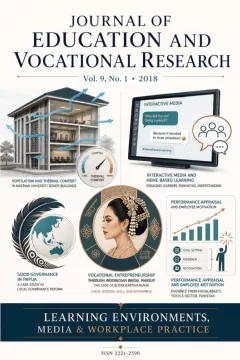 Vol. 9 No. 1 (2018)
Learning Environments, Media & Workplace Practice
View issue contents
Published
Submissions
Have research to publish? Journal of Education and Vocational Research welcomes submissions.
Make a Submission