Abstract
This study aimed to examine whether students consider that their mobile phones are useful devices for academic learning. Moreover, it was to investigate whether students’ opinion on their mobile devices are useful devices for academic learning have any differences based on students’ gender, age, college and type of their mobile phone; and students’ opinion regarding capabilities of all features of Smartphone have positive correlation for effect of Smartphone to students’ learning. The participants were students of four colleges in National Dong Hwa University. The effectiveness of Smartphone was measured by questionnaire consisted students’ opinion on using their Smartphone in learning. Based on the findings of this study, students consider that their mobile phones were useful devices for academic learning, and provided positive impact in students’ learning. However, students considered that their mobile phones were useful devices for academic learning did not depend on their gender, age, college, or type of their Smartphone. Capabilities of all features of Smartphone had positive correlation for effect of Smartphone to their learning.
Keywords
References
- Attewell, J. (2005, December 25). From research and development to mobile learning: tools for education and training provider and their learners.
- Crompton, H. (2013). A historical overview of mobile learning: Toward learner-centered education. In Berge, Z. L. & Muilenburg, L. Y. Handbook of Mobile Learning (pp. 3-14). Florence, KY: Routledge.
- El-Hussein, M. O. & Cronje, J. C. (2010). Defining mobile learning in the higher education landscape. Educational Technology & Society , 13(3), 12-21.
- Elias, T. (2011). Universal instructional design principles for mobile learning. International Review of Research in Open and Distance Learning , 12(2), 143-156.
- Etoekleous, N. & Ktoridou, D. (2009, April 28). Investigating Mobile Devices Integration in Higher Education in Cyprus: Faculty Perspective. Frederick University Cyprus, School of Education, Nicosia, Cyprus and University of Nicosia, School of Business, Nicosia, Cyprus, 38-40.
- Hopkins, W. G. (2000). Quantitative research design. Sportscience , 4(1), 12-21.
- Kuznekoff, J. H. & Titsworth, S. (2013). The impact of mobile phone usage on student learning, communication education , 62(3), 233-252.
- McFarlane, Triggs, P. & Yee, W. (2008). Mobile learning: Research findings.
- Mokoena, S. (2011). Smartphones and regular cellular phones: assessing their impact on students’ education at the university of zululand (main campus).
- Ransford, M. (2009, March 25). Survey Finds Smart Phones Transforming mobile lifestyles of college students. Sharples, M., Taylor, J. & Vavoula, G. (2010). Medienbildung in neuen Kulturräumen, 87-99.
- Taipei Times. (2012). One in three people use Smartphone, tablet computers. Taiwan: Taipei Times.
- Thornton, P. & Houser, C. (2005). Using mobile phones in English Education in Japan. Journal of Computer Assisted Learning, 21, 217-228.
- Vavoula, G., Sharples, M., Rudman, P., Meek, J. & Lonsdale, P. (2009). MyArtSpace: Design and evaluation of support for learning with multimedia phones between classrooms and museums. Computer and Education , 53(2), 286-299.
- Want China Times. (2014). Taiwan No.1 for Smartphone dependency in Asia-Pacific: poll. China: Want China Times.
- Yang, S. H. (2012). Exploring college students’ attitudes and self-efficacy of mobile learning. The Turkish Online Journal of Educational Technology , 11(4), 1-7.
- Zhou, W., Zhou, Y., Jiang, X. & Ning, P. (2012). Detecting repackaged smartphone applications in third-party android marketplaces, North Carolina State University. CODASPY , 12, 317-326.
- Zickuhr, K. (2011). Generations and gadgets.
Downloads
No downloads have been recorded for this article yet. Figures appear here once readers begin downloading the full text.
How to Cite
Share this article
License
Copyright (c) 2019 Murni Sianturi, Nurhayati (Author)

This work is licensed under a Creative Commons Attribution 4.0 International License.
Author (s) should affirm that the material has not been published previously. It has not been submitted and it is not under consideration by any other journal. At the same time author (s) need to execute a publication permission agreement to assume the responsibility of the submitted content and any omissions and errors therein. After submission of revised paper in the light of suggestions of the reviewers, the editorial team edits and formats manuscripts to bring uniformity and standardization in published material.
This work will be licensed under Creative Commons Attribution 4.0 International (CC BY 4.0) and under condition of the license, users are free to read, copy, remix, transform, redistribute, download, print, search or link to the full texts of articles and even build upon their work as long as they credit the author for the original work. Moreover, as per journal policy author (s) hold and retain copyrights without any restrictions.
Keywords
Section
Published in
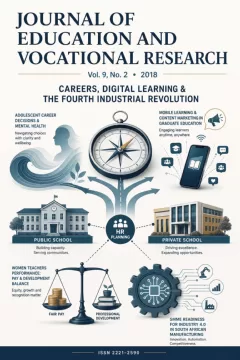 Vol. 9 No. 2 (2018)
Careers, Digital Learning & the Fourth Industrial Revolution
View issue contents
Published
Submissions
Have research to publish? Journal of Education and Vocational Research welcomes submissions.
Make a Submission