Abstract
Planning and management of curriculum and human resources in schools is precisely liable and precarious in nature. The present study addressed the matter while exploring the practices of educational planning and human resource management in public and private primary level schools in Punjab, Pakistan. The case studies of two public and private schools in Rawalpindi District of Punjab Province were conducted by interviewing the mangers and principles of private and public school respectively. The participant observations were also taken to substantiate the information provided by the respondents. The schools were selected on the basis of their reputation and high enrollment of the students. The findings of the study elaborated the differences in public and private schools with respect to educational planning and managing human resource. The public schools followed the standard curriculum designed by the Punjab text book board which is universal for all the public schools. The teachers are mostly on permanent position and experienced. Whereas in the private schools, international level curriculum is followed this differs from school to school. Every private school has their own curriculum which they followed according to the standard of the school. The manager of the school generally decides the nature of the curriculum and recruitment of the teacher on its own will and interests. The medium of instruction is English in private schools, while public school used both national and international language. As far as teacher competence is concern, the public school teachers are more experienced as compare to private schools as they are working at the same school for a longer time period due to which better able to manage various task in the school and also take part in educational planning. On the other hand, in private school, fresh and most of the time untrained young females are hired. For these employees, professional development and retention is very important for the managers. Selecting and recruiting new teacher is very tedious job as well as it also affects the student’s performances and achievements. It is indicated that the owner of the private school was in continues struggle and in apprehension of hiring, and retaining their staff by providing them extra bonuses and facilities at school, such as leaves, time flexibility, and reward etc.
Keywords
- Educational Planning Search this journal for Educational Planning (opens in a new tab)
- Management Search this journal for Management (opens in a new tab)
- Public School Search this journal for Public School (opens in a new tab)
- Private School Search this journal for Private School (opens in a new tab)
References
- Ahmad, I., Rauf, M., Rashid, A., Rehman, S. & Salam, M. (2013). Analysis of the Problems of Primary Education System in Pakistan: Critical Review of Literature. Academic Research International , 4(2), 324-331.
- Andarabi, Tahir, Jishnu Das. & Asim, K. (2002). The Rise of Private Schooling in Pakistan: Catering to the Urban Elite or Educating the Rural Poor? Mimeo, Kennedy School of Government, Harvard University
- Ball, D. L. (1990). Prospective elementary and secondary teachers’ understanding of division. Journal of Research in Mathematics Education , 21, 132-144.
- Coulson, A. (2003). How Markets Affect Quality: Testing the theory of market education against the international evidence. Paper presented at the Educational Freedom and Urban America:
- Hoodbhoy, P. (1998). Education and the State: Fifty Years of Pakistan, Oxford University Press, Pakistan.
- Malik, S. R. (1991). The System of Education in Pakistan. National Book Foundation, Islamabad, Pakistan, 1320.
- Qureshi, S. (2002). Decentralization to District Level. Ministry of Education, Islamabad, Pakistan, 31-40. Suleman, Q., Aslam, D. H., Shakir, M., Hussain, I. & Lodhi, A. M. (2012). Effectiveness of Educational Management System in Elementary and Secondary Education at District Level in Khyber Pukhtunkhwa (Pakistan). American Journal of Scientific Research , 75, 92-116.
- Zafar, M. (2003). Fiscal devolution in education. Case study reflecting initial responses, 34-41.
Downloads
No downloads have been recorded for this article yet. Figures appear here once readers begin downloading the full text.
How to Cite
Share this article
License
Copyright (c) 2019 Adeela Rehman (Author)

This work is licensed under a Creative Commons Attribution 4.0 International License.
Author (s) should affirm that the material has not been published previously. It has not been submitted and it is not under consideration by any other journal. At the same time author (s) need to execute a publication permission agreement to assume the responsibility of the submitted content and any omissions and errors therein. After submission of revised paper in the light of suggestions of the reviewers, the editorial team edits and formats manuscripts to bring uniformity and standardization in published material.
This work will be licensed under Creative Commons Attribution 4.0 International (CC BY 4.0) and under condition of the license, users are free to read, copy, remix, transform, redistribute, download, print, search or link to the full texts of articles and even build upon their work as long as they credit the author for the original work. Moreover, as per journal policy author (s) hold and retain copyrights without any restrictions.
Keywords
- Educational Planning Search this journal for Educational Planning (opens in a new tab)
- Management Search this journal for Management (opens in a new tab)
- Public School Search this journal for Public School (opens in a new tab)
- Private School Search this journal for Private School (opens in a new tab)
Section
Published in
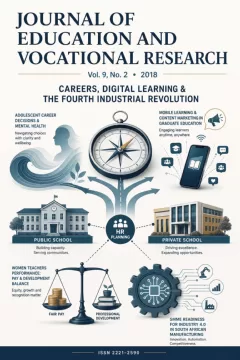 Vol. 9 No. 2 (2018)
Careers, Digital Learning & the Fourth Industrial Revolution
View issue contents
Published
Submissions
Have research to publish? Journal of Education and Vocational Research welcomes submissions.
Make a Submission