Abstract
Pakistan is a developing country and with the changing global trend, technological advancement and human development are taking place. As we know that training and development is a constant growing process which keeps improving the excellence of employees. In education sector training, development and continuous learning play an important role. Teachers spend their lives grooming our children, youth and shaping our generations. Education is the key element for the success of any society. But unfortunately, there are various reasons why the quality of learning and competency level in the Public sector is not up to the benchmark both for students and teachers in Pakistan. According to report 2015-16 of Pakistan education institution of statistics the total primary schools is 145829 of 145, in which is 125573 is public primary school. On the other hand, as per education statistics there are a total of 422,797 primary school teachers of which 324,561 (77%) represents the public sector With such a huge contribution of public schools, there is a great room of improvement for teacher particularly their educational capability to deliver, then only a gradual change can be seen in the long run. The aim of the study is investigating the relationship between training and development, work engagement and women public teachers’ performance. This study also examines compensation & benefits as a moderating variable. This study has used a total of 220 samples to analyze the data. The study has used Smart PLS and SPSS 22 statistical technique to analyze the data. This study used a quantitative method, in which data collected from working women (public school teachers) in Multan, Lodhran, Khanewal, and Vehari cities of the province Punjab in Pakistan. The findings have concluded that there is a significant relationship between training & development, work engagement and employee performance. However, compensation & benefits do not found to be a moderating variable. This research will be helpful for women public teacher’s related issue to training, work engagement, compensation, and benefits. The study recommends this problem could be resolved by considering some basic measures such as appropriate government policy for public teachers training and development, foolproof accountability system, education quality assessment. Injecting latest talent in the education system, international competitive pay scale, and merit-based transparent hiring process and believe that only education can change our children’s future.
Keywords
References
- Abdullah, H. (2009). Major Challenges to the Effective Management of Human Resource Training and Development Activities. The Journal of International Social Research , 2, 11–21.
- Abraham, S. (2012). Job satisfaction as an antecedent to employee engagement , SIES Journal of Management , 8(2), 27-36.
- Alan, M. & Saks (2019). Antecedents and consequences of employee engagement revisited, Journal of Organizational Effectiveness: People and Performance, 6(1), 19-38.
- Anitha, J. (2014). Determinants of employee engagement and their impact on employee performance. International Journal of Productivity and Performance Management , 63(3), 308–323.
- Copeley, L. (2015). Applicability of Works’ Compensation Acts to Mental Disabilities: The Plaintiffs Perspective.
- Cunningham, G. B. & Mahoney, K. (2004). Self-efficacy of part-time employees in university athletics: The influence of organizational commitment, valence of training, and training motivation. Journal of Sport Management, 18, 59-73.
- Deepa, E., Palaniswamy, R. & Kuppusamy, S. (2014). Effect of performance appraisal system in organizational commitment, job satisfaction and productivity. Journal of Contemporary Management Research , 8(1), 72.
- Diamantidis, A. D. & Chatzoglou, P. (2019). Factors affecting employee performance: an empirical approach. International Journal of Productivity and Performance Management , 68(1), 171-193.
- Farooq, M. S. & Kai, Y. T. (2017). Female Teacher Problems at Primary Level in Pakistan Administered Kashmir. International Online Journal of Primary Education , 6(1), 19–25.
- Feraro-Banta, L. & Shaikh, S. (2017). Relation of Compensation and enefits on Employees’ Performance: A Study of Audit Firms in Bahrain. International Advanced Research Journal in Science, Engineering and Technology , 4(5), 175–183.
- Fornell, C. & Larcker D. F. (1981). Evaluating structural equation models with unobservable variables and measurement error. Journal of Marketing Research , 18(1), 39–50.
- Hair, J. F., Black, W. C., Babin, B. J., Anderson, R. E. & Tatham, R. L. (2006). Multivariate Data Analysis: International Edition, 6th ed., Pearson Prentice-Hall, New Jersey.
- Hashami, M. F. (2016). The Main Problems of the Students at Primary Level in rural area of Tehsil: Ferozwala, District: Sheikhupura-Pakistan. International Journal of Education (IJE) , 4(1), 1–11.
- Franklin, D. K., Cowden, R. & Karodia, M. A. (2014). The Impact of Training and Development on Employee Performance: A Case Study of Escon Consulting. Singaporean Journal of Business Economics and Management Studies, 3(3), 72-105.
- Kenney, H. (1992). Management Made Easy, 1st ed. South Carolina: Omron Publishers
- Malhorta, N. K. (Eds) (2004). Marketing Research: An Applied Orientation, Pearson Prentice-Hall, Upper Saddle River.
- McMillan, H. J. & Schumacher, S. (2006). Research in Education: Evidence-Based Inquiry. Pearson Education Inc.
- Moncarz, E., Zhao, J. & Kay, C. (2009). An exploratory study of US lodging properties organizational practices on employee turnover and retention. International Journal of Contemporary Hospitality Management, 21(4), 437- 458.
- Nabi, M. N., Syduzzaman, M. & Munir, M. S. (2016). The Impact of Human Resource Management Practices on Job Performances: A Case Study of Dhaka Bank Pvt. Ltd., Bangladesh. Human Resource Management Research , 6(2), 45-54.
- Naris, S. N. & Ukpere, W. I. (2012). Evaluation of human resource development and training at a higher educational institution in Namibia. African Journal of Business Management , 6(49), 118-159.
- Nassazi, A. (2013). Effects of Training on Employee Performance: Evidence from Uganda. Business Economics and Tourism. University of Applied Sciences.
- Pakistan Education Statistics Report. (2015-16). National Education Management Information System Academy of Educational Planning and Management Ministry of Federal Education and Professional Training Government of Pakistan - February 2017.
- Sabir, R. I., Javed, S., Ahmad, W., Noor, N. & Munir, H. M. (2014). Assessing Customer Satisfaction Level of Transport Services Using SERVQUAL: A Case OF Daewoo Express, Pakistan. Journal of Basic Applied Science Research , 4(2), 207-213.
- Shariful Alam, M., Shahrani, A. S, Sahabuddin, M. & Akter, S. (2013). Relationship between Employee Recognition and Employee Contribution in Service Industry. International Journal of Business and Marketing Management , 1(1), 1- 8.
- Shem, J. M. & Ngussa, . M. (2015). Effect of Training on Employees’ Performance: A Case of Institutions of Higher Learning in Arusha City, Tanzania. International Journal of Science and Research , 6(10), 1924– 1930.
- Sultana, A., Irum, S. Ahmed, K. & Mehmood, N. (2012). Impact of Training on Employee Performance: A Study of Telecommunication Sector in Pakistan, Interdisciplinary Journal of Contemporary Research in Business , 4(6), 646-661.
- Van Dorsal, W. R. (1962). The successful supervisor. New York: Harper and Row.
- Zack, M., James, M. and Satyendra. S, (2009). Knowledge Management and Organizational Performance: An explanatory Analysis.
Downloads
No downloads have been recorded for this article yet. Figures appear here once readers begin downloading the full text.
How to Cite
Share this article
License
Copyright (c) 2019 Amir Saif, Maira Amir, Fawad Hussain (Author)

This work is licensed under a Creative Commons Attribution 4.0 International License.
Author (s) should affirm that the material has not been published previously. It has not been submitted and it is not under consideration by any other journal. At the same time author (s) need to execute a publication permission agreement to assume the responsibility of the submitted content and any omissions and errors therein. After submission of revised paper in the light of suggestions of the reviewers, the editorial team edits and formats manuscripts to bring uniformity and standardization in published material.
This work will be licensed under Creative Commons Attribution 4.0 International (CC BY 4.0) and under condition of the license, users are free to read, copy, remix, transform, redistribute, download, print, search or link to the full texts of articles and even build upon their work as long as they credit the author for the original work. Moreover, as per journal policy author (s) hold and retain copyrights without any restrictions.
Keywords
Section
Published in
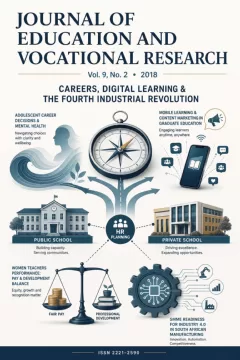 Vol. 9 No. 2 (2018)
Careers, Digital Learning & the Fourth Industrial Revolution
View issue contents
Published
Submissions
Have research to publish? Journal of Education and Vocational Research welcomes submissions.
Make a Submission