Abstract
The educational system in any country plays a vital role for the development and achieving infrastructural goals. Pakistan since last few decades is facing critical economic and developmental challenges. The nature of work conditions in public and private organizations are getting more intensified and employees are facing critical time in term of workload, job security and satisfaction issues. This study is aiming to investigate the relationship between job security and workload factors influencing teacher’s job satisfaction. This paper has use SMART-PLS-SEM to examine the data using quantitative research techniques. The study was conducted among 266 teachers. The teachers’ job satisfaction was determined by two separate measures namely the teacher’s job security and workload influencing teacher’s job satisfaction. This study was trigged as teachers in higher education institutions were facing challenges regarding their job security and workload. The outcome exposed that there is an important relationship among teachers job security, workload, and teacher job satisfaction. The effects of these factors call further research. There is prerequisite to carry out a similar but comparative study in rural settings. In addition, it is very important to comprehend the significance of teachers’ job satisfaction where the industry is so uncertain. There is a need to address job satisfaction and workload stress with appropriate assessment such as rating system and teachers’ satisfaction index evaluation according to the tasks and work pressure allocated to each and every teacher. This reach adds value to knowledge by making universities, institutes and colleges administration to know the causes of teachers’ uncomfortable zone regarding their job security and workload. Conversely, it is also important for the administration in these institutes to well understand the needs and demands of their teachers and what factors will contribute to their satisfaction.
Keywords
References
- Abdullah, A. & Ramay, I. M. (2012). Antecedents of organizational commitment of banking sector employees in Pakistan. Serbian Journal of Management, 7(1), 89-102.
- Akpan, C. P. (2013). Job security and job satisfaction as determinants of organizational commitment among university teachers in cross river state, Nigeria. British Journal of Education, 1(2), 82-93.
- Dogan, A. & Anıl, Ibrahim. (2016). The Comparison Of The Individual Performance Levels Between FullTime And Part-Time Employees: The Role Of Job Satisfaction. Procedia-Social and Behavioral Sciences, 235, 382-391.
- Bhatti, K., Cheema, F., Shaikh, A., Syed, N. A. & Bashir, R. (2014). Faceted and overall job satisfaction among university teachers: A case study of Laar Campus, Sindh University, Pakistan. Global Management Journal for Academic & Corporate Studies, 4(2), 137-146.
- Brkich, M., Jeffs, D. & Carless, S. A. (2002). A global self-report measure of person-job fit. European Journal of Psychological Assessment, 18(1), 43.
- Cheng, Y. C. (2002). The changing context of school leadership: Implications for paradigm shift. In Second international handbook of educational leadership and administration (pp. 103-132). Springer, Dordrecht.
- Chipunza, C. & Malo, B. (2017). Organizational culture and job satisfaction among academic professionals at a South African university of technology. Problems and Perspectives in Management, 15(2), 148-161.
- Çogaltay, N. & Karadag, E. (2016). The Effect of Educational Leadership on Organizational Variables: A Meta-Analysis Study in the Sample of Turkey. Educational Sciences: Theory and Practice, 16(2), 603-646.
- Dachapalli, P. L. & Parumasur, S. B. (2012). Employees susceptibility to experience job insecurity, south African Journal of Economic and management science, 15(1), 31-43.
- Davy, j. A., Kinicki, A. J. & Scheck, C. L. (1997). A test of job security direct and medicated effects on withdrawal cognition. Journal of organization Behaviour, 18(4), 224-249.
- Graham, M. W. & Messner, P. E. (1998). Principle and job satisfaction. International journal of educational Management, 12(5), 196-202.
- Hair, J., Black, W., Babin, B., Anderson, R. & Tatham, R. (2006). Multivariate data analysis (6th ed). Upper saddle River, N.J.: Pearson Prentice Hall.
- Hall, V. (1996). Dancing on the ceiling: A study of women managers in education. SAGE.
- Hameed, F., Ahmed-Baig, I. & Cacheiro-González, M. (2019). Job satisfaction of teachers from public and private sector universities in Lahore, Pakistan: A comparative study. Economics & Sociology, 11(4), 230–245.
- Iverson, R. D. (1996). Employee acceptance of organizational change: the role of organizational commitment. International Journal of Human Resource Management, 7(1), 122-149.
- Lankveld, T., Schoonenboom, J., Volman, M., Croiset, G. & Beishuizen, J. (2017). Developing a teacher identity in the university context: a systematic review of the literature. Higher Education Research & Development, 36(2), 325-342.
- Mueller, C. W., Boyer, E. M., Price, J. L. & Iverson, R. D. (1994). Employee attachment and no coercive conditions of work: The case of dental hygienists. Work and occupations, 21(2), 179-212.
- Nadim, M., Chaudhry, M. S., Kalyar, M. N. & Riaz, T. (2012). Effects of motivational factors on teachers' job satisfaction: A study on public sector degree colleges of Punjab, Pakistan. The Journal of Commerce, 4(4), 25-32.
- Noorshella C. N. & Muhammad Ismail. (2017). Job satisfaction among Academic staff, a case study in public universities of Malaysia, 11(3), 649-657.
- Oshagbemi, T. (1997). Job Satisfaction and dissatisfaction in Higher Education. Education + Training, 39(9), 354-359.
- Ostroff, C. (1992). The relationship between satisfaction, attitudes, and performance: An organization level analysis; Journal of Applied Psychology, 77(6), 963-974.
- Price, J. L. (1997). Handbook of organizational measurement. International journal of manpower, 18(4/5/6), 305-558.
- Raza, M. Y., Akhtar, M. W., Husnain, M. & Akhtar, M. S. (2015). The impact of intrinsic motivation on employee’s job satisfaction. Management and Organizational Studies, 2(3), 80-88.
- Singh, R. & Greenhaus, J. H. (2004). The relation between career decision-making strategies and person–job fit: A study of job changers. Journal of Vocational Behavior, 64(1), 198-221.
- Sverke, M., Hellgren, J. & Näswall, K. (2002). No security: a meta-analysis and review of job insecurity and its consequences. Journal of occupational health psychology, 7(3), 242.
- Waheed ul Haq. & Husnain, M. (2014). Level of job satisfaction of school teacher in private sector of Bahawalpur (Pakistan). Journal developing country studies, 4(9).
- Wiley, S. D. (2001). Contextual effects on student achievement: School leadership and professional community. Journal of Educational Change, 2(1), 1-33.
- Yee, L. C. (2018). An analysis on the relationship between job satisfaction and work performance among academic staff in Malaysian private universities. Journal of Arts & Social Sciences, 1(2), 64-73.
Downloads
No downloads have been recorded for this article yet. Figures appear here once readers begin downloading the full text.
How to Cite
Share this article
License
Copyright (c) 2019 Fawad Hussain, Amir Saif (Author)

This work is licensed under a Creative Commons Attribution 4.0 International License.
Author (s) should affirm that the material has not been published previously. It has not been submitted and it is not under consideration by any other journal. At the same time author (s) need to execute a publication permission agreement to assume the responsibility of the submitted content and any omissions and errors therein. After submission of revised paper in the light of suggestions of the reviewers, the editorial team edits and formats manuscripts to bring uniformity and standardization in published material.
This work will be licensed under Creative Commons Attribution 4.0 International (CC BY 4.0) and under condition of the license, users are free to read, copy, remix, transform, redistribute, download, print, search or link to the full texts of articles and even build upon their work as long as they credit the author for the original work. Moreover, as per journal policy author (s) hold and retain copyrights without any restrictions.
Keywords
Section
Published in
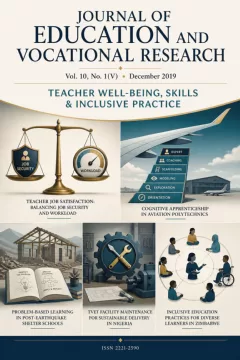 Vol. 10 No. 1(V) (2019)
Teacher Well-Being, Skills & Inclusive Practice
View issue contents
Published
Submissions
Have research to publish? Journal of Education and Vocational Research welcomes submissions.
Make a Submission