Abstract
Internships are a method of connecting learning in schools with actual work powered by experts in the field of work. Self-efficacy skills are very necessary in the world of work. Self efficacy is, a person's belief in carried out their duties. The research purpose determined the effect of cognitive apprenticeship on students self efficacy in Flight Polytechnics. The research method used ANOVA with the experimental and control groups, with 140 research subjects. The results showed the influence of cognitive apprenticeship on self efficacy. Self-efficacy ability is needed in the world of work, because it relates to one's success in doing work. Vocational education aims to prepare a skilled workforce. Internships are a means to bring students closer to the world of work. Soft skills in vocational education must be developed. The apprentice is able to bring the development of soft skills to students. Workers with self-efficacy skills are needed in the industrial era.
Keywords
References
- Bandura, A. (1977). Self-efficacy: Toward a unifying theory of behavioral change. Psychological Review, 84, 191-215.
- Cheah, S., li, S. & Ho, Y. P. (2019). Mutual Support, Role Breadth Self-E_cacy, and Sustainable Job Performance ofWorkers in Young Firms. Sustainability, 2-17.
- Collins, A. B. (1987). Cognitive Apprenticeship: Teaching the Craft of Reading, Writing, and Mathematics. Illinois: Universty of Illinois .
- Darabi, A. A. (2005). Application of Cognitive Apprenticeship Model to a Graduate Course in Performance Systems Analysis: A Case Study. ETR & D, 49–61.
- Davis, W. D., Fedor, D. B., Parsons, C. K. & Herold, D. M. (2000). The development of self eficacy during aviation training. Journal of Organizational Behavior, 857-871.
- Dennen, V. P. & Burner, K. J. (2008). The Cognitive Apprenticeship Model in Educational Practice. In J. M. Spector, M. D. Merrill, J. v. Merrienboer, & M. P. Driscoll, Handbook of Research on Educational Communications and Technology (3ed ed., pp. 425-440). New York: Routledge.
- Gavriel, J. (2015). Cognitive apprenticeship. Education for Primary Care, 422–423.
- Gessler, M. (2009). Situated Learning and Cognitive Apprenticeship. In R. Maclean, & D. Wilson, International Handbook of Education for the Changing World of Work: Bridging Academic and Vocational Learning (pp. 1611-1625). Jerman: Springer.
- Gist, M. E. (1987). Self-Efficacy: Implications for Organizational Behavior and Human Resource Management. The Academy of Management Review, 472-485 .
- Lisbona, A., Palaci, F., Salanova, M. & Frese, M. (2018). The Effects of Work Engagement and Self Efficacy on Personal Initiative and Performance. Psicothema, 89-96.
- Maritz, A. & Brown, C. R. (2013). Illuminating The Black Box of Entrepreneurship Education Programs. Education + Training, 5, 234-252.
- Potosky, D. (2010). Goal Orientation, Learning Self-Efficacy, and Climate Perceptions in a Post-acquisition Corporate Context. Human Resource Development Quarterly, 273-289.
- Ramey-Gassert, L., Shroyer, M. G. & Staver, J. R. (1996). A qualitative study of factors influencing science teaching self-efficacy of elementary level teachers. Science Education, 283-315.
- Reiser, B. J. & Tabak, I. (2014). Scaffolding. In R. K. Sawyer, The Cambridge Handbook of the Learning Sciences (pp. 44-62). New York: Cambridge University Press.
- Ritten, J. M., Boone, W. J. & Rubba, P. A. (2001). Development of an Instrument to Assess Prospective Elementary Teacher Self-Efficacy Beliefs about Equitable Science Teaching and Learning . Journal of Science Teacher Education, 175-198.
- Scunk, D. H. (1985). Self Efficacy and Classroom Learning. Psychology in the Schools, 208-223.
- Willemsen, E. W. & Gainen, J. (1995). Reenvisioning Statistics: A Cognitive Apprenticeship Approach. New Direction for Teachin and Learning, 99-108.
- Wolf, K. N. (1997). Predicting Positive Self-Efficacy in Group Problem Solving. Human Resource Development Quarterly, 155-169.
- Wood, R. E. & Locke, E. E. (1987). Self-efficacy: Implications for organizational behavior and human resource management. Academy of Management Review, 12, 472–485.
- Zhao, H., Seibert, S. E. & Hills, G. E. (2005). The Mediating Role of Self-Efficacy in the Development of Entrepreneurial Intentions. Journal of Applied Psychology, 90(6), 1265-1272.
Downloads
No downloads have been recorded for this article yet. Figures appear here once readers begin downloading the full text.
How to Cite
Share this article
License
Copyright (c) 2019 Setiyo, Yatim Riyanto, Luthfiyah Nurlaela (Author)

This work is licensed under a Creative Commons Attribution 4.0 International License.
Author (s) should affirm that the material has not been published previously. It has not been submitted and it is not under consideration by any other journal. At the same time author (s) need to execute a publication permission agreement to assume the responsibility of the submitted content and any omissions and errors therein. After submission of revised paper in the light of suggestions of the reviewers, the editorial team edits and formats manuscripts to bring uniformity and standardization in published material.
This work will be licensed under Creative Commons Attribution 4.0 International (CC BY 4.0) and under condition of the license, users are free to read, copy, remix, transform, redistribute, download, print, search or link to the full texts of articles and even build upon their work as long as they credit the author for the original work. Moreover, as per journal policy author (s) hold and retain copyrights without any restrictions.
Keywords
Section
Published in
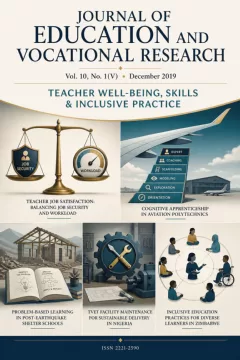 Vol. 10 No. 1(V) (2019)
Teacher Well-Being, Skills & Inclusive Practice
View issue contents
Published
Submissions
Have research to publish? Journal of Education and Vocational Research welcomes submissions.
Make a Submission