Abstract
After natural disasters, such as earthquakes, the community and schools’ conditions were uncontrolled and unconducive. Students could not carry out the learning process as before. Anxiety and fear came to students when in school. This study explained about the implementation of problem based learning on students at a shelter school after earthquake and the effect towards their learning outcomes. This study aimed to know the effect of problem-based learning on students’ learning outcomes after an earthquake happened. Problem based learning brought students closer to the problematic context. This research compared the effect of problem based learning as well as the conventional teaching on 2different groups from different emergency schools. The total number of the subject research was 120 students. The results of the study showed a positive influence on students’ learning outcomes. In the learning process of problem based learning, students were brought closer to real problems in their environment and fostered a sense of confidence.
Keywords
References
- Albanese, M. A. & Mitchell, S. (1993). Problem-based Learning: A Review of Literature on Its Outcomes and implementation Issues. Academic Medicine, 52-81.
- Allen, D. E., Donham, R. S. & Bernhardt, S. A. (2011). Problem-Based Learning. New Directions for Teaching and Learning, 21-29.
- Arends, R. I. (2009). Learning to Teach (9th Ed.). New York: McGraw-Hill.
- Colliver, J. A. (2000). Effectiveness of Problem-based Learning Curricula: Research and Theory. Academic Medicine, 259-266.
- Dochy, F., Segers, M., Bossche, P. V. & Gijbels, D. (2003). Effects of Problem-Based Learning: A Meta-Analysis from the Angle of Assessment. Learn Instr, 533–568.
- Gallagher, S. A., Sher, B. T., Stepien, W. J. & Workman, D. (1995). Implementing Problem-Based Learning in Science Classrooms. School Science and Mathematics, 95, 136-146.
- Gijbels, D., Dochy, F., Bossche, P. V. & Segers, M. (2005). Effects of Problem-Based Learning: A Meta-Analysis from the Angle of Assessment. Review of Educational Research, 27–61.
- Gijbels, D., Dochy, F., Bossche, P. V. & Segers, M. (2005). Effects of Problem-Based Learning: A Meta-Analysis from the Angle of Assessment. David Gijbels, 27–61.
- Hmelo-SilverEmail, C. E. (2004). Problem-Based Learning: What and How Do Students Learn? Educational Psychology Review, 235–266.
- Hun, W., Moallem, M. & Dabbagh, N. (2019). Social Foundations of Problem‐Based Learning. In M. Moallem, W. Hung, & N. Dabbagh, The Wiley Handbook of Problem‐Based Learning (pp. 51-80). Pondicherry: Wiley-Blackwell .
- Kilroy, D. A. (2004). Problem Based Learning. Emergency medicine journal, 21, 11–413.
- Konings, K. D., Wiers, R. W., Wiel, M. W. & Schmidt, H. G. (2005). Problem-Based Learning as a Valuable Educational Method for Physically Disabled Teenagers? The Discrepancy between Theory and Practice. Journal of Developmental and Physical Disabilities, 107-117.
- McParland, M., Noble, L. M. & Livingston, G. (2004). The Effectiveness of Problem-Based Learning Compared to Traditional Teaching in Undergraduate Psychiatry. Medical Education, 859–867.
- Norman, G. R. & Schmidt, H. G. (2003). Effectiveness of Problem-Based Learning Curricula: Theory, Practice and Paper Darts. Medical Education, 721-728.
- Norman, G.& Schmidt, H. (1992). The Psychological Basis of Problem-Based Learning: A Review of the Evidence. Academic Medicine, 557-565.
- Savery, J. R. (2018). Overview of Problem-Based Learning: Definitions and Distinctions. Wisconsin: University of Wisconsin-Platteville.
- Schunk, D. H. (2011).Learning Theories: An Educational Perspective (6th Ed.). Boston: Pearson.
- Selçuk, G. S. (2010, Juni). The effects of problem-based learning on pre-service teachers’ achievement, approaches and attitudes towards learning physics. International Journal of the Physical Sciences, 5(6), 711-723.
- Swaak, J., Jong, T. D. & Joolingen, W. R. (2004). The Effects of Discovery Learning and Expository Instruction on the Acquisition of Definitional and Intuitive Knowledge. Journal of Computer Assisted Learning, 225-234.
- Zakaria, E., Chin, L. C. & Daud, M. Y. (2010). The Effects of Cooperative Learning on Students’ Mathematics Achievement and Attitude towards Mathematics. Journal of Social Sciences, 6(2), 272-275.
Downloads
No downloads have been recorded for this article yet. Figures appear here once readers begin downloading the full text.
How to Cite
Share this article
License
Copyright (c) 2019 Hujair Faizan, Siti Masitoh, Bachtiar S. Bachri (Author)

This work is licensed under a Creative Commons Attribution 4.0 International License.
Author (s) should affirm that the material has not been published previously. It has not been submitted and it is not under consideration by any other journal. At the same time author (s) need to execute a publication permission agreement to assume the responsibility of the submitted content and any omissions and errors therein. After submission of revised paper in the light of suggestions of the reviewers, the editorial team edits and formats manuscripts to bring uniformity and standardization in published material.
This work will be licensed under Creative Commons Attribution 4.0 International (CC BY 4.0) and under condition of the license, users are free to read, copy, remix, transform, redistribute, download, print, search or link to the full texts of articles and even build upon their work as long as they credit the author for the original work. Moreover, as per journal policy author (s) hold and retain copyrights without any restrictions.
Keywords
Section
Published in
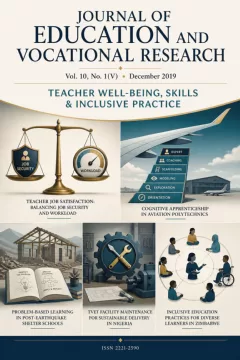 Vol. 10 No. 1(V) (2019)
Teacher Well-Being, Skills & Inclusive Practice
View issue contents
Published
Submissions
Have research to publish? Journal of Education and Vocational Research welcomes submissions.
Make a Submission