Abstract
This qualitative study examined the competency of in-service teachers in inclusive education in Zimbabwe. A purposive sample of 15 graduate in-service special needs education teachers selected from one state university participated in the study. Semi structured interviews were used to collect data. Thematic analysis was used to analyse data. The study established that for most of the teachers, the in service training fairly managed to prepare them adequately to teach in an inclusive class. It was also found from the study that most teachers interviewed are knowledgeable in identifying children with special needs. Peer tutoring and interaction groups were common methods of teaching. It was also reported that lack of resources and lack of support from other teachers were major challenges impeding teachers from meeting the needs of the learners in inclusive setting. The study further revealed that extensive training on use of individual educational program is needed during training. The study recommends that teachers be evaluated on all relevant competences during teaching practise which could enhance the professional development of in-service teachers in inclusive education. Another recommendation is that micro teaching strategy be used to fine tune the teachers skills in teaching in an inclusive classes.
Keywords
References
- Agbenyega, J. & Deku, P. (2011). Building new Identities in Teacher Preparation for Inclusive Education in Ghana. Current Issues in Education.
- Atta, M., Shah, M. & Khan, M. (2006). Inclusive School and Inclusive Teacher. University of Peshawar.
- Bruns, D. & Mogharreban, C. (2009). The Gap between Beliefs and Practices: Early Childhood practitioners' perceptions about inclusion. Taylor & Francis online.
- Bukvic, Z. (2014). Teacher competency for inclusive Education. The European Journal of Social and Behavioural Science, (R)ISSN, 2301-2218.
- Carroll, A., Forlin, C. & Joblin, A. (2003 ). The impact of teacher training in special education on the attitudes of Australian pre-service general educators towards people with disabilities. Teacher Education Quarterly, 30, 65-79.
- Cate, P., Markova, I. & Krischler, M. (2018). Promoting inclusive Education: The Role of teachers’ competence and attitudes. Insights into Learning Disabilities, 15(1), 49-63.
- Creswell, J. (2013 ). Research design; Qualitative, quantitative and mixed method approaches. Sage Publications.
- Crick, R. (2008). Key Competences for Education in a European Context: Narrative of Accountability or Care. European Educational Research Journal, 7(3).
- Desimone, L. & Garet, M. S. (2015). Best practice in teachers’professional development in the United States. Psychology, Society and Education.
- Dingle, M., Falvey, M., Givner, C. & Haager, D. (2004). Essential Special and General Education teacher competences for preparing Teachers for Inclusive Settings. In Issues in Teacher Education, 13(1), 35-50.
- Dyson, A. & Squires, G. (2016). Early school learning and learners with disabilities and /or special educational needs. European Agency for Special Needs & Inclusive Education.
- Eredics, N. (2018). Inclusion in Action,. Baltimore: Brooks Publishing Company.
- Flecha, R. & Soler, M. (2013). Turning difficulties into possibiities: Engaging Roma families and students in school through dialogic learning. Cambridge Journal of Education - Taylor and Francis online.
- Florian, L. (2012). Preparing teachers to work in Incusive Classrooms: Key lessons for the professionlal development of Teacher Educators from Scotland. Sage: Journal of Teacher Education.
- Forlin, C. (2010). Reframing Teacher Education for Inclusion. In C. Forlin, Teacher Education for Inclusion; Changing paradigms and Innovative approaches, 3-12.
- Kigen, J. (2017). Teacher Competencies in Implementation of Curriculum for learners with special needs in Kenyan Schools. IOSR Journal of Research & Method in Education.
- Kusuma, A. & Ramdevi, K. (2013). Inclusive Education- Teacher Competences. Shanlax International journal of Education, 1(3), 2320-2653.
- Kuyini, A. (2016). Ghananian teachers competences perceived as important for inclusive education. . International Journal of Inclusive Education.
- Kuyini, A. & Desai, I. (2008). ProvidinInstruction to students with special needs in Inclusive Classrooms in Ghana: Issues and Challenges. International journal of whole schooling, 4.
- Kuyini, A. & Mangope, B. (2011). Student Teachers’attitudes and concerns about inclusive education in Ghana and Botswana. International Journal of Whole Schooling, 7.
- Majoko, T. (2019). Teacher key competencies for Inclusive Education: Tapping pragmatic Ralities to Zimbabwean Special Needs Education. Sage.
- Mcmillan, J. H. & Schumacher, S. (2010). Research in Education. Evidence-Based Inquiry, 7th Edition. Virginia Commonwealth University.
- Musengi, M. & Chireshe, R. (2012). Inclusion of Deaf Students in mainstream rural primary schools: Challenges and opportunities. Studies of Tribes and Tribal.
- Naicker, J. (2008). Educators' preparedness for Inclusive Education (Doctoral dissertation). Education Resources Information Centre.
- Oddome, F. (2016). Self efficacy: A booster for pedagogical Innovation. Journal of E-learning and knowledge Society, 12(3).
- Osamwoyi, E. (2016). In service of Teachers: Overview, Problems and the way forward. Ekiadolor-Benin: Tayo Akpata University of Education.
- Selvi, K. (2010). Teachers' Competencies. Cultura International Journal of Philosophy of Culture and Axiology.
- Theron, C. & Pasha, N. (2015). Cultural Pathways to Resilience: Opportunities and Obstacles as recalled by Black South African Students. Dordrecht. Springer.
- Wang, M. (1984). Effective Special Education in Regular Classes. Remedial and Special Education; Sage, 5(6).
- Watkins, P. (2012). Teacher Education for Inclusion; A Profile of Inclusive Teachers. European Agency for Development in Special Needs.
- Yin, R. (2014). Case Study Reasearch Design and Methods: 5th Ed. Thousand Oaks: Sage.
Downloads
No downloads have been recorded for this article yet. Figures appear here once readers begin downloading the full text.
How to Cite
Share this article
License
Copyright (c) 2019 Patricia Muvirimi (Author)

This work is licensed under a Creative Commons Attribution 4.0 International License.
Author (s) should affirm that the material has not been published previously. It has not been submitted and it is not under consideration by any other journal. At the same time author (s) need to execute a publication permission agreement to assume the responsibility of the submitted content and any omissions and errors therein. After submission of revised paper in the light of suggestions of the reviewers, the editorial team edits and formats manuscripts to bring uniformity and standardization in published material.
This work will be licensed under Creative Commons Attribution 4.0 International (CC BY 4.0) and under condition of the license, users are free to read, copy, remix, transform, redistribute, download, print, search or link to the full texts of articles and even build upon their work as long as they credit the author for the original work. Moreover, as per journal policy author (s) hold and retain copyrights without any restrictions.
Keywords
Section
Published in
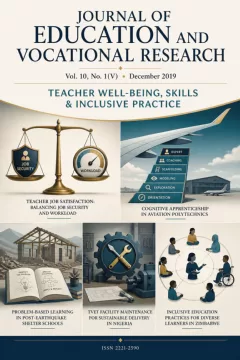 Vol. 10 No. 1(V) (2019)
Teacher Well-Being, Skills & Inclusive Practice
View issue contents
Published
Submissions
Have research to publish? Journal of Education and Vocational Research welcomes submissions.
Make a Submission