Abstract
The aim of this study was to ascertain the university brand model that characterizes postgraduate student choice of ZCAS University. The brand model comprises brand attributes that attract postgraduate students to the university, the information sources they consult, who influences their decisions and what makes the university unique. The study was qualitative in design, while sampling of research participants was done purposively. Three focus group discussions involving seventeen first years part time and open distance e-learning postgraduate students, and five semi-structured interviews with marketing and recruitment staff at ZCAS University were used to collect data on the brand model. Thematic analysis and content analysis were then used as the primary data analysis techniques. Results of the study revealed that reputation, teaching quality, student support, fees and facilities were the top five ZCAS University brand traits that underpin postgraduate students’ choice of the university. With respect to competitive advantage, facilities, teaching quality reputation and accreditations are perceived to be the university’s primary unique characteristics. The study further identified friends, self, workmate and family as the greatest influencers of postgraduate student choice of the university; while websites, social media, print media and television are believed to be the most consulted information sources by prospective postgraduate students.
Keywords
- University Brand Search this journal for University Brand (opens in a new tab)
- Information Sources Search this journal for Information Sources (opens in a new tab)
- Postgraduate Search this journal for Postgraduate (opens in a new tab)
- Influencers Search this journal for Influencers (opens in a new tab)
- ZCAS University Search this journal for ZCAS University (opens in a new tab)
- Competitive Advantage Search this journal for Competitive Advantage (opens in a new tab)
References
- Al Shobaki, M. J. & Abu Naser, S. S. (2017). The Role of the Practice of Excellence Strategies in Education to Achieve Sustainable Competitive Advantage to Institutions of Higher Education-Faculty of Engineering and Information Technology at Al-Azhar University in Gaza A Model. International Journal of Digital Publication Technology, 135-157.
- Ali-Choudhury, R., Bennet, R. & Savani, S. (2009). University marketing directors’ views on the components of a university brand. Int Rev Public Nonprofit Mark, 6, 11-33.
- AL-Mutairi, A. & Saeid, M. (2016). Factors affecting students’ choice for MBA program in Kuwait Universities. International Journal of Business and Management, 11(3), 119-128.
- Ancheh, K. S., Krishnan, A. & Nurtjahja, O. (2007). Evaluative criteria for selection of private universities and colleges in Malaysia. Journal of International Management Studies, 2(1), 1-11.
- Badwan, J. J., Al Shobaki, M. J., Abu Naser, S. S. & Abu Amuna, Y. M. (2017). Adopting Technology for Customer Relationship Management in Higher Educational Institutions. International Journal of Engineering and Information Systems, 20-28.
- Blackburn, G. (2011). Which Master of Business Administration (MBA)? Factors influencing prospective students’ choice of MBA programme - an empirical study. Journal of Higher Education Policy and Management, 33, 473–483.
- Bryman, A. & Bell, E. (2011). Business Research Methods (3rd ed.). New York: Oxford University Press.
- Carter, S. & Yeo, A. (2009). My place or yours? Perceptions of, and selection choice criteria for, higher education institutions: the case of UK and Malaysian students. International Journal of Economics and Business Research, 1(2), 165-190.
- Central Statistical Office and Zambia Information and Communications Technology Authority. (2018, January 5). National Survey on Access and Usage of Information and Communication Technologies by Households and Individuals. Retrieved January 5, 2020, from Zambia Information and Communications Technology Authority: https://www.zicta
- Chaguluka, C., Beharry-Ramraj, A. & Amolo, J. (2018). International postgraduate students’ perceptions of service quality. Problems and Perspectives in Management, 438-448.
- Chapleo, C. (2010). What defines “successful” university brands? International Journal of Public Sector Management, 23(2), 169-183.
- Chiu, R. & Stembridge, A. (1999). How do full-time employees select part-time MBA programs in Hong Kong? SAM Advanced Management Journal, 64(2), 34-39.
- Cvetkoska, V. (2019). Key Factors Influencing Students’ Choice of University for Postgraduate Studies Abroad: A Multicriteria Decision Model. Journal of Contemporary Economic and Business Issues, 6(1), 31-43.
- Dibb, S., Simkin, L., Pride, W. M. & Ferrell, O. C. (2006). Marketing Concepts and Strategies (5th ed.). Boston: Houghton Mifflin.
- Furey, S., Springer, P. & Parsons, C. (2014). Positioning University as a Brand: Distinctions between the Brand Promise of Russell Group, 1994 Group, University Alliance, and Million+ Universities. Journal of Marketing for Higher Education, 24(1), 99–121.
- Galan, M., Lawley, M. & Clements, M. (2015). Social media's use in postgraduate students' decision-making journey: an exploratory study. Journal of Marketing for Higher Education, 25(2), 287-312.
- Ganushchak-Yefimenko, L., Shcherbak, V. & Nifatova, O. (2017). Managing a Project of Competitive-integrative Benchmarking of Higher Educational Institutions. Eastern-European Journal of Enterprise Technologies, 38-46.
- Grzeda, M. & Miller, G. (2009). The effectiveness of an online MBA program in meeting mid-career student expectations. The Journal of Educators Online, 6(2), 1-16.
- Hemsley-Brown, J. & Oplatka, I. (2006). Universities in a competitive marketplace – A systematic review of the literature on higher education marketing. International Journal of Public Sector Management, 19(4), 316–338.
- Hemsley-Brown, J. & Oplatka, I. (2015). University choice: what do we know, what don’t we know and what do we still need to find out? International Journal of Educational Management, 29, 254–274.
- Higher Education Authority. (2019). Ensuring Quality in Higher Education. Retrieved October 26, 2019, from Higher Education Authority Web Site: https://www.hea.org.zm/
- Higher Education Authority. (2019, October 26). Ensuring Quality in Higher Education. Retrieved October 26, 2019, from Higher Education Authority: https://www.hea.org.zm/
- Ivy, J. (2008). A new higher education marketing mix: the 7Ps for MBA marketing. International Journal of Educational Management, 22(4), 288-99.
- Kayombo, K. M. (2014). The Identification, Measurement and Competitive Positioning of a Higher Education Institution Brand in Zambia: The Case of the Zambia Centre for Accountancy Studies (ZCAS). Edinburgh: Heriot-Watt University.
- Kayombo, K. M. & Carter, S. (2016). Understanding student preferences for university choice in Zambia. Journal of Education Policy, Planning & Administration, 6(3), 1-21.
- Khalifa, B., Dukhan, O. & Mouselli, S. (2017). Master degree under crisis: the salient motives of Business students to enroll in a postgraduate programme. International Journal of Educational Management.
- Kusumawati, A. (2010). Privatisation and Marketisation of Indonesian public universities: a systematic review of student choice criteria literature. Indonesian Student International Conference, Melbourne, Australia. Melbourne.
- Lee, N. & Lings, I. (2013). Doing Business research: A Guide to Theory and Practice. London: Sage Publications Ltd.
- Liu, D. & Morgan, W. J. (2015). Students’ Decision-Making about Postgraduate Education at G University in China: The Main Factors and the Role of Family and of Teachers. Asia-Pacific Edu Res, 325–335.
- Lomer, S., Papatsiba, V. & Naidoo, R. (2018). Constructing a National Higher Education Brand for the UK: Positional Competition and Promised Capitals. Studies in Higher Education, 134-153.
- Marks, J. & Edgington, R. (2006). Motivations and barriers for women in the pursuit of an MBA degree. Graduate Management Admission Council, 1, 6-12.
- Mihail, D. & Elefterie, K. (2006). Perceived effects of an MBA degree on employability and career advancement: The case of Greece. Career Development International, 11(4), 352-361.
- Moogan, Y. J. (2018). An investigation into international postgraduate students’ decision-making process. Journal of Further and Higher Education.
- Mvunga, C. (2019, March 6). Zambia to have 96% of universal coverage of both internet and communication facilities.
- Nicholls, J., Harris, J., Morgan, E., Clarke, K. & Sims, D. (1995). Marketing higher education: the MBA experience. The International Journal of Educational Management, 9(2), 31-38.
- Nyaribo, M., Prakash, A. & Owino, E. (2012). Motivators of choosing a management course: A comparative study of Kenya and India. The International Journal of Management Education, 10, 201–214.
- Ries, A. & Trout, J. (2001). Positioning: The Battle for Your Mind. New York: McGraw-Hill.
- Robson, C. (2002). Real World Research (2nd ed.). Oxford: Blackwell.
- Rydzewski, D., Eastman, J. & Bocchi, J. (2010). Important characteristics in an MBA program: The perceptions of online MBA students. American Journal of Business Education, 3(4), 33-41.
- Saiti, A., Papa, R. & Brown, R. (2017). Postgraduate students’ factors on program choice and expectation. Journal of Applied Research in Higher Education, 9, 407–423.
- Saunders, M., Lewis, P. & Thornhill, A. (2016). Research Methods for Business Students. Essex: Pearson Education Limited.
- Soilemetzidis, I., Bennett, P. & Leman, J. (2014, October 19). The Postgraduate Taught Experience Survey.
- Soliman, M. & Karia, N. (2017). Antecedents for the Success of the Adoption of Organizational ERP among Higher Education Institutions and Competitive Advantage in Egypt. Engineering, Technology & Applied Science Research, 1719-1724.
- Songan, P., Sam, H. K., Tonga, G., Rahman, M. A. & Wah, T. K. (2010). Factors Influencing Student Choice: A Study of a Malaysian Public University. Asian Journal of University Education, 6(1), 75-89.
- Towers, A. & Towers, N. (2018). Re-Evaluating The Postgraduate Students’ Course Selection Decision Making Process In The Digital Era. Studies In Higher Education, 47(2), 2-11.
- Vrontis, D., Thrassou, A. & Melanthiou, Y. (2007). Contemporary higher education student-choice model for developed countries. Journal of Business Research, 60(9), 979-989.
- Wiese, M., van Heerden, N., Jordaan, Y. & North, E. (2009). A marketing perspective on choice factors considered by South African first-year students in selecting a higher education institution. Southern African Business Review, 13(1), 39-60.
- Yamane, T. (1967). Statistics: An Introductory Analysis (2nd ed.). New York: Harper and Row.
- Zambia Statistics Agency. (2019, November 24). Key Indicators. Retrieved from Zambia Statistics Agency: https://www.zamstats.gov.zm/
- ZCAS University. (2017). ZCAS University Strategic Plan 2018 – 2021. Lusaka: ZCAS University.
- Zhu, L. & Reeves, P. (2019). Chinese students’ decisions to undertake postgraduate study overseas. International Journal of Educational Management, 33, 999–1011.
Downloads
No downloads have been recorded for this article yet. Figures appear here once readers begin downloading the full text.
How to Cite
Share this article
License
Copyright (c) 2020 Kelvin Mukolo Kayombo, Gwebente Mudenda, Burton Mweemba, Janis Nduli (Author)

This work is licensed under a Creative Commons Attribution 4.0 International License.
Author (s) should affirm that the material has not been published previously. It has not been submitted and it is not under consideration by any other journal. At the same time author (s) need to execute a publication permission agreement to assume the responsibility of the submitted content and any omissions and errors therein. After submission of revised paper in the light of suggestions of the reviewers, the editorial team edits and formats manuscripts to bring uniformity and standardization in published material.
This work will be licensed under Creative Commons Attribution 4.0 International (CC BY 4.0) and under condition of the license, users are free to read, copy, remix, transform, redistribute, download, print, search or link to the full texts of articles and even build upon their work as long as they credit the author for the original work. Moreover, as per journal policy author (s) hold and retain copyrights without any restrictions.
Keywords
- University Brand Search this journal for University Brand (opens in a new tab)
- Information Sources Search this journal for Information Sources (opens in a new tab)
- Postgraduate Search this journal for Postgraduate (opens in a new tab)
- Influencers Search this journal for Influencers (opens in a new tab)
- ZCAS University Search this journal for ZCAS University (opens in a new tab)
- Competitive Advantage Search this journal for Competitive Advantage (opens in a new tab)
Section
Published in
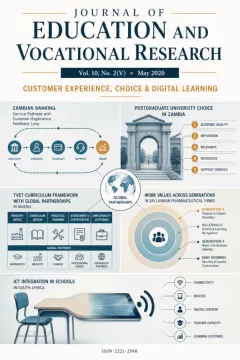 Vol. 10 No. 2(V) (2019)
Customer Experience, Choice & Digital Learning
View issue contents
Published
Submissions
Have research to publish? Journal of Education and Vocational Research welcomes submissions.
Make a Submission