Abstract
Despite the recent emphasis on the quality of education for all in South Africa, the department of education still faces major challenges that hinder the progress of implementing quality education, especially in rural areas. Consequently, this study followed an action qualitative method. The overall purpose of the study was to determine the influence of ICT integration in on the quality of teaching and learning in the classroom and to further examine the benefits of using ICT to enhance personal growth, individual performance, critical thinking skills reading and writing skills. The research questions were semi-structured and open-ended. The researcher interviewed nine (9) learners and seven (7) teachers in a two-session focus group, the first session involved only teachers and the last session had only grade, 12 learners. The themes of the sessions were documented separately; however, the relationship between the themes was identified. The study also performed an observation in the classroom to access situations that would have been almost impossible to identify in an interview or a questionnaire. Results showed that a lot still needs to be done by the government to initiate the process of integrating ICT in education or empower teachers with ICT skill and to do away with the traditional teaching method. The study, however, concluded on the positive influence of ICT integration on teaching and learning practices in the classroom for both teachers and learners. Consequently, the study recommends the following: government must provide training and incentives to encourage personal development in teachers and for young graduates to value teaching; policies about lost equipment must be drafted and understood by all parties; deployments of technology innovation, as well, as the imperatives of following the recommendation of UNESCO’s four stages of ICT integration.
Keywords
- Information Communication Technology (ICT) Search this journal for Information Communication Technology (ICT) (opens in a new tab)
- ICT Integration Search this journal for ICT Integration (opens in a new tab)
- Action Qualitative Method Search this journal for Action Qualitative Method (opens in a new tab)
- Educational Intervention Search this journal for Educational Intervention (opens in a new tab)
- South Africa Search this journal for South Africa (opens in a new tab)
References
- Asika, N. & Awolusi, O. D. (2013). Modelling Critical Success Factors of Business Process Re-Engineering and Business Performance of Nigerian Oil and Gas Companies, International Journal of Services and Operations Management, 15(1), 28–43.
- Asikhia, U. O. & Awolusi, O. D. (2015). Assessment of Critical Success Factors of Business Process Reengineering in the Nigerian Oil and Gas Industry, South African Journal of Business Management, 46(2), 1-14.
- Asrar-ul-Haq, M. & Kuchinke, K. P. (2016). Impact of leadership styles on employees’ attitude towards their leader and performance: Empirical evidence from Pakistani banks, Future Business Journal, 2(1), 54-64.
- Awolusi, O. D. (2013a). Effects of motivation on employee job commitment in the Nigerian banking industry: an empirical analysis, International Journal of Business and Innovation Research, 1(3), 1–17.
- Awolusi, O. D. (2013b). The effects of total quality management on customer service management in the Nigerian banking industry: an empirical analysis, International Journal of Management and Network Economics, 3(1), 57–77.
- Awolusi, O. D., Mbonigaba, J. & Tipoy, C. K. (2018). Mineral resources endowment and economic growth in Southern African countries, International Journal of Diplomacy and Economy, 4(1), 59–79.
- Awolusi, O. D. & Atiku, O. S. (2019). Business Process Re-Engineering and Profitability in the Nigerian Oil and Gas Industry: The Mediating Influence of Operational Performance, Information Management and Business Review, 11(3), 13-26.
- Awolusi, O. D. (2019). Human Capital Development and Economic Growth in BRICS Countries: Controlling for Country Differences, Journal of Economics and Behavioral Studies, 11(4), 1-17.
- Agudo, J. E. & Sánchez H. (2005). Development and implantation of an adaptive hypermedia system for young learners. Euro-call Conference. Cracow, Poland.
- Archer, J. (2014). The Outcome-Based Curriculum Initiatives.
- Barak, M. & Dori, Y. J. (2009). Enhancing higher-order thinking skills among in-service science teachers via embedded assessment. Journal of Science Teacher Education, 20(1), 459-474.
- Brush, T., Glazewski, K. D. & Hew, K. F. (2008). Development of an instrument to measure preservice teachers’ technology skills, technology beliefs, and technology barriers. Computers in the Schools, 25(1), 112-125.
- Burns, N. & Grove, S. K. (2000). The practise of nursing research: Conduct, critique & utilization. 4th edition. Philadelphia: WB Saunders.
- Corey, S. M. (1953). Action research to improve school practice’. New York: Teachers college, Columbia University.
- Department of Education. (2003). White Paper on e-Education. Transforming Learning and Teaching through Information and Communication Technologies’. Pretoria: Department of Education.
- De Vos, A. S. (1998). Research at grassroots. 1st edition. Pretoria: JL van Schaik
- Chisholm, L. (2003). The Politics of Curriculum Review and Revision in South Africa.
- Department of Basic Education (DBE) Republic of South Africa. (2010). Delivery agreement for outcome.
- DBE Republic of South Africa. (2011a). NEIMS (National Education Infrastructure Management System) reports May 2011.
- DBE Republic of South Africa. (2011b). Report on the Annual National Assessments of 2011.
- Eze, T. O. & Awolusi, O. D. (2018). Effect of Critical Factors on Expatriate Assignment Performance in the Nigerian Oil and Gas Sector, Global Journal of Interdisciplinary Social Sciences, 7(2), 6-19.
- Faggella-Luby, M. & Deshler, D. (2008). Reading comprehension in adolescents with LD: What we know; what we need to learn, in Learning Disabilities Research and Practice, 23(2), 70-78.
- Fredrickson, G. M. (1981). White Supremacy. New York, New York: Oxford University Press.
- Jansen, J. D. (1998). Essential alterations? A critical analysis of the states syllabus revision process, Perspectives in Education, 17(2), 1-11.
- Hartshorne, K. B. (1992). Crisis and Challenge: Black Education 1910-1990. Cape Town: New York: Oxford University Press, 1992.
- Haugland, S. W. (1998). The best development software for young children. Early childhood education journal, 25(1), 247-254.
- Kallaway, P. (1984). Apartheid and Education: The Education of Black South Africans. Johannesburg: Ravan Press, 1984.
- Koc, M. (2011). Implications of learning theories for effective technology integration and preservice teacher training: A critical literature review, Journal of Turkish Science Education, 2(1), 2-18.
- Meenakshi, P. G. (2013). Importance of ICT in Education. Journal of Research & Method in Education, 1(2), 468-493.
- Olaofe, I. A. (2005). Nigerian educational emancipation: a roadmap from crisis to resurgence. Faculty of Education Seminar Series, No. 1. Ahmadu Bello University, Zaria.
- Oladejo, M. J. & Awolusi, O. D. (2018). Effect of Work-Family Role Conflicts on Employees Commitment and Organizational Performance: A study of AKLAD Interlink concept, Nigeria, Global Journal of Commerce and Management Perspective, 7(2), 81-96.
- Rampersad, C. A. (2011). Teachers ‘perceptions of the Contribution of Information and Communication Technology To The Teaching of Modern Studies, Using An Integrated System, In An Urban Secondary School (Doctoral dissertation, The University of the West Indies).
- Tapscott, D. (1998). Growing up digital: The rise of the Net generation, New York: McGraw-Hill.
- Pitan, O. S. & Muller, C. (2019a). University reputation and undergraduates self-perceived employability: mediating influence of experiential learning activities, Higher Education Research & Development, 38(6), 1269-1284.
- Pitan, O. S. & Muller, C. (2019b). Students’ self-perceived employability (SPE): Main effects and interactions of gender and field of study, Higher Education, Skills and Work-Based Learning, Vol. 10(2), 355-368.
- Polit, D. F. & Hungler, B. P. (1997). Essentials of nursing research: Methods, appraisals and utilisation. 4th edition. Philadelphia: Lippincott-Raven Publishers.
- Roos, G. (2005). Educational Plan Implementation Strategy, Supporting Documentation. Gauteng On-Line (GoL), 21.
- Shafika, I. J. (2007). Survey of ICT and education in Africa: South Africa Country Report.
- WEF. (2015). The Global Information Technology Report.
Downloads
No downloads have been recorded for this article yet. Figures appear here once readers begin downloading the full text.
How to Cite
Share this article
License
Copyright (c) 2020 Meladi, O. Makgati, Olawumi D. Awolusi (Author)

This work is licensed under a Creative Commons Attribution 4.0 International License.
Author (s) should affirm that the material has not been published previously. It has not been submitted and it is not under consideration by any other journal. At the same time author (s) need to execute a publication permission agreement to assume the responsibility of the submitted content and any omissions and errors therein. After submission of revised paper in the light of suggestions of the reviewers, the editorial team edits and formats manuscripts to bring uniformity and standardization in published material.
This work will be licensed under Creative Commons Attribution 4.0 International (CC BY 4.0) and under condition of the license, users are free to read, copy, remix, transform, redistribute, download, print, search or link to the full texts of articles and even build upon their work as long as they credit the author for the original work. Moreover, as per journal policy author (s) hold and retain copyrights without any restrictions.
Keywords
- Information Communication Technology (ICT) Search this journal for Information Communication Technology (ICT) (opens in a new tab)
- ICT Integration Search this journal for ICT Integration (opens in a new tab)
- Action Qualitative Method Search this journal for Action Qualitative Method (opens in a new tab)
- Educational Intervention Search this journal for Educational Intervention (opens in a new tab)
- South Africa Search this journal for South Africa (opens in a new tab)
Section
Published in
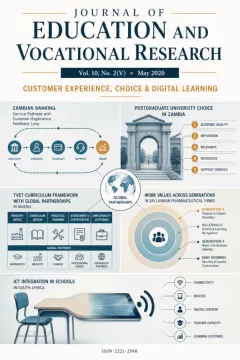 Vol. 10 No. 2(V) (2019)
Customer Experience, Choice & Digital Learning
View issue contents
Published
Submissions
Have research to publish? Journal of Education and Vocational Research welcomes submissions.
Make a Submission