Articles

  • Article 1 in this issue

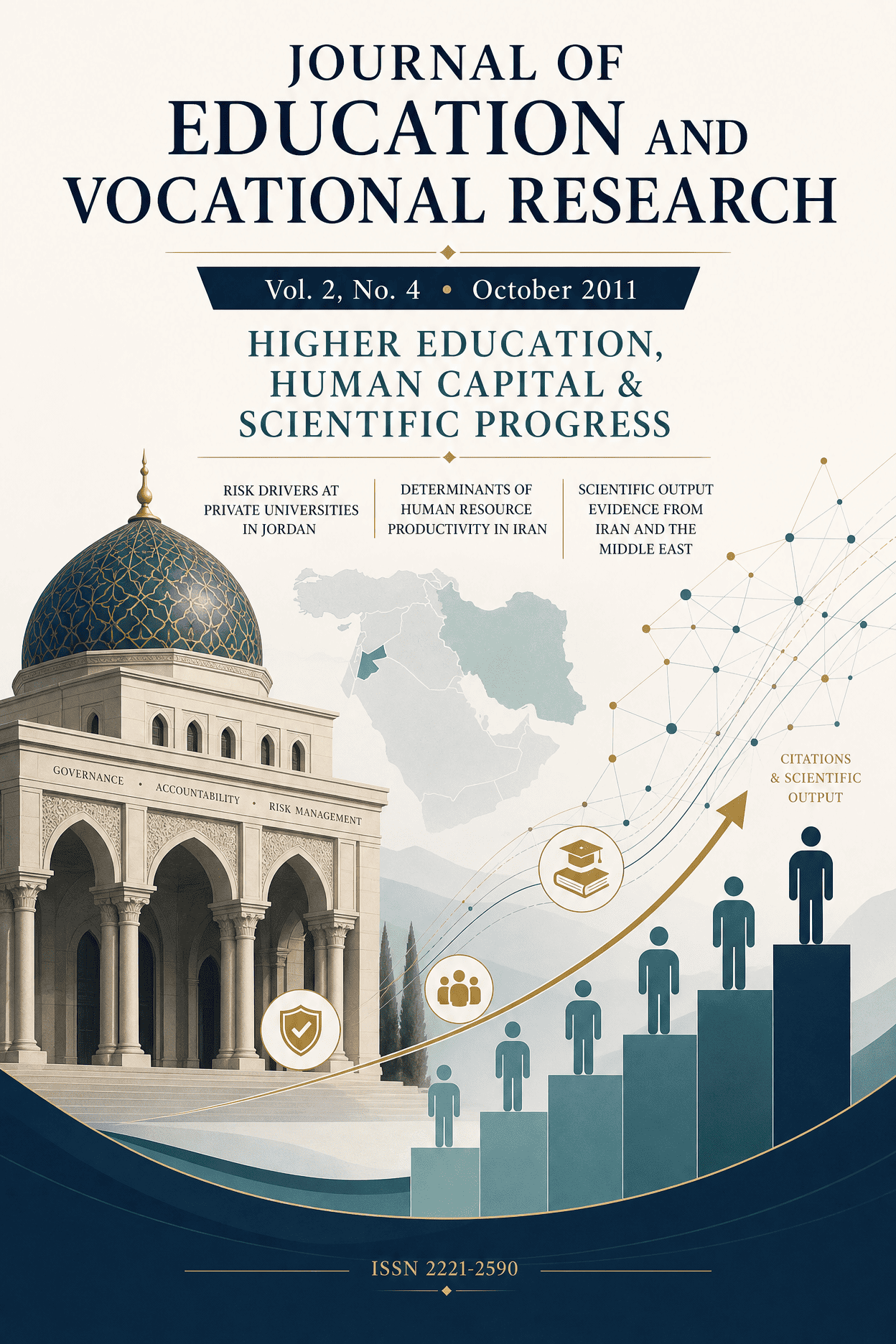
    The Impeding Drivers of Risks at Private Higher Education Institutions in Jordan: An Analytical Approach

    • Author: Hala Abdulqader Sabri

    This study provides an in depth assessment of the main drivers of risk impeding private higher education institutions in Jordan. The study adopts an analytical approach that incorporates reviewing available literature and conducting interviews and discussions with some shareholders and board of trustees' members in addition to faculty members and students of private universities. The analysis revealed that although private universities in Jordan are making progress and provide important contributions to the economy, however, they face important strategic and operational risks in addition to other compliance, financial and reputational risks. These risks include educational delivery systems, quality of academic programs, executive management, competition, and utilization of new technologies, compliance with accrediting agencies, financial issues, societal perception, students' violence, and demographic challenges. The study concludes that private universities need to place risk management plans to effectively deal with the all risk indicators analyzed in the study. Recommendations on how to implement a risk management plan are also presented and highlighted.

    Pages 120-131

    PDF - The Impeding Drivers of Risks at Private Higher Education Institutions in Jordan: An Analytical Approach (opens in a new tab)
  • Article 2 in this issue

    Determinants of Human Resource Productivity in Iran

    • Author: Mokhtari Mehran, Motiee Reza

    According to the modern growth theory, the accumulation of human capital is an important contributor to economic growth. Investment in human resources and educating and training human force to learn different skills to advance the production process can improve the production quality and leads to efficient use of material capital and optimum utilization of them through improving the skill and proficiency of the workforce, making them efficient and increasing capabilities. The results of the studies on the role of Human resources in economic growth from 1966 up to now show that the better utilization of workforce, effective utilization of capitals and physical equipments, using the best skilled expert workforce, utilization of advanced equipments and machinery with advanced technologies and the proficiency of more efficient and desired resources of production factors improves the economic growth of Iran. This research show that Iran’s economy, with 6% growth potential, hopes for improving the skill of human resources, labors and experts to change the current economic growth rate of 4.5% to over 8%.

    Pages 132-137

    PDF - Determinants of Human Resource Productivity in Iran (opens in a new tab)
  • Article 3 in this issue

    Scientific Output: Evidence from Iran and the Middle East

    • Author: Ahmad Jafari Samimi, Hoda Rezaei Roshan

    Scientific output is one of the most important determinants of economic development in every country. The process of economic growth and social development is entirely related to the count of scientific output in different countries. The purpose of the present paper is to examine the scientific output in Iran and compare it to selected Middle Eastern countries. Our findings indicate that not only scientific output in Iran increased during 1996-2009 but this country presented the fastest-growing rate in the world in the last 5 years of this period. The best performance of Iran has been in the field of engineering and ranked first in Middle East. Also, in other fields this country performance has been by far better than the average of the region. The interesting point regarding the Iranian performance is that at the beginning of this period the scientific output of Iran has been much less than countries such as Egypt and even Saudi Arabia in the region. Iran ranked 22nd in 20 in the World and if maintains its current trend it will soon be among the first 10 countries in the World.

    Pages 138-142

    PDF - Scientific Output: Evidence from Iran and the Middle East (opens in a new tab)