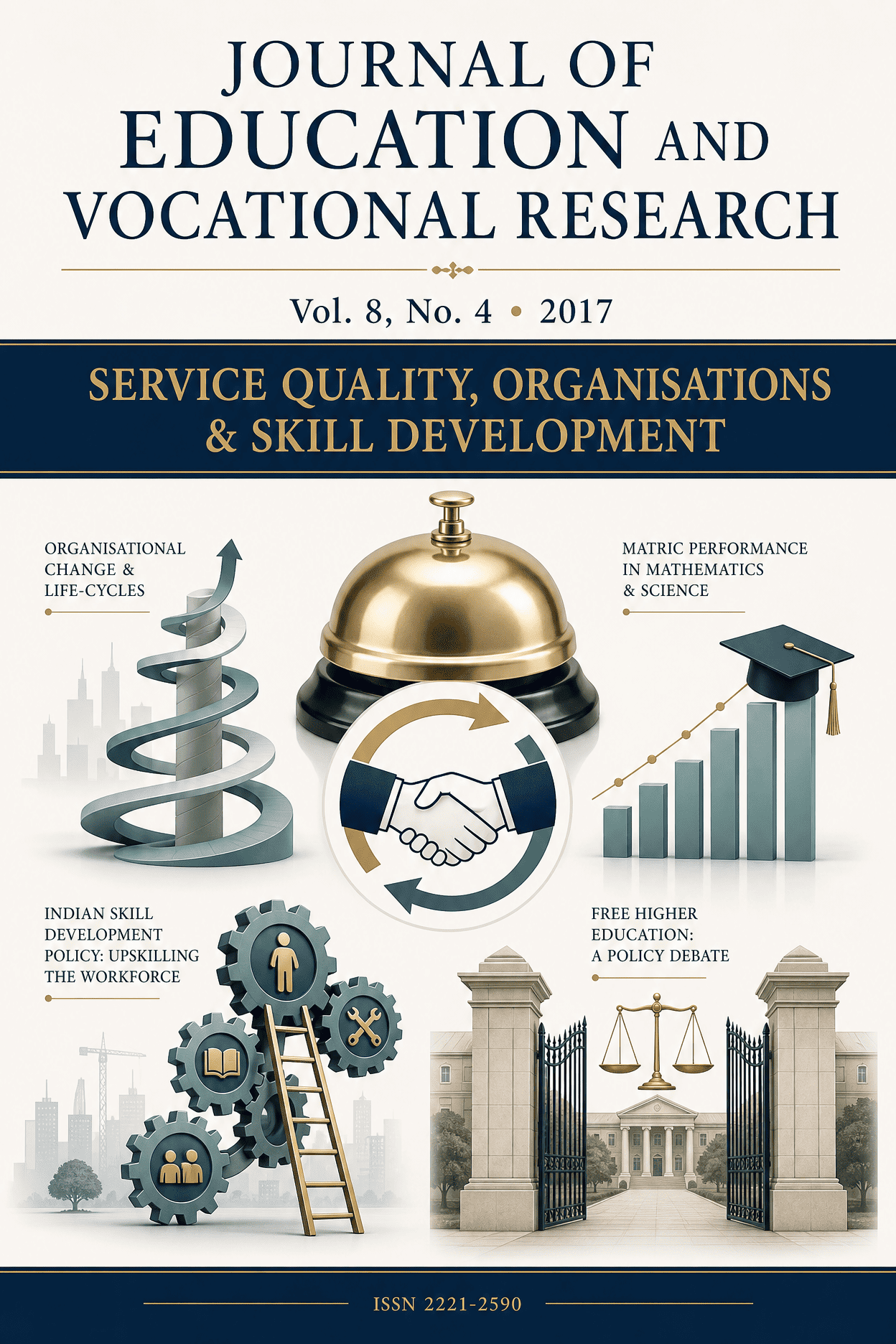
Articles

  • Article 1 in this issue

    Impact of service quality on Loyalty & Mediating role of Trust: An empirical investigation of Restaurants

    • Author: Fiza Amjad, Sajjad Ahmad Baig, Khalid Jamil, Asma Amjad

    S tudy was conducted to investigate the relationship between service quality, trust and loyalty. The trust is mediating between service quality and loyalty. Service quality provided to the customer is responsibility of the restaurants. Using a convenient sampling data was collected from consumers. Service quality positively associated with trust and loyalty and trust is also positively linked with loyalty and mediates the relationship between service quality and loyalty according to our finding. This article helps the organizations to understand the importance of service quality provide and how consumers become loyal to the organization. Customer retention is higher and profitability is greater for the business over the long period of time.

    Pages 6-14

    PDF - Impact of service quality on Loyalty & Mediating role of Trust: An empirical investigation of Restaurants (opens in a new tab)
  • Article 2 in this issue

    Understanding Corporate Life-Cycles

    • Author: Ousanee Sawagvudcharee, Maurice Yolles, Gerhard Fink, Paul Iles, Chanchai Bunchapattanasakda, Buncha Limpabandhu

    This paper considers the nature of the dominant corporate paradigm, its change, failures or successes, and its relationship with the homeostatic organization. There is a popular way of understanding the dynamics of organizational change and that is through the pre-configured sequence of stages in a corporate life-cycle. Through there are a number of competing models for this kind of analysis. In all of them, the sequence of stages is defined by that which configures the life-cycle deterministically. However, there is little discussion given for how these models of organizations shift between stages, and none appear to dominate in the literature. A major criticism of these models is that they do not represent complex organizational processes of change. Therefore, this paper represents an alternative model, called “the paradigm life-cycle”, which is connected to the homeostatic processes that maintain an organization, and which is, in principle, capable of generating corporate life-cycles under conditions of complexity.

    Pages 15-27

    PDF - Understanding Corporate Life-Cycles (opens in a new tab)
  • Article 3 in this issue

    The Effect of Mathematics and Physical Science on Matriculants’ Overall Performances: Analysis Using Multilevel Model

    • Author: ME Letsoalo

    This comparative, cross-sectional, quantitative and ex-post-facto designed study used secondary and correlated data to compare the likelihood of passing matric between learners from Gauteng and Western Cape provinces, even after adjusting for subject-type. This study attempted to assess the relation between school resources input, subject offered, learner’s gender and learners’ academic achievements. The data used in this study were supplied by the Umalusi Council. The dataset contained 145783 matric learners (65245 [44.75%] males and 80538 [55.25%] females) who wrote the matric examinations in Gauteng and Western Cape provinces in November 2009. The unadjusted model indicated that learners in Western Cape were significantly 1.193 more likely to pass matric than learners in Gauteng province (p < 0.001, OR = 1.193, 95%CI: 1.164 - 1.223). The adjusted model results indicated that learners in the Western Cape province were 1.5122 more likely to pass matric when compared to learners in Gauteng province (p < 0.001, OR = 1.512, 95%CI: 1.471 - 1.555). These results indicate that the odds of passing matric, after adjusting for science subjects, increased in favour of learners in the Western Cape Province. It can be concluded that the Western Cape Province provides more enabling conditions to ensure matriculants’ superior performance. It is suggested the strategies to improve the quality of mathematics and science educators need to be implemented, especially in Gauteng province. Also, the policy that advocates for the differentiation approach should be adopted, as opposed to the current policy that advocates for a more general, rigid approach that does not recognise the inherent differences in the provinces.

    Pages 28-42

    PDF - The Effect of Mathematics and Physical Science on Matriculants’ Overall Performances: Analysis Using Multilevel Model (opens in a new tab)
  • Article 4 in this issue

    Skill Development Policies in India: Implications and Challenges

    • Author: Harshil Sharma

    India which is moving through ‘demographic dividend’ and wants to achieve tag of ‘knowledge based economy’ need to invest in skill formation and developing educated and skilled workforce. This article will begin by broad overview of education and critical evaluation of current skill development policies at school and vocational level. There would be a brief discussion on role played by private sector in training of workforce in India and what are challenges faced by employers and employees and where lies the conflict of interest. After that in concluding section the major problems will be combined together to come out with the broad basic reason for the failure of such policies and conclude by scrutinizing what can be done in future to bridge the gap between educated and employed. Policy approach to skill development is supply driven and less attention is paid to demand side factors. Study recommends creating national training funds which can be used to collect levies from organized and large firms to be used for skill development of the informal sector. Levy based financing can help in solving problem of free rider and moral hazard as is held by the private sector. Study also recommends making vocational education compulsory from 8th standard and bridging the wide gap that exists in Indian labor market between ‘educated’ and ‘employable’.

    Pages 43-50

    PDF - Skill Development Policies in India: Implications and Challenges (opens in a new tab)
  • Article 5 in this issue

    The Provision of Free Higher Education in South Africa: A Proper Concept or a Parable?

    • Author: Halalisani Victor Mlambo, Mduduzi Hlongwa, Mandla Mubecua

    The provision of free-higher education is one of the most debated issues in South Africa today. The issue of free-higher education has drawn many commentators from sectors such as the media, business and within the political dominions. The main argument is where will the money to fund free-higher education will come from, whether the provision of free-higher education in South Africa is a proper concept or just a parable and also the terms of reference with regards to the provision of free-higher education in the country. By strictly examining the available and relevant literature on the concept of free-higher education in South Africa, the study was able to comprehensively understand the dynamics, implications and probability of providing free-higher education. Infrastructure challenges and economic growth are undoubtedly the major factors hindering the country from providing free-higher education, and unfortunately, with the government already forging ahead with implementing free-higher education without a proper and extensive feasibility study, the hasty implementation of free-higher education will have devastating implications for growth and service delivery in the country.

    Pages 51-61

    PDF - The Provision of Free Higher Education in South Africa: A Proper Concept or a Parable? (opens in a new tab)