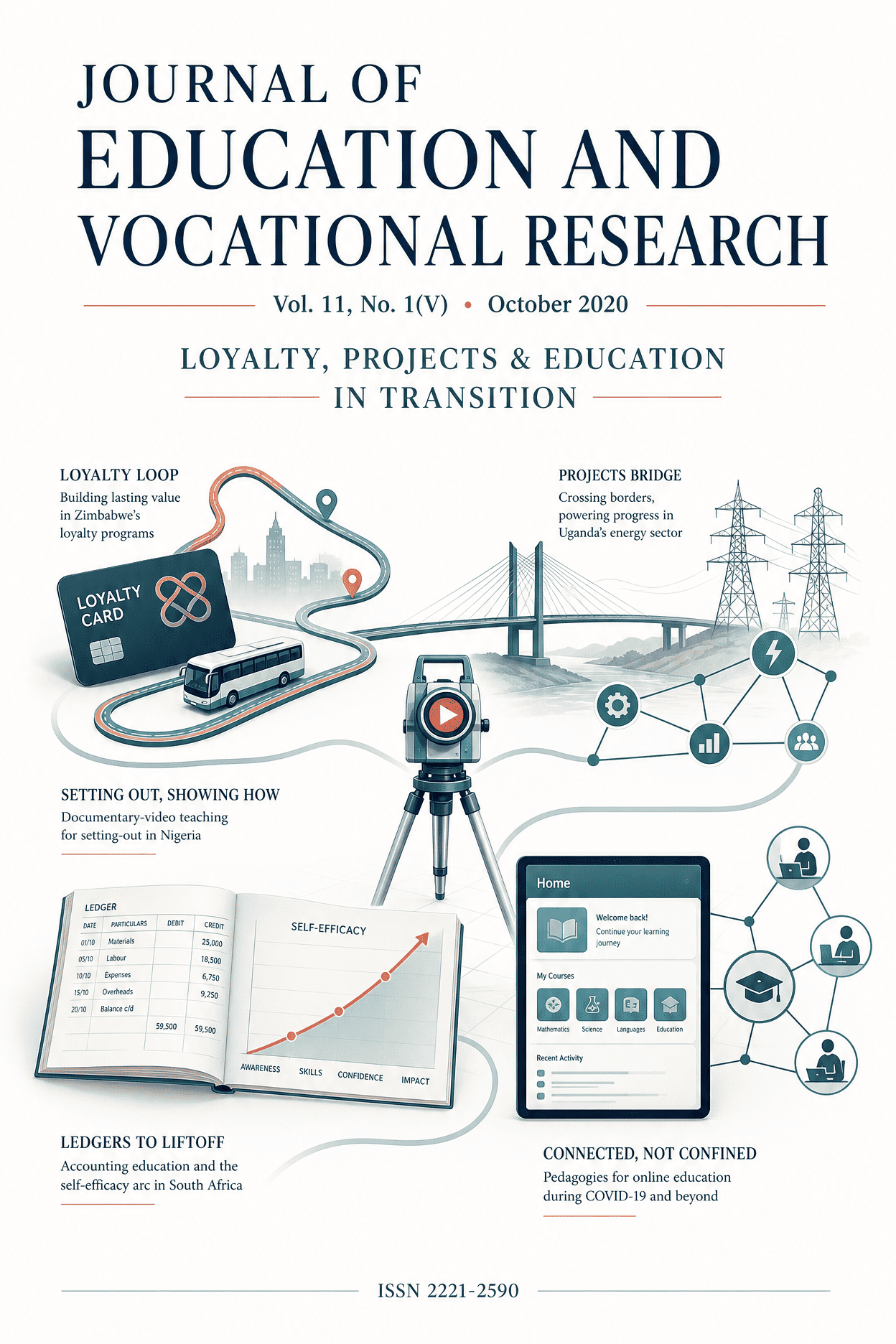
Articles

  • Article 1 in this issue

    Systematic Review of COVID Spillover and Online Education Pedagogy

    • Author: Haroon Aziz, Samina Malik, Abdul Ahad, Umair Javed

    This paper has touched one of the most critical area affected due to pandemic situation created by the COVID-19 and its powerful spillover effect on education sector by customizing education pedagogy. Earlier researchers have studied online education separately, whereas this paper discussed the natural transition and systematic review of upsurge of e-learning. The objective of this paper is to make the systematic review of COVID spillover and transition towards e-learning education pedagogy through theoretical framework. The study makes systematic review of switchover towards e-learning and spillover effect of COVID-19 and customization of the education pedagogy. In this study, past literature has been utilized to make critical analysis of spillover effect of COVID-19 and impact on education pedagogy by creation of prepositions. The findings of the study reveal that in the exceptional circumstances of COVID-19, e-learning transition has taken place from conventional to e-learning modules. All over the world, countries have shifted towards online education by schooling out but classes in campaign ignited by Chinese government. The same has also been replicated in other countries of the world during COVID-19.

    Pages 1-4

    PDF - Systematic Review of COVID Spillover and Online Education Pedagogy (opens in a new tab)
  • Article 2 in this issue

    Loyalty Programs for the Passenger Transportation Industry: A Study of Zimbabwean Companies

    • Author: Farium Kautsiro, Olawumi D. Awolusi

    The paper examined firstly whether companies in the passenger transportation industry have utilised loyalty programs and then ascertained how much value the companies have drawn from them in enhancing market share, operational efficiency and financial benefit. Specifically, the study assessed the influence of loyalty program on customer relationship management, operational efficiency and profitability. The research was undertaken on ten companies who have implemented some form of loyalty programs through applied research’s in-depth interviews with the top executives. The qualitative methodology was utilised to simplify and manage the collection of data without affecting the environment and context. Data collected were further analysed via Chi-square statistics and the three hypotheses were tested at 5% level of significance. The results indicate that companies have begun to utilise loyalty programs in their operations, though not entirely sweating the programs to attain the best possible value from them. Most importantly, the study concluded on the positive significant relationship between loyalty program and customer relationship management, operational efficiency and profitability in the Zimbabwe loyalty program. Both filled a few highlighted gaps in the literature. Research for the road passenger transportation sub-sector offers useful theoretical and managerial implications as few studies have been conducted for the airline industry, which has successfully implemented loyalty programs through frequent flier schemes. It is recommended that companies should ascertain passenger behaviour through passenger registration, thereby enhancing the sustainability of the relationship. This study provides theoretical support for the importance of loyalty programs as passenger relationship management tools if appropriately applied and implemented. Loyalty programs offer companies across industrial sectors with useful benefits such as brand loyalty, business efficiency due to enhanced planning and profitability due to increase in patronage from passengers who are less sensitive to the marketing efforts of competing brands. This knowledge should, therefore, enable transporters to ascertain the value of adopting and using loyalty programs appropriately thereby enhancing their competitive advantage in a fast-paced world economy.

    Pages 5-22

    PDF - Loyalty Programs for the Passenger Transportation Industry: A Study of Zimbabwean Companies (opens in a new tab)
  • Article 3 in this issue

    The Integration of General Education in the Academic Programme to Enhance the Self-Efficacy of Accounting Students at a South African University

    • Author: S.K. Naidoo, S. Govender

    The purpose of this paper is to investigate the impact of General Education in enhancing the Selfefficacy of Cost and Management Accounting (CMA) students to assess whether Self-efficacy, is having any positive influence on the students’ academic performance. The research design for this paper was descriptive, longitudinal and a mixed-methods approach. The nature of the quasi-experimental approach that was used in the current paper is a non-equivalent pre-test and post-test control group design. The target population was CMA students. A census survey was conducted. Findings, which were analysed with the aid of descriptive statistics, indicate a significant correlation in the post-test (Self-efficacy) scores of the group that undertook the General Education Modules and not the group that did not undertake the General Education Modules. This paper recommends the implementation of General Education skills into the curriculum and a model to measure Self-efficacy of students. Moreover, these skills appear to be very poor amongst current learners and respondents believed that Self-efficacy could have a positive effect on the academic performance of learners.

    Pages 23-43

    PDF - The Integration of General Education in the Academic Programme to Enhance the Self-Efficacy of Accounting Students at a South African University (opens in a new tab)
  • Article 4 in this issue

    The Impact of Cross-Cultural Differences on Project Performance: A Study of Power Sector Development Operation and Electricity Sector Development Project in Uganda

    • Author: Gubala Fredrick, Olawumi D. Awolusi

    The purpose of this research was to establish a relationship between people’s cultural attributes, multinational project management processes, project technologies and project performance in Uganda’s energy sector concerning the practice during the implementation of the Power Sector Development Operation (PSDO) and Electricity Sector Development Project (ESDP) as case studies. The study employed a comprehensive survey design which mostly quantitative thus requiring the collection and analysis of data. It tangled both analytical and descriptive research designs. The research targeted 136 project beneficiaries or ‘project clients’ spread across the various target areas. The simple random sampling method was employed. Data compiled was reviewed to fill any gaps for incompleteness and inconsistency. This was to make ensure the exactness of the material provided acquired from the participants, through the continued reviews and comments provided by the Supervisor. Data was re-organized and software called the Statistical package. For social scientists (SPSS) was used to enter the data and analyze it, the results indicated a strong positive correlation people’s cultural attributes and project performance, multinational project management processes and project performance and between project technologies and project performance(r = .535 p ≤ 0.01, r = .758 p ≤ 0.01 and r = .656** p ≤ 0.01) correspondingly. It was concluded that people’s culture attributes, multinational project management and project technologies are pre-requisites for effective project performance in the Power Sector Development Operation Project and Electricity Sector Development project in Uganda and that Project technologies are a better predictor of project performance. The suggestion or recommendation for project managers to ensure that they progress implementation of their projects, peoples culture attributes, multinational project management and project technologies need to be enhanced through training of project staff and effective involvement of the communities.

    Pages 44-63

    PDF - The Impact of Cross-Cultural Differences on Project Performance: A Study of Power Sector Development Operation and Electricity Sector Development Project in Uganda (opens in a new tab)
  • Article 5 in this issue

    Effects of the use of Documentary Videos in Teaching Setting-out in Nigerian Secondary Schools

    • Author: M. A. Auta, M. Giwa

    The purpose of the study was to determine the effect of the use of documentary videos in teaching setting-out in Nigerian secondary schools. One research question and one hypothesis guided the study. The study adopted Quasi-experimental research design. The population for the study was 16 ST 1 students from Government Technical Training School, Jalingo offering Building Construction subject. There was no sampling. The instrument for data collection was Setting-out Test (ST) developed by the researcher. The instrument was validated by three experts. Test re-test was used to establish the reliability of the instrument and a reliability coefficient of 0.83 and 0.87 was obtained for the traditional and documentary video teaching methods respectively. The ST 1 students were arranged in intact groups, A and B; treatment was given to the two groups. Group a students were taught using the traditional method while Group B students were taught using the documentary video. A Pre-Test and Post-test was administered on the two groups under examination condition. The data obtained were analyzed using mean, standard deviation for research question and analysis of covariance (ANCOVA) for the hypothesis. Findings from the study indicated that students taught Setting-out with documentary videos performed better than those taught with the traditional teaching method; and there was a significant difference in the performance of students taught Setting-out with documentary video and those taught with traditional teaching method. Based on the findings some recommendations were made.

    Pages 64-67

    PDF - Effects of the use of Documentary Videos in Teaching Setting-out in Nigerian Secondary Schools (opens in a new tab)