Abstract
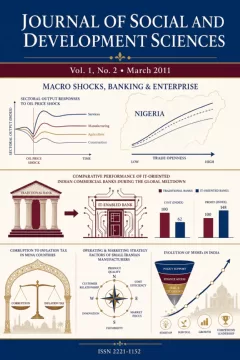
This study investigated the relative effectiveness of trade and policy shocks on sectoral output growth in a small open Nigerian economy. It is a country-specific, time series study verifies whether there is difference in the effect of sectoral output response to policy shocks in Nigeria. A CVAR model was specified to assess the effects of policy shocks on real aggregate and sectoral output measures. The model included oil price shock and an interactive term of trade openness as measures of supply and external shocks to the economy. The empirical results showed that there was remarkably difference in sectoral output responses to policy distortion. The effects of monetary policy shocks were positive and significant on manufacturing, service and industrial sector while fiscal policy shock was only significant and positive on agricultural output growth. The result further showed that international oil price shock and trade openness had pronounced negative effects on both sectoral and aggregate outputs. In addition, oil and trade openness’ negative effects overwhelmed the positive effects of fiscal and monetary policy shocks. The policy implication of the finding is that the effectiveness of domestic macroeconomic policy is constrained by the external shocks from both oil price and trade openness. Thus, confirming the open economic version of policy ineffectiveness proposition of the New classical macroeconomic in Nigeria
Keywords
- Trade Openness Search this journal for Trade Openness (opens in a new tab)
- Oil Price Shocks Search this journal for Oil Price Shocks (opens in a new tab)
- Macroeconomic Policy Shocks Search this journal for Macroeconomic Policy Shocks (opens in a new tab)
- Real Output Growth Search this journal for Real Output Growth (opens in a new tab)
References
- Aitken, B. and Harrison, A. (1999). Do Domestic Firms Benefit from Direct Foreign Investment? Evidence from Venezuela. American Economic Review, 89: 605-618.
- Ajisafe, R. O. and Folorunso, B. A. (2001). The Relative Effectiveness of fiscal and monetary policy in macroeconomic management in Nigeria. The Nigerian Economic and Financial Review, 6(1): 147-161.
- Apergis, N. and Miller, S. (1998). Macroeconomic Rationality and Lucas’s misconception Model: Further Evidence from Forty-one Countries. A Paper presented at the 45th Atlantic conference, Rome Italy.
- Asogu, J. O. (1998). An economic Analysis of the Relative Potency of Monetary and fiscal policy in Nigeria. CBN Economic and Financial Review, 36(2): 30-65.
- Bernanke, B. S. and Blinder, A. S. (1992b). The Federal Funds rate and the channel of Monetary policy transmission. American Economic Review , 82: 901-921.
- Blanchard, O. J. and Gali, J. (2007). Real Wage Rigidities and the New Keynesian Model. Journal of Money, Credit, and Banking , 39(1): 35-66.
- Bryant, R., Henderson, D., Holtham, G. P. and Symansky, S. (1988). Empirical Macro Economics for Independent Economies, Brookings Institution, Washington, DC.
- Burement H. and Dogan, B. (2001). Openness and the Efficiencies of Monetary Policy Evidence from Turkey. Applied Economic letter, 4: 217-221.
- Dale, S. and Haldane, G. (1995). Interest rates and the channels of monetary transmission: Some sectoral estimates. European Economic Review , 39: 1611–1626.
- Dennis, R. (2001). Monetary policy and Exchange rates in small open Economies. FRBSF Economic Letter Issue, 16 1-164.
- Ekpo, A. H. (1995). Openness and Economic growth in Nigeria: Proceedings of the Annual Conference of Nigeria Economic Society.
- Friedman, B. and Kuttner, K. (1992). Money, income, prices, and interest rates. American Economic Review , 82: 472–492.
- Ganley, J. and Salmon, C. (1996). The industrial impact of monetary policy, Bank of. England Quarterly Bulletin, 3: 288–98.
- Gauger, J. and Enders, W. (1989). Money neutrality at aggregate and sectoral level. Southern Economic Journal , 55(3): 676-680.
- Gertler, M. and Gilchrist, S. (1994). Monetary policy, business cycles and the behaviour of Small manufacturing firms. Quarterly Journal of Economics, 109: 309-40.
- Guncavdi, O. and Kucukcifci, S. (2001). Foreign trade and factor intensity in an open developing country: an input-output analysis for Turkey. Russian and East European Finance and Trade , 37(1): 75–88.
- Karras, G. (1999a). Openness and the effect of monetary policy. Journal of International Money and Finance, 18: 13-26.
- Karras, G. (1999b). Monetary Policy and the exchange rate: The role of Openness. International Economic Journal , 13(2): 75-88.
- Lane, P. R. (2000). Asymmetric shocks and Monetary Policy in a Currency Union. Scandinavian Journal of Economics, 102: 585- 604.
- Levine, R. and Renelt, D. (1992). A sensitivity Analysis of cross country growth regressions. American Economic Review, 82(4): 942-963.
- Odusola, A. F. and Akinlo, A. E. (2003). Assessing the impact of Nigeria’s naira depreciation on output and inflation, Applied Economics, 35: 691-703.
- Ogun, T. P. and Akinlo, A. E. (2010). The effectiveness of Bank Credit Channels on Monetary Policy Transmission: The Nigerian Experience. African Economic and Business Review, 8(2): 16-29.
- Oladipo, O. S. (1998). Trade liberalization and economic Growth in Nigeria. Ife Social Sciences Review , 15(1): 80.
- Olaloye, A. O. and Ikhide, S. I. (1995). Economic Sustainability and the Role of Fiscal and Monetary Policies in a Depressed Economy: The Case Study of Nigeria. Sustainable Development , 3: 89–100.
- Olomola, P. A. (2001). Determinant of Long Run Growth in Nigeria. A PhD thesis dissertation in the Department of Economics Obafemi Awolowo University Ile-Ife.
- Olomola, P. A. and Adejumo, A. V. (2006). Oil Price shocks and Macroeconomic Activities in Nigeria. International Research Journal of Finance and Economics , 3: 28-34.
- Romer, D. (1993). Openness and Inflation Theory and Evidence. Quarterly Journal of Economics, 11(4): 869903.
- Saibu, M. O. (2004). Openness and Economic growth in Nigeria: Further Evidence on Causality Issue. South African Journal of Economics and Management Sciences, 7(2): 115-131.
- Sim, C. A. (1980). Macroeconomics and reality. Econometrica 48: 1-48.
- Stock, J. H. and Watson, M. W. (1989). New indexes of coincident and leading economic indicators, NBER Macroeconomic Annual, 351-393.
- Terra, C. T. (1998). Openness and inflation” A New Assessment. Quarterly Journal of Economics 39: 312–320.
Downloads
No downloads have been recorded for this article yet. Figures appear here once readers begin downloading the full text.
How to Cite
Share this article
License
Copyright (c) 2011 Saibu M. O. (Author)

This work is licensed under a Creative Commons Attribution 4.0 International License.
Author (s) should affirm that the material has not been published previously. It has not been submitted and it is not under consideration by any other journal. At the same time author (s) need to execute a publication permission agreement to assume the responsibility of the submitted content and any omissions and errors therein. After submission of revised paper in the light of suggestions of the reviewers, the editorial team edits and formats manuscripts to bring uniformity and standardization in published material.
This work will be licensed under Creative Commons Attribution 4.0 International (CC BY 4.0) and under condition of the license, users are free to read, copy, remix, transform, redistribute, download, print, search or link to the full texts of articles and even build upon their work as long as they credit the author for the original work. Moreover, as per journal policy author (s) hold and retain copyrights without any restrictions.
Keywords
- Trade Openness Search this journal for Trade Openness (opens in a new tab)
- Oil Price Shocks Search this journal for Oil Price Shocks (opens in a new tab)
- Macroeconomic Policy Shocks Search this journal for Macroeconomic Policy Shocks (opens in a new tab)
- Real Output Growth Search this journal for Real Output Growth (opens in a new tab)
Section
Published
Submissions
Have research to publish? Journal of Social and Development Sciences welcomes submissions.
Make a Submission