Abstract
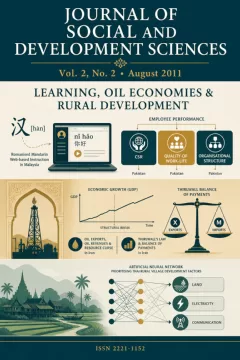
This paper explores the relation between oil revenues and economic growth in Iran using annual data for the period 1959-2008 to check whether this relation has a structural breakpoint effect. The results indicate the threshold level of growth rate of oil revenues above which oil revenues significantly slows growth is around 22% percent for Iran economy. In contrast, linear estimation without any allowance for threshold effects would misleadingly have us believe that an increase in the oil revenues increase the growth rate. Failure to account for nonlinearities conceal the resource curse in these countries particularly during extreme oil booms as suggested in previous studies.
Keywords
- Iran Economy Search this journal for Iran Economy (opens in a new tab)
- Oil Revenues Search this journal for Oil Revenues (opens in a new tab)
- Economic Growth Search this journal for Economic Growth (opens in a new tab)
- Resource Curse Search this journal for Resource Curse (opens in a new tab)
- Threshold Model Search this journal for Threshold Model (opens in a new tab)
References
- Aguiar, L & Wen, Y. (2011), OPEC’s Oil Exporting Strategy and Macroeconomic (In)Stability, Working Paper, Federal Reserve Bank , 2011-013A.
- Auty, R. M. (2001). Resource Abundance and Economic Development . Oxford University Press, Oxford
- Berument, H. & Ceylan, N. B. (2007). The impact of oil price shocks on the economic growth of the selected MENA countries. Webpage: http://www.bilkent.edu.tr/~berument.
- Bredin, D., Elder, J. & Fountas, S. (2008), The Effects of Uncertainty about Oil Prices in G-7. Working paper, Banking & Finance Subject Area UCD Business Schools, WP 08/08.
- Choi, I. (1992). Effects of Data Aggregation on the Power of the Tests for a Unit Root. Economics Letters , 40, 397–401.
- Devlin, J. & Lewin, M. (2004). Managing Oil Booms and Busts in Developing Countries, Draft Chapter for: Managing Volatility and Crises, A Practitioner's Guide.
- Frederick, V. D. P (2010), Aggressive Oil Extraction and Precautionary Saving: Coping with Volatility, Cesifo Working Paper, 3038.
- Gelb, A. H. (1988). Windfall Gains: Blessing or Curse? New York: Oxford University Press .
- Gylfason, T., Herbertsson T. T. & Zoega, G. (1999). A Mixed Blessing: Natural Resources and Economic Growth. Macroeconomic Dynamics , 3, 204-225.
- Hansen, B. (1999). Threshold Effects in Non-Dynamic Panels: Estimation, Testing, and Inference. Journal of Econometrics , 93(2), 345-68.
- Hausmann, R. & Rigobon, R. (2003). An alternative explanation of the resource curse. In: Jeffrey Davis, Rolando Ossowski, and Annalisa Fedelino, eds., Fiscal Policy Formulation and Implementation in Oil-Producing Countries. Washington, D.C. International Monetary Fund.
- Karl, T. L., (1997). The Paradox of Plenty: Oil Booms and Petro States. University of California Press, Berkeley, CA.
- Kwiatkowski, D., Phillips, P. C. B., Schmidt, P. & Shin, Y. (1992). Testing the null hypothesis of stationary against the alternative of a unit root: How sure are we that economic time series have a unit root? Journal of Econometrics , 54, 159-178.
- Levine, R. & Renelt, D. (1992). A Sensitivity Analysis of Cross-Country Growth Regressions. American Economic Review , 82, 942-63.
- Mendoza, O. & Vera, D. (2010). the Asymmetric Effects of Oil Shocks on an Oil-exporting Economy, Cuadernos De Economia , 47, 3-13.
- Mohammadi, H. & JahanParvar, M. R. (2010). Oil prices and exchange rates in oil-exporting countries: evidence from TAR and M-TAR models. Journal of Economics and Finance , 1-14-14.
- Nakov, A & Pescatori, A. (2010). Oil and the Great Moderation. The Economic Journal , 120(543), 131–156.
- Phillips, P. C. B. & Perron, P. (1988). Testing for a unit root. Biometrica , 75, 335-346.
- Pineda, J. & Rodriguez, F. (2010). Curse or Blessing? Natural Resources and Human Development, United Nations Development Program, Human Development Reports, Research Paper 2010/04.
- Romer, D. (1990). Endogenous technological change. Journal of Political Economy , 98, 71–102.
- Sachs, J. D. & Warner, A. M. (1995). Natural Resource Abundance and Economic Growth. NBER Working, 5398.
- Sachs, J. D. & Warner, A. M. (1997). Sources of Slow Growth in African Economies. Journal of African Economies , 6 (3), 335–76.
- Sachs, J. D. & Warner, A. M. (2001). The Curse of Natural Resources. European Economic Review , 45, 827838.
- Sala-i-Martin, X. & Subramanian, A. (2003). Addressing the Natural Resource Curse: An Illustration from Nigeria. NBER Working Paper, 9804.
- Spatafora, N. & Warner, A. M. (1995). Macroeconomic Effects of Terms-of-Trades Shocks: the Case of Oil Exporting Countries. Policy Research Working Paper , 1410, the World Bank.
- Temple, J. (1999). The New Growth Evidence. Journal of Economic Literature , 37, 112-156.
- Thorsten, B. (2010). Finance and Oil is there a resource curse in financial development? European Banking Center Discussion, 2011-004.
- Trung, L. V. & Vinh, N. T. T. (2011). The impact of oil prices, real effective exchange rate and inflation on economic activity: Novel evidence for Vietnam, Discussion Paper Series, RIEB, Kobe University, DP 2011-09.
- Yang, B. & Lam, Y. (2007). Resource booms and economic development: the time series dynamics for 17 oil-rich countries. Applied Economics Letters , 15(13-15), 1011-1014.
Downloads
No downloads have been recorded for this article yet. Figures appear here once readers begin downloading the full text.
How to Cite
Share this article
License
Copyright (c) 2011 Mohsen Mehrara, Maysam Musai, Abbas Rezazadeh Karsalari (Author)

This work is licensed under a Creative Commons Attribution 4.0 International License.
Author (s) should affirm that the material has not been published previously. It has not been submitted and it is not under consideration by any other journal. At the same time author (s) need to execute a publication permission agreement to assume the responsibility of the submitted content and any omissions and errors therein. After submission of revised paper in the light of suggestions of the reviewers, the editorial team edits and formats manuscripts to bring uniformity and standardization in published material.
This work will be licensed under Creative Commons Attribution 4.0 International (CC BY 4.0) and under condition of the license, users are free to read, copy, remix, transform, redistribute, download, print, search or link to the full texts of articles and even build upon their work as long as they credit the author for the original work. Moreover, as per journal policy author (s) hold and retain copyrights without any restrictions.
Keywords
- Iran Economy Search this journal for Iran Economy (opens in a new tab)
- Oil Revenues Search this journal for Oil Revenues (opens in a new tab)
- Economic Growth Search this journal for Economic Growth (opens in a new tab)
- Resource Curse Search this journal for Resource Curse (opens in a new tab)
- Threshold Model Search this journal for Threshold Model (opens in a new tab)
Section
Published
Submissions
Have research to publish? Journal of Social and Development Sciences welcomes submissions.
Make a Submission