Abstract
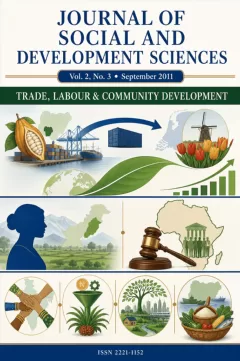
The study examined the degree of market power in the export demand for Nigerian Cocoa with focus on the Dutch Market. The study covered the periods of 1961–2007 and data comprised published national aggregates on specific trade and macroeconomic variables from reputable sources. Two Stage Least Squares (2 SLS) approach was used in the estimation after instrumenting for simultaneity and establishing stationarity alongside cointegration relationship. Findings, on the demand side, showed that the demand for cocoa increases as income of Netherlands (importing country) increases. Total production of the non– participating countries traced out a positive relationship with demand for cocoa by the importing country while the coefficient of price of Coffee (substitute crop) possessed a negative sign. On the supply relation side, the demand for the export crop has a negative sign, indicating decreasing marginal output with respect to cost while the proxy for ocean freight rate with its negative sign, imply increasing export cost. The result further showed that there is relative competitiveness in the Dutch market on the strength of a market power coefficient -0.712 with a Lerner index of 0.122. Based on the findings, the study calls for government intervention in the agricultural export subsector with the aim to revitalize the country’s agricultural export capacity and enhance her market power via increased market shares. These interventions could be in the form of input/production subsidies, targeted export promotion programs, farm settlement, expanded export processing zones to mention but a few.
Keywords
References
- Adegeye, A. J. & Dittoh, S. J. (1985). Essentials of Agricultural Economics . Impact Publishers Nigeria Limited, Ibadan.
- Bresnahan, T. F. (1989). Empirical Studies of Industries with Market Power, In: Handbook of Industrial Organization. R. Schmalensee and R. Willig (eds) II, Chapter 17,Amsterdam, North Holland.
- Buschena, D. E. & Perloff, J. M. (1991). The Creation of Dominant Firm Market Power in the Coconut Oil Export Market. American Journal of Agricultural Economics , 73, 1000-1008.
- Daramola, A. S., Ehui, E. U. & McIntire, J. (2007). Agricultural Export Potential: In Collier P. and C. Pattillo (eds.), Economic Policy Options for a Prosperous Nigeria, London: Palgrave Macmillan.
- Deodhar, S. Y. & Sheldon, I. M. (1997). Market Power in the World Market for Soymeal Exports. Journal of Agricultural and Resource Economics 22(1), 78-86.
- De Wulf, L. (2004). Globalization and International Competitiveness: Concepts and Policy Implications for Agriculture, In: Report of the Asian Productivity Organization (APO) Study Meeting on Agricultural Diversification and International Competitiveness, Tokyo, 16 – 23 May.
- Dittmann, I. (2002). Residual Based Tests for Fractional Cointegration: A Monte Carlo Study, Journal of Time Series Analysis , 21(6), 615 –647.
- Erelu, O. O. (2008). Cocoa for Health and Wealth. A Paper presented in a Fourth Cocoa Day Celebration in Osun State, Nigeria between 22nd – 24th April.
- FAO (2009). Food and Agriculture Organization Statistical Yearbook. A Publication of FAO, Rome
- Nkang, N. M., Abang, O. S., Akpan, O. E. and Ofem, K. J. (2006). Cointegration and Error – Correction Modelling of Agricultural Export Trade in Nigeria: The Case of Cocoa. Journal of Agriculture and Social Sciences, 2(4), 249–255.
- Nwachukwu, I. N., Agwu, N. M., Nwaru, J. C. & Imonikhe, G. (2010). Competitiveness and Determinants of Cocoa Export from Nigeria. Report and Opinion , 2(7), 51–54.
- Oluyole, K. A. (2005). Evaluation of the Economics of Post Harvest Processing of Cocoa in Cross River State, Nigeria. Journal of Agriculture, Forestry and the Social Sciences . 3(2), 58-64.
- Omonona, B. T., Oni, O. A. & Akpan, E. (2007). The Determinants of Demand for Nigeria’s Agricultural Export Commodities. Pakistan Journal of Social Sciences. 4(2), 247 – 251.
- Oyedele, J. O. (2007). Enhancing the Sustainability of Cocoa Growing in Nigeria. A Paper Presented at the ICCO Roundtable Congress on Sustainable World Cocoa Economy at Accra, Ghana. 3rd – 6th October.
- Perloff, J. M. (1992). Econometric Analysis of Imperfect Competition and Implications for Trade Research. In: Proceedings of a Workshop on Industrial Organization and International Trade (eds) I. M. Sheldon and D. R. Henderson, NC-194 Research Monograph Number 1, Ohio State University, Columbus, USA.
- Sasore, G. M. (2004). Nigeria’s Export Trade of Agricultural Commodities: Quality Control and Standards. A Paper presented at Nigeria National Crop Outlook Conference held at Durbar Hotel, Kano. 26th – 27th May.
- Sexton, R. J. (2000). Industrialization and Consolidation in the US Food Sector: Implications for Competition and Welfare. American Journal of Agricultural Economics , 82, 1087-1104.
- Sexton ,R. J. & Zhang, M. (2001). An Assessment of the Impact of Food Industry Market Power on U.S. Consumers. Agribusiness 17, 59–79.
- Sperling, R. (2002). Estimating Oligopsony Power in the United States Market for Slaughter Hogs: An Error Correction Approach, Ph.D. Thesis submitted to the Department of Agricultural Environmental and Development Economics, The Ohio State University, USA.
- Susanto, D. (2006). Measuring the Degree of Market Power in the Export Demand for Soybean Complex. Ph.D Thesis submitted to the Department of Agricultural Economics and Agribusiness, The Louisiana State University, USA.
- Thomas, A. (2007). Econometrics, Andren and Ventus Publishing APS, USA.
- Wilcox, M. D. and Abbott, P. C. (2004). Market Power and Structural Adjustment: The Case of West African Cocoa Market Liberalization. Paper Presented at the American Agricultural Economics Association Annual Meeting, Denver, Colorado, 1st – 4th August.
Downloads
No downloads have been recorded for this article yet. Figures appear here once readers begin downloading the full text.
How to Cite
Share this article
License
Copyright (c) 2011 Nwachukwu, I. N., C. E. Onyenweaku, J. C. Nwaru, C. Paveliuc–Olariu (Author)

This work is licensed under a Creative Commons Attribution 4.0 International License.
Author (s) should affirm that the material has not been published previously. It has not been submitted and it is not under consideration by any other journal. At the same time author (s) need to execute a publication permission agreement to assume the responsibility of the submitted content and any omissions and errors therein. After submission of revised paper in the light of suggestions of the reviewers, the editorial team edits and formats manuscripts to bring uniformity and standardization in published material.
This work will be licensed under Creative Commons Attribution 4.0 International (CC BY 4.0) and under condition of the license, users are free to read, copy, remix, transform, redistribute, download, print, search or link to the full texts of articles and even build upon their work as long as they credit the author for the original work. Moreover, as per journal policy author (s) hold and retain copyrights without any restrictions.
Keywords
Section
Published
Submissions
Have research to publish? Journal of Social and Development Sciences welcomes submissions.
Make a Submission