Abstract
The Web-based instruction (WBI) is the instructional materials that are used in the learning system that involves the network operation center (NOC), the WWW resources, the learners, instructors and the regularly conducted lectures of fulltime teaching staff. The main objective of this paper is to describe the system architecture of web-based Hanyu Pinyin (Romanised Mandarin) instruction and its main features. The Hanyu Pinyin WBI is tailored to tackle the weaknesses and to meet the specific needs of Malay learners. This paper also discusses the first impression of UiTM students who study through Guru Hanyu Pinyin web-based instruction (Romanised Mandarin Web-based instruction). To conduct the study, descriptive statistical tool was used. A group of 28 students in UiTM Penang campus were selected to attend a 4-hour self-learning session using Hanyu Pinyin instruction at the language computer laboratory. An questionnaire on user friendliness of the instruction is given to them to find out their first impression about the instruction. The finding shows that the majority of the students feel that Guru Hanyu Pinyin WBI is user friendly
Keywords
- Romanised Mandarin Search this journal for Romanised Mandarin (opens in a new tab)
- Web-Based Instruction Search this journal for Web-Based Instruction (opens in a new tab)
- System Architecture Search this journal for System Architecture (opens in a new tab)
- System’s Main Features Search this journal for System’s Main Features (opens in a new tab)
- Nonnative Mandarin Learners Search this journal for Nonnative Mandarin Learners (opens in a new tab)
References
- Ariew, R. (1984). Computer-assisted foreign language materials: Advantages and limitations. CALICO Journal, 2, 44-45.
- Bourgerie, D. S. (2003). Computer Aided Language Learning for Chinese: A Survey and Annotated Bibliography. Journal of the Chinese Language Teachers Association, 38(2), 17-47.
- Clark, G (1996). Glossary of CBT/WBT Terms. Retrieved January 07, 2010 from http://www.clark.net/pub/nractive/alt5.htm.
- Khan, B. H. (1997). Web-Based Instruction, 1997, Educational Technology Publications, Englewood Cliffs, New Jersey:6.
- Longman Dictionary of Contemporary English. 3rd Edition (1995). Harlow:Longman,
- Relan, A. & Gillani, B. B. (1997). Web-Based Information and the Traditional Classroom: Similarities and Differences. In Khan, B. H., (Ed.), Web-Based Instruction, 1997a, Educational Technology Publications, Englewood Cliffs, New Jersey: 43.
- Shao, B. (2005). A brief introduction of Online Hanyu Pinyin Web Sites] [Online].Taiwan: International Conference on Internet Chinese Education. Retrieved December 20, 2010 from http://edu.ocac.gov.tw/discuss/academy/netedu04/ICICE2005/html/paper2/C12.pdf
- Xu, Z. (2005). A Review and Evaluation of Online Hanyu Pinyin Web Sites.Taiwan: International Conference on Internet Chinese Education. Retrieved December 20, 2010 from http://edu.ocac.gov.tw/discuss/academy/netedu04/ICICE2005/html/paper2/C08.pdf
- Zhang, J. (2006). Hanyu Pinyin for Mandarin Speakers, [Online]. Boston:MIT. Retrieved November 21, 2010 from http://web.mit.edu/~jinzhang/www/pinyin/
Downloads
No downloads have been recorded for this article yet. Figures appear here once readers begin downloading the full text.
How to Cite
Share this article
License
Copyright (c) 2011 Lim Soo Giap, Ong Sheau Fen (Author)

This work is licensed under a Creative Commons Attribution 4.0 International License.
Author (s) should affirm that the material has not been published previously. It has not been submitted and it is not under consideration by any other journal. At the same time author (s) need to execute a publication permission agreement to assume the responsibility of the submitted content and any omissions and errors therein. After submission of revised paper in the light of suggestions of the reviewers, the editorial team edits and formats manuscripts to bring uniformity and standardization in published material.
This work will be licensed under Creative Commons Attribution 4.0 International (CC BY 4.0) and under condition of the license, users are free to read, copy, remix, transform, redistribute, download, print, search or link to the full texts of articles and even build upon their work as long as they credit the author for the original work. Moreover, as per journal policy author (s) hold and retain copyrights without any restrictions.
Keywords
- Romanised Mandarin Search this journal for Romanised Mandarin (opens in a new tab)
- Web-Based Instruction Search this journal for Web-Based Instruction (opens in a new tab)
- System Architecture Search this journal for System Architecture (opens in a new tab)
- System’s Main Features Search this journal for System’s Main Features (opens in a new tab)
- Nonnative Mandarin Learners Search this journal for Nonnative Mandarin Learners (opens in a new tab)
Section
Published in
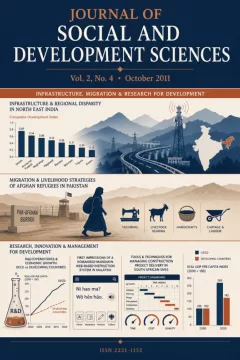 Vol. 2 No. 4 (2011)
Infrastructure, Migration & Research for Development
View issue contents
Published
Submissions
Have research to publish? Journal of Social and Development Sciences welcomes submissions.
Make a Submission