Abstract
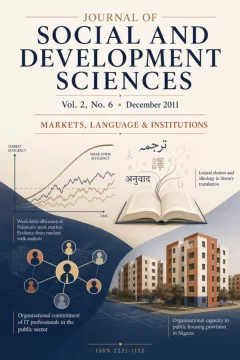
This study focuses on the factors like salary/incentives, interpersonal conflicts, employeesorganization interface, job satisfaction and organizational culture, in order to clarify the behavior of organizational commitment among information technology employees in public sector organizations. The study provides an insight of the culture of public sector organization, which managers may use for the improvement of organizational commitment. The study tested and analyzed the proposed model, which gave valuable results. The result of the study also claims that organizational commitment may be increased.
Keywords
References
- Ajzen, I. (2001). Nature and Operation of Attitudes. Annual Review of Psychology, 52(1), 27–58.
- Akerlof, G. A. (1984). Gift Exchange and Efficiency Wages: Four Views. American Economic Review, 74, 79–83.
- Akerlof, G. A. & Yellen, J. (1990). The Fair Wage-Effort Hypothesis and Unemployment. Quarterly Journal of Economics, 105, 255–283.
- Barney, J. B. (1991). Firm Resources and Sustained Competitive Advantage. Journal of Management, 17, 99120.
- Burn, R., Eagamia, D., Louis, C. & Poon, B. (2000). Job Expectations of IS Professionals in Hong Kong. ACM Press, New York. 231-24.
- Buono, A. F., Bowditch, J. L. & Lewis, J. W. (1985). When cultures collide: the anatomy of a merger. Human Relations , 38(5), 477-500.
- Boxx, W. R., Odom, R. Y. & Dunn, M. G. (1991). Organizational Values and Value Congruency and Their Impact on Satisfaction, Commitment, and Cohesion: An Empirical Examination within the Public Sector. Public Personnel Management , 20 (2), 1991, 195-205.
- Chatman, J. A. & Barsade, S. G. (1995). Personality, organizational culture, and cooperation: evidence from a business simulation. Administrative Science Quarterly , 40, 423-43.
- Coff, R. W. (1997). Human Assets and Management Dilemmas: Coping with Hazards on the Road to ResourceBased Theory. Academy of Management Journal , 22, 374- 402.
- Davies, B. & Philp, A. (1994). Monitoring company culture. Personnel Management , 26(5).
- Denison, D. R. (1990). Corporate Culture and Organizational Effectiveness, John Wiley & Sons, New York, NY.
- Denhardt, R. B. (1991). Public Administration: An Action Orientation, Brooks/Cole Publishing, Pacific Grove, CA.
- Dalton, D. & Todor, W. D. (1981). Turnover, Transfer, Absenteeism: An Interdependent Perspective. Journal of Management , 19(2), 193-22.
- Flowers, V. S. & Hughes, C. L. (1973). Why Employees Stay. Harvard Business Review , 51(4), 49-60.
- Fox, S., Spector, P. E. Miles, D. (2001). Counter productive Work Behavior in Response to Job Stressors and Organizational Justice: Some Mediator and Moderator Tests for Autonomy and Emotions . Journal of Vocational Behavior 59(3), 291–309.
- Gordon, G. G. (1991). Industry determinants of organizational culture. Academy of Management Review, 16, 396-415.
- Herman, J. B. & Hulin, C. L. (1972). Studying Organizational Attitudes from Individual and Organizational Frames of Reference. Organizational Behavior and Human Performance , 8, 84-108.
- Hrebiniak, L. G. & Alutto, J. A. (1972). Personal and Role-Related Factors in the Development of Organizational Commitment. Administrative Science Quarterly , 16, 555-72.
- Hofstede, G., Neuijen, B., Ohayv, D. D. & Sanders, G. (1990). Measuring organizational cultures: a qualitative and quantitative study across twenty cases. Administrative Science Quarterly, 35(1), 286-316.
- Jreisat, J. E. (1997). Public Organization Management: The Development of Theory and Process, Praeger, Westport, CT.
- Korman, A. (1970). Toward a Hypothesis of Work Behavior. Journal of Applied Psy chology, 54, 31–41.
- Lawler, E. E. (1992). The Ultimate Advantage: Creating the High Involvement Organization (Jossey-Bass, San Francisco).
- Lincoln, J. R. & Kalleberg, A (1990). A. Culture, Control and Commitment: A Study of Work Organization and Work Attitudes in the United States and Japan (Cambridge University Press, Cambridge).
- Mitchell, T. R., Holtom, B. C., Lee, T. W., Sablynski, C. J. & Erez, M. (2001). Why People Stay Using Job Embeddedness to Predict Voluntary. Academy of Management Journal, 44, 1102–1121.
- Mulki, J. P., Jaramillo, F. & Locander, W. B. (2006). Effects of Ethical Climate and Supervisory Trust on Salesperson, Job Attitudes and Intentions to Quit. Journal of Personal Selling & Sales Management, 26(1), 19–26.
- Neiderman & Summer, W. (1997). Decision Path Affecting Turnover Intensions among IT professional Workforce ACM Press New York, 11-20.
- O’Reilly, C. A., Chatman, J. A. & Caldwell, D. F. (1991). People and organizational culture: a profile comparison approach to assessing person-organization fit. Academy of Management Journal, 14, 487-516.
- O’Reilly, C. A., Chatman, J. & Caldwell, D. F. (1991). People and Organizational Culture: A Profile Comparison Approach to Assessing Person-Organization Fit. Academy of Management Journal , 34(3), 487-516.
- O’Reilly, C. A. & Robert, K. (1975). Individual Differences in Personality, Position in the Organization and Job Satisfaction. Organizational Behavior and Human Performance , 14, 144-50.
- Penney, L. M. & Spector, P. E. (2005). Job Stress, Incivility, and Counterproductive Work Behavior: The Moderating Role of Negative Affectivity. Journal of Organizational Behavior, 26(7), 777–796.
- Ritu, A. & Ferry, H. (2001). Retention and Career Motives of IT Professionals Workforce, ACM Press New Yook, 158-166.
- Rusbult, C. E., Farrel, D., Rogers, G & Mainous, A. G. (1988). Impact of Exchange Variables on Exit, Voice, Loyalty, and Neglect: An Integrative Model of Response to Declining Job Satisfaction. Academy of Management Journal, 31(3), 599–628.
- Reid, M. F., Allen, M. W., Armstrong, D. J. & Riemenschneider, C. K. (2001). ACM Press New Yook NY, US 321331.
- Salop, S. C. (1979). A Model of the Natural Rate of Unemployment. American Economic Review, 69, 117–125.
- Simon, H. A. (1976). Administrative Behavior: A Study of Decision-making Processes in Administrative Organization, New York, Free Press.
- Spector, P. E. (1997). Job Satisfaction: Application, Assessment, Causes, and Consequences.
- Steers, R. M. (1977). Antecedents and Outcomes of Organizational Commitment. Administrative Science Quarterly, 22(1), 46–56.
- Schulz, J. W. (2001). Tapping the best that is within why corporate culture matters. Management Quarterly, 42, 29-35.
- Valle, M. (1999). Crisis, culture and charisma: the new leader’s work in public organizations. Public Personnel Management, 28(2), 245-57.
- Weiss, A. (1980). Job Queues and Layoffs in Labor Markets with Flexible Wages. Journal of Political Economy, 88, 526–538.
Downloads
No downloads have been recorded for this article yet. Figures appear here once readers begin downloading the full text.
How to Cite
Share this article
License
Copyright (c) 2011 Zahid Mehmood Awan, Sayed Fayaz Ahmed, Muhammad Khalil Shahid (Author)

This work is licensed under a Creative Commons Attribution 4.0 International License.
Author (s) should affirm that the material has not been published previously. It has not been submitted and it is not under consideration by any other journal. At the same time author (s) need to execute a publication permission agreement to assume the responsibility of the submitted content and any omissions and errors therein. After submission of revised paper in the light of suggestions of the reviewers, the editorial team edits and formats manuscripts to bring uniformity and standardization in published material.
This work will be licensed under Creative Commons Attribution 4.0 International (CC BY 4.0) and under condition of the license, users are free to read, copy, remix, transform, redistribute, download, print, search or link to the full texts of articles and even build upon their work as long as they credit the author for the original work. Moreover, as per journal policy author (s) hold and retain copyrights without any restrictions.
Keywords
Section
Published
Submissions
Have research to publish? Journal of Social and Development Sciences welcomes submissions.
Make a Submission