Abstract
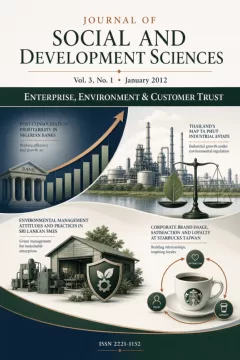
The industrial estate has played an important part in the post-WWII economic development of Thailand, representing a focal point for the inward investment necessary to promote the version of the East Asian Economic Model employed in the country. Industrial estates have also been influential in shaping internal labour migration and in determining which economic activities provide competitive advantage in export sectors. The presence of the estates has not, however, been entirely positive since migration is often associated with social issues, because of excessive industrial pollution and because they made profitable otherwise unprofitable and undesirable activities. One of the largest and most significant industrial estates is that of Map Ta Phut, which is located on the eastern seaboard of Thailand. This estate has become particularly strongly linked with the presence of industrial pollution and with the protests of local residents who claim their health has been negatively affected by the various factories and facilities involved. This paper adopts Map Ta Phut Industrial Estate as an exemplar of all industrial estates of Thailand and uses it to identify the various characteristics and individualities of the Thai version of this institution. By doing this, lessons are drawn for both business practitioners and policy-makers concerning the regulation of pollution and other administrative activities, together with forward planning for employment and labour market upgrading.
Keywords
- Industrial Estate Search this journal for Industrial Estate (opens in a new tab)
- Industrial Geography Search this journal for Industrial Geography (opens in a new tab)
- Map Ta Phut Search this journal for Map Ta Phut (opens in a new tab)
- Pollution Search this journal for Pollution (opens in a new tab)
- Thailand Search this journal for Thailand (opens in a new tab)
References
- Akira, S. (1996). Capital Accumulation in Thailand, 1855-1985, Chiang Mai: Silkworm Books.
- Barbieri, E., Marco, R., Tommaso, D. & Stefano, B. (2011). Industrial Development Policies and Performances in Southern China: Beyond the Specialised Industrial Cluster Program, China Economic Review, in press.
- Boyenge, J. P. S. (2007). ILO Database on Export Processing Zones (revised), ILO Working Paper, 251, Geneva: ILO.
- Buakhamsri, T. (2005). What is in the air? Secrets that Map Ta Phut and Thai People Have Never Known, Bangkok: Thailand Bucket Brigade.
- Chen, S. & Chong, J. C. (2004). Creating a Knowledge-Based City: the Example of Hsinchu Science Park. Journal of Knowledge Management , 8(5), 73-82.
- Crispin, S. W. (2007). Cambodia’s Cowboy Capitalism, Asia Times Online (July 13th ), available at: http://www.atimes.com/atimes/Southeast_Asia/IG13Ae01.html.
- Doner, R. F. (2009). The Politics of Uneven Development: Thailand’s Economic Growth in Comparative Perspective, Cambridge: Cambridge University Press.
- Farole, T. (2011). Special Economic Zones in Africa, New York: The World Bank. doi: 10.1596/978-0-82138638-5.
- Florida, R. (1996). Regional Creative Destruction: Production Organization, Globalization, and the Economic Transformation of the Midwest. Economic Geography , 72(3), 314-34.
- Fuller, T. (2009). In Industrial Thailand, Health and Business Concerns Coincide, The New York Times (December 18th , available at: http://www.nytimes.com/2009/12/19/world/asia/19thai.html?_ r=3&th&emc=th.
- Ge, W. (1999). Special Economic Zones and the Opening of the Chinese Economy: Some Lessons for Economic Liberalization. World Development , 27(7), 1267-85.
- Gill, I. & Homi, K. (2007). An East Asian Renaissance: Ideas for Economic Growth, New York: World Bank.
- Industrial Estate Authority of Thailand (IEAT). (2009). IEAT Annual Report, 2009, Bangkok: IEAT, available at: http://www.ieat.go.th/IEAT/ieat_docs/annuay/ArIEAT2009%28E%29.pdf.
- Kunmakara, M. (2010). Cheap Labour Pays Dividends, The Phnom Penh Post (July 9th ), available at: http://www.phnompenhpost.com/index.php/2010070940377/Business/cheap-labour-paysdividends.html.
- Linn, T. (2010). Dawei Deep-Sea Port, SEZ Gets Green Light, and Myanmar Times (November 15-21st ), available at: http://www.mmtimes.com/2010/business/549/biz54901.html.
- Mallet, V. (2000). The Trouble with Tigers: The Rise and Fall of Southeast Asia, London: Harper Collins Business.
- Marshall, A. (1890). Principles of Economics, London: MacMillan.
- Mason, P. (2008). Live Working or Die Fighting: How the Working Class Went Global, London: Vintage Books.
- Mehmet, O., Errol, M. & Robert, S. (1999). Towards a Fair Global Labour Market: Avoiding a New Slave Trade, London and New York: Routledge.
- Michinobu, R. (2005). Lives in Transition: The Influence of Northern Thailand’s Economic and Cultural Change on Young Factory Women’s Sexual Behaviour and HIV Risk, Nakhon Pathom: Centre for Health Policy Studies, Mahidol University.
- Morris, J. (1988). The Who, Why and Where of Japanese Manufacturing Investment in the UK, Industrial Relations Journal , 19(1), 31-40.
- Pathamanand, U. (2009). The Relationship between the State and Private Sector in Industrial Policy (1960present): from Alliance System to Oligopoly, in Suthiphand Chirathivat and Ng Chee Yuen (eds). Emerging Asia’s Growth Practices: Recent Experiences of China, Indonesia, Malaysia, the Philippines and Thailand, Bangkok: Chula Global Network, 380-408.
- Pereira, A. (2004). The Suzhou Industrial Park Experiment: the Case of China-Singapore Governmental Collaboration, Journal of Contemporary China , 13(38), 173-93.
- Porter, M. E. (1998). Clusters and the New Economics of Competition. Harvard Business Review (NovemberDecember), 77-90.
- Preecharushh, D. (2009). Naypyidaw: New Capital of Burma, Bangkok: White Lotus.
- Sonobe, T. & Keijiro, O. (2006). Cluster-based Industrial Development: An East Asian Model, Basingstoke: Palgrave Macmillan.
- Suocheng, D., Li Zehong, L. B. & Xue, M. (2007). Problems and Strategies of Industrial Transformation of China’s Resource-Based Cities. China Resources, Population and Environment , 17(5), 12-17.
- Tobey, J. A. & Henri, S. (1996). The Polluter-Pays Principle in the Context of Agriculture and the Environment. The World Economy , 19(1), 63-87.
- Walsh, J. & Sittichai, A. (2009). Management Style of Chinese Business Owners in the Chiang Rai Province of Thailand, Southeast Asian Journal of Management , 3(1), 29-40.
- Walsh, J. (2010). The Rise and Fall of the East Asian Economic Model in Thailand, paper presented at the International Colloquium on Business and Management, Bangkok (January 26th -28th ).
- Zeng, D. Z. (2010). Building Engines for Growth and Competitiveness in China, New York: World Bank, 2010). doi: 10.1596/978-0-8213-8432-9.
Downloads
No downloads have been recorded for this article yet. Figures appear here once readers begin downloading the full text.
How to Cite
Share this article
License
Copyright (c) 2012 Supaporn Pinyochatchinda, John Walsh (Author)

This work is licensed under a Creative Commons Attribution 4.0 International License.
Author (s) should affirm that the material has not been published previously. It has not been submitted and it is not under consideration by any other journal. At the same time author (s) need to execute a publication permission agreement to assume the responsibility of the submitted content and any omissions and errors therein. After submission of revised paper in the light of suggestions of the reviewers, the editorial team edits and formats manuscripts to bring uniformity and standardization in published material.
This work will be licensed under Creative Commons Attribution 4.0 International (CC BY 4.0) and under condition of the license, users are free to read, copy, remix, transform, redistribute, download, print, search or link to the full texts of articles and even build upon their work as long as they credit the author for the original work. Moreover, as per journal policy author (s) hold and retain copyrights without any restrictions.
Keywords
- Industrial Estate Search this journal for Industrial Estate (opens in a new tab)
- Industrial Geography Search this journal for Industrial Geography (opens in a new tab)
- Map Ta Phut Search this journal for Map Ta Phut (opens in a new tab)
- Pollution Search this journal for Pollution (opens in a new tab)
- Thailand Search this journal for Thailand (opens in a new tab)
Section
Published
Submissions
Have research to publish? Journal of Social and Development Sciences welcomes submissions.
Make a Submission