Abstract
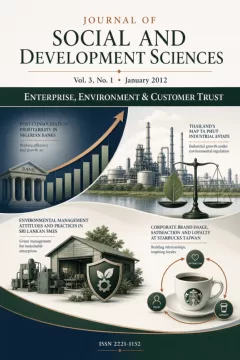
The main objective of this paper was to investigate whether there is an association amongst SMEs’ attitudes, awareness on environmental issues and their environmental management practices. A questionnaire-based survey was chosen to obtain the information on attitudes, awareness and environmental management practices of SMEs. The questionnaire was developed to find out SMEs’ current environmental management practices as well as their attitudes and awareness on environmental issues. The associations amongst attitudes, awareness and environmental practices for waste, energy, and the environment were investigated by calculating correlation coefficient. These analyses revealed that there is no significant association between attitudes and awareness or attitudes and environmental management practices. Attitudes appear to be remaining positive even where awareness is limited. Managers/owners who expressed rather more positive attitudes appear no more likely introduce environmental management practices for their organizations than managers/owners with less or negative attitude.
Keywords
- Environmental Management Search this journal for Environmental Management (opens in a new tab)
- Environmental Management Practices Search this journal for Environmental Management Practices (opens in a new tab)
- Attitudes Search this journal for Attitudes (opens in a new tab)
- Awareness Search this journal for Awareness (opens in a new tab)
- SMEs Search this journal for SMEs (opens in a new tab)
References
- Barrows, C. J. (2005). Environmental Management and Development, Abingdon, Rutledge.
- Bianchi, R. & Noci, G. (1998). Greening SMEs’ Competitiveness. Small Business Economics , 11, 269-281. Biel, A., Dahlstrand, U. & Grankvist, G. (2005). Habitual and value-guided purchase behavior. Ambio , 30, 360365.
- Biel, A. & Dahlstrand, U. (2005). Values and habits: a dual process model. In environment, information and Consumer Behavior, Cheltenham, Edward Elgar.
- Bosworth, D. & Jacobs, C. (1989). Management attitudes, behavior, and abilities as barriers to growth, in barriers to Growth in Small Firms, Rutledge, London.
- Chavan, M. (2005). An appraisal of environment management systems: a competitive advantage for small businesses. Management of Environmental Quality: An International Journal, 16(5), 444-463.
- Clarkson, M. B. E. (1995). A stakeholder Network for Analyzing and Evaluating Corporate Social Performance. Academy of Management Review , 20(1), 92-117.
- Cooray, M. N. R. & Silva, K. R. D. (2008). Facilitating the development of SMEs of Sri Lanka through Sustainable Consumption and Production.
- Dandridge, T. C. (1979). Children are not little Grown- ups: Small Business needs its own Organizational Theory. Journal of Small Business Management , 17(2), 53-57.
- Dasanayake, D. (2009). Paper presented for the special IARIW – SAIM Conference on “Measuring the Informal Economy in Developing Countries Kathmandu, Nepal, September, 22-26.
- DeCanio, S. J. (1998). The efficiency paradox: bureaucratic and organizational barriers to profitable energy saving investments. Energy policy , 26(5), 441-454.
- Donaldson, T. & Preston, L. E. (1995). The stakeholder Theory of the Corporation: Concepts, Evidence, and Implications. Academy of Management Review , 20(1) 65-91.
- Geiser, K. & Crul, M. (1996). Greening of Small and Medium Sized Firms: Government, Industry and NGOs initiatives, the greening of Industry Resource Guide and Bibliography, Island, Washington DC.
- Gladwin, T. N. (1993). The Meaning of Greening: A Plea for Organizational Theory, Washington D.C., Island Press.
- Goss, D. (1991). Small Business and Society, Rout ledge, London.
- Hillary, R. (1998). An Assess of the Implementation status of Council Regulation (No 1836/93) Eco Management and Audit Scheme (EMAS) in the European Union Member Status (AIMS-EMAS, Imperial College, London, UK http://europa.eu.int/comm/emas.
- Hillary, R. (1995). Small firms and the environment—a groundwork status report, Birmingham: Groundwork.
- Hillary, R. (1999). Evaluation of Study Reports on the Barriers, Opportunities and Drivers for Small and Medium Sized Enterprises in the Adoption of Environmental Management Systems, Department of Trade and Industry Environment Directorate.
- Hillary, R. (2004). Environmental management systems and the smaller enterprise. Journal of Cleaner Production 12, 561-569.
- Howes, S. (1997). Integrated Pollution Control, Clean and Competitive? In motivating Environmental Performance in Industry, Earth scan, London. Http://.ijes.or.jp/APEIS/RSIPO/spo/pdf/ overall/3.5.2 sme.pdf
- Industrial Development Board. (2011). Centre for Industrial Information Technology Service, (CITIS), Moratuwa, Sri Lanka.
- Jones, T. M. (1980). Corporate Social Responsibility Revisited, Redefined. California Management Review , 22(2), 59-67.
- Martin, S. (2002). Professionals and Sustainability. Journal of the Institution of Environmental Science , 11(3), 6-7.
- Merritt, J. Q. (1998). EM into EMS won’t go? Attitudes, awareness and practices in the London, Borough of Croydon. Business Strategy and the Environment , 7, 90-100.
- Mitchell, R. K., Agle, B. R. & Wood, D. J. (1997). Toward a Theory of Stakeholder Identification and Salience: Defining the Principle of whom and What Really Counts. Academy of Management Review , 22(4), 853886.
- Montabon, F., Melnyk, S. A., Sroufe, R. & Calantone, R. J. (2000). ISO 14000: assessing its perceived impact on corporate performance. Journal of Supply Chain Management, 36 , 4–16.
- Naffziger, D. W., Ahmed, N. U. & Montagno, R. V. (2003). Perceptions of environmental consciousness in U.S. small businesses: An empirical study. Advanced Management Journal , 68(2).
- Petts, J., Herd, A., Gerrard, S. & Horne, C. (1999). The climate and culture of environmental compliance within SMEs. Business Strategy and the Environment , 8(1), 14-31.
- Schaper, M. (2002). Small firms and environmental management: predictors of green purchasingin Western Australian pharmacies. International Small Business Journal , 20(3), 235-251.
- Simpson, M., Taylor, N. & Barker, K. (2004). Environmental responsibility in SMEs: does it deliver competitive advantage? Business Strategy and the Environment , 13, 156-171.
- SMEDeF. (2010). Crisis Response SME Development Facility, Ministry of Finance and Planning.
- Smith, M. (1997). Stimulating environmental action in Small to Medium-sized Enterprises, Environmental Management Systems and Cleaner Production, Wiley: Chic ester.
- State of the Environment Sri Lanka. (2008). United Nations Environment program, Regional Resources Centre for Asia and the Pacific (UNEP-RRC. AP).
- Steager, U. (2000). Environmental Management Systems: Empirical evidence and further perspectives. European Management Journal , 18, 23-27.
- Stuart, R. (2000). Environmental Management Systems in the 21st Century. Chemical Health and Safety , 7(6), 23-25.
- Thompson, D. (2002). Tools for Environmental Management: A Practical Introduction and Guide, Gabriola Island, BC: New Society Publishers.
- Tilley, F. (1999). The gap between the environmental attitudes and the environmental behavior of small firms. Business Strategy and the Environment , 8, 238-248.
- Welford, R. & Gouldson, A. (1993). Environmental Management & Business Strategy, London, Pitman.
- Welsh, J. A. & White. J. F. (1981). A Small Business is not a Big Business. Harvard Business Review , 59(4), 1832.
- Williams, H., Van-Hooydonk, A., Dingle, P. & Annandale, D. (2000). Developing tailored environmental management systems for small business. Eco – Management and Auditing , 7, 106-113.
Downloads
No downloads have been recorded for this article yet. Figures appear here once readers begin downloading the full text.
How to Cite
Share this article
License
Copyright (c) 2012 Sudath Weerasiri, Zhang Zhengang (Author)

This work is licensed under a Creative Commons Attribution 4.0 International License.
Author (s) should affirm that the material has not been published previously. It has not been submitted and it is not under consideration by any other journal. At the same time author (s) need to execute a publication permission agreement to assume the responsibility of the submitted content and any omissions and errors therein. After submission of revised paper in the light of suggestions of the reviewers, the editorial team edits and formats manuscripts to bring uniformity and standardization in published material.
This work will be licensed under Creative Commons Attribution 4.0 International (CC BY 4.0) and under condition of the license, users are free to read, copy, remix, transform, redistribute, download, print, search or link to the full texts of articles and even build upon their work as long as they credit the author for the original work. Moreover, as per journal policy author (s) hold and retain copyrights without any restrictions.
Keywords
- Environmental Management Search this journal for Environmental Management (opens in a new tab)
- Environmental Management Practices Search this journal for Environmental Management Practices (opens in a new tab)
- Attitudes Search this journal for Attitudes (opens in a new tab)
- Awareness Search this journal for Awareness (opens in a new tab)
- SMEs Search this journal for SMEs (opens in a new tab)
Section
Published
Submissions
Have research to publish? Journal of Social and Development Sciences welcomes submissions.
Make a Submission