Abstract
Social networks have various aspects affecting the identification of opportunities in some ways. The present paper aims at investigating the effects of social networks on entrepreneurial opportunities in the area of entrepreneurial businesses. The research method is descriptive-survey and practical. The statistical population is the social entrepreneurship managers. Data collection was conducted through scientist-made questionnaire with the reliability is best (0.92). Data analysis is conducted in two different levels of descriptive and deductive. In summation, social network have greatest impact on entrepreneurial opportunity via several ways that teaching and learning.
Keywords
References
- Ardichvili, A. (2000). A theory of entrepreneurial opportunity identification and development. Journal of Business venturing , 18, 105-123.
- Barringer, B. R. & Ireland, R. D. (2006). Entrepreneurship: Successfully launching new Ventures. Pearson Prentice Hall.
- Bhagavatula, S. & Elfring, T. (2010). How social and human capital influence opportunity recognition and resource mobilization in India's handloom industry. Journal of Business Venturing , 25, 245–260.
- Cross, R., Parker, A., Prusak, L. & Borgatti, S. P. (2001). Knowing what we know: Supporting knowledge creation and sharing in social networks. Organizational Dynamics , 30 (2), 100-120.
- Granovetter, M. S. (1973). The Strength of Weak Ties. The American Journal of Sociology , 78(6), 13601380.
- Gundry, L. K. & Kichul, J. R. (2007). Entrepreneurship Strategy, Changing Patterns in New Venture Creation, Growth, and Reinvention. Sage Publications.
- Jack, S. L. (2010). Approaches to studying networks: Implications and outcomes. Journal of Business Venturing , 25(1), 120-137.
- Klyver, K., Hindle, K., & Meyer, D. (2008). Influence of social network structure on entrepreneurship participation—a study of 20 national cultures. The International Entrepreneurship and Management Journal , 4 (3), 331–347.
- Kuratko, D., Hornsby, J., Naffziger, D. & Montagno, R. (1993). Implementing entrepreneurial thinking in established organazation. Advanced mManagement Journal , 3, 28-34.
- Leung, A., Zhang, J., Wong, P. K. & Foo, M. D. (2006). The use of networks in human resource acquisition for entrepreneurial firms: Multiple fit considerations. Journal of Business Venturing , 21 (5), 664– 686.
- Levin, D. Z. & Cross, R. (2004). The Strength of Weak Ties You Can Trust: The Mediating Role of Trust in Effective Knowledge Transfer. Management Science , 50 (11), 1477-1490.
- Nicolaou, N. & Shane, S. (2009). Opportunity recognition and the tendency to be an entrepreneur: A bivariate genetics perspective. Organizational Behavior and Human Decision Processes , 110, 108– 117.
- Ozgen, E. & Baron, R. A. (2007). Social sources of information in opportunity recognition: Effects of mentors, industry networks, and professional forums. Journal of business venturing , 22 (2), 174– 192.
- Roos, G. & Roos, J. (1997). Measuring your company’s intellectual performance. Long Range Planning , 30(3), 413-426.
- Sadler, R. (2000). Corporate Entrepreneurship in the Public Sector: The Dance of the Chameleon. Australian Journal of Public Administration , 59(2), 25–43.
- Shockley, G. E., Frank, P. M. & Stough, R. R. (2002). Toward a Theory of Public Sector Entrepreneurship. NCIIA 7th Annual Meeting: BigIdeasin a Small World March 20-. Boston, Massachusett, 56.
Downloads
No downloads have been recorded for this article yet. Figures appear here once readers begin downloading the full text.
How to Cite
Share this article
License
Copyright (c) 2012 Peyman Pournasr Khakbaz, Leyla Aghazadeh (Author)

This work is licensed under a Creative Commons Attribution 4.0 International License.
Author (s) should affirm that the material has not been published previously. It has not been submitted and it is not under consideration by any other journal. At the same time author (s) need to execute a publication permission agreement to assume the responsibility of the submitted content and any omissions and errors therein. After submission of revised paper in the light of suggestions of the reviewers, the editorial team edits and formats manuscripts to bring uniformity and standardization in published material.
This work will be licensed under Creative Commons Attribution 4.0 International (CC BY 4.0) and under condition of the license, users are free to read, copy, remix, transform, redistribute, download, print, search or link to the full texts of articles and even build upon their work as long as they credit the author for the original work. Moreover, as per journal policy author (s) hold and retain copyrights without any restrictions.
Keywords
Section
Published in
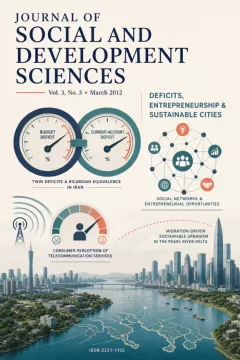 Vol. 3 No. 3 (2012)
Deficits, Entrepreneurship & Sustainable Cities
View issue contents
Published
Submissions
Have research to publish? Journal of Social and Development Sciences welcomes submissions.
Make a Submission