Abstract
Under influence of globalization regional boundaries seem to be melted with the hands of migrants and pave the integration process. Ideally integration occur through voluntary linking in the economic and political domains of two or more formerly independent states to the extent that authority over key areas of national policy is shifted towards the supra-national level. The Pearl River Delta (PRD) region of South China is unique as its status transformed from an international boundary between the UK and the People’s Republic of China (PRC) to an internal boundary inside China under ‘one country-two systems’ in 1997. Cross-border migration between Hong Kong and the PRD can be seen as the discourse of dependant development. Contrary to the contribution of migrants through spontaneously locating and relocating themselves across border with their social and entrepreneurial interplay in history, governments responded selectively to cross-border issues While most research emphasize economic and political aspects, analysis into the migration history reveals that integration in the PRD region is a unique form of ‘inter-dependent urbanism’ through the hands of temporary and permanent migrants who once happened to be separated by force, are merging in the same nation-state recently. This subtly perceived trend of urbanization has scope to achieve sustainability of the region.
Keywords
- Migration Search this journal for Migration (opens in a new tab)
- Inter-dependent Urbanism Search this journal for Inter-dependent Urbanism (opens in a new tab)
- Regional Integration Search this journal for Regional Integration (opens in a new tab)
- Sustainability Search this journal for Sustainability (opens in a new tab)
References
- Ambrose, M. A. & Chow, N. W. S. (2006). The Residential Mobility and Housing Preferences of Hong Kong Retiree Movers to the Pearl River Delta. In A. G. O. Yeh, V. F. S. Sit, G. Chen & Y. Zhou (Eds.), Developing a Competitive Pearl River Delta in South China Under One Country-Two Systems (229-252). Hong Kong: Hong Kong University Press.
- Anderson, N. (1964). Aspects of urbanism and urbanization. In N. Anderson (Ed.), Urbanism and urbanization (1-6). Leiden: Brill.
- Chan, K. & Cheng, H. (2002). One Country, Two Systems Cultural Values Reflected in Chinese and Hong Kong Television Commercials. International Communication Gazette, 64 (4), 385-400.
- Chan, K. L. (2006). Population movement statistics in Hong Kong. Retrieved from http://www.iaos2006conf.ca/pdf/Chan.pdf
- Chan, M. K. (1995). All in the family: The Hong Kong-Guangdong link in historical perspective. In R. Y. W. Kwok & A. Y. So (Eds.), The Hong Kong-Guangdong link: partnership in flux (31-63). Hong Kong: Hong Kong University Press.
- Chan, R. C. K. (1998). Cross-border regional development in Southern China. GeoJournal, 44 (3), 225-237.
- Chan, R. C. K. (2006). Regional Integration and Governance in the Pearl River Delta Region from a CrossBorder Perspective. In A. G. O. Yeh, V. F. S. Sit, G. Chen & Y. Zhou (Eds.), Developing a competitive Pearl River Delta in South China under one country-two systems (481-508). Hong Kong: Hong Kong University Press.
- Chen, C., Chang, L. & Zhang, Y. (1995). The role of foreign direct investment in China's post-1978 economic development. World Development, 23 (4), 691-703.
- Cheung, P. T. Y. (2006). Cross-boundary Cooperation in South China: Perspectives, Mechanisms and Challenges. In A. G. O. Yeh, V. F. S. Sit, G. Chen & Y. Zhou (Eds.), Developing a competitive Pearl River Delta in South China under one country-two systems (449-480). Hong Kong: Hong Kong University Press.
- Choe, S. C. (1998). Urban corridors in Pacific Asia. In F. C. Lo & Y. M. Yeung (Eds.), Globalization and the world of large cities (155-173). Tokyo, Japan: The United Nations University Press.
- Choi, T. M., Liu, S. C., Pang, K. M. & Chow, P. S. (2008). Shopping behaviors of individual tourists from the Chinese Mainland to Hong Kong. Tourism Management, 29 (4), 811-820.
- Destexhe, J. F. (1995). Hong Kong and 1997: The facts. In W. Menski (Ed.), Coping with 1997: the reaction of the Hong Kong people to the transfer of power (17-56). Staffordshire: Trentham Books Ltd.
- Frank, A. G. (1978). Dependent accumulation and underdevelopment. London: Macmillan.
- Garnaut, R., Song, L. & Yao, Y. (2006). Impact and Significance of State-Owned Enterprise Restructuring in China. The China Journal, 55, 35-63.
- Guldin, G. E. (1995). Toward a greater Guangdong: Hong Kong’s sociocultural impact on the Pearl River Delta and beyond. In R. Y. W. Kwok & A. Y. So (Eds.), The Hong Kong–Guangdong Link: Partnership in Flux (89-118). Hong Kong: Hong Kong University Press.
- Hsieh, C. T. & Woo, K. T. (2005). The impact of outsourcing to China on Hong Kong's labor market. The American Economic Review, 95 (5), 1673-1687.
- Koo, S. (1968). The Role of Export Expansion in Hong Kong's Economic Growth. Asian Survey, 8 (6), 499-515.
- Kwok, D. W. Y. (1991). unification and division in the chinese historical experience. Paper presented at the Historical Changes in Hong Kong and South China: Sociocultural Integration Toward 1997.
- Kwok, R. Y. W. (1986). Regional Relationship and Interaction Between Hong Kong and China. In L. Y. Choi, K. W. Fong & K. Y. W. (Eds.), Planning and Development of Coastal Open Cities (Part II: Hong Kong Section) (159-173). Hong Kong: Center of Urban Studies and Regional Planning, University of Hong Kong.
- Law, K. & Lee, K. (2006). Citizenship, economy and social exclusion of mainland Chinese immigrants in Hong Kong. Journal of Contemporary Asia, 36 (2), 217-242.
- Lee, L. T. & McCobb, J. B. J. (1971). United States Trade Embargo on China, 1949-1970: Legal Status and Future Prospects. Internation Law and Politics, 3 (4).
- Lin, G. (1999). State policy and spatial restructuring in post-reform China, 1978-95. International Journal of Urban and Regional Research, 23 (4), 670-696.
- Ling, C., Hanna, K. & Dale, A. (2009). A Template for Integrated Community Sustainability Planning. Environmental Management, 44 (2), 228-242.
- Lui, T. L. & Chiu, S. W. K. (2001). Flexibility under Unorganized Industrialism? The Experience of Industrial Restructuring in Hong Kong. In F. C. Deyo, R. F. Doner & E. Hershberg (Eds.), Economic governance and the challenge of flexibility in East Asia (55–78). Lanham, Md.: Rowman & Littlefield Publishers.
- Ma, Z. (2001). Urban labour-force experience as a determinant of rural occupation change: evidence from recent urban-rural return migration in China. Environment and Planning A, 33 (2), 237-256.
- Marcotullio, P. (2001). Globalization and urban sustainability in the Asia Pacific Region. Taipei: Academia Sinica, Program for Southeast Asian Area Studies.
- Mattli, W. (1999). The logic of regional integration: Europe and beyond. Cambridge: Cambridge University Press.
- Nye, J. S. & Keohane, R. O. (1971). Transnational Relations and World Politics: An Introduction. In R. O. Keohane & J. S. Nye (Eds.), Transnational Relations and World Politics (ix-xxix). Cambridge, MA: Harvard University Press.
- Pannell, C. (2002). China's continuing urban transition. Environment and Planning A, 34 (9), 1571-1590.
- Planning Department. (2009). Survey of Hong Kong People Living in Shenzhen 2008. Hong Kong.
- Prasai, S. B. (1993). Intra-Asian Labor Migration: Redefining the Implications. Asian Survey, 33 (11), 10551070.
- Rosenau, J. N. (1980). The study of global interdependence: essays on the transnationalization of world affairs. London: Frances Pinter.
- Schiffer, J. (1983). Urban enterprise zones: a comment on the Hong Kong model. International Journal of Urban and Regional Research, 7 (3), 429-438.
- Shen, J. (2004). Cross-border urban governance in Hong Kong: the role of state in a globalizing city-region. The Professional Geographer, 56 (4), 530-543.
- Sit, V. F. S. (1989). Hong Kong's new industrial partnership with the Pearl River Delta. Asian Geographer, 8 (1/2), 103-115.
- Sit, V. F. S. (1998). Hong Kong's transferred industrialization and industrial geography. Asian Survey, 38 (9), 880-904.
- Sit, V. F. S. (2001). Economic integration of Guangdong Province and HK: implications for China's opening and its accession to the WTO. Regional Development Studies, 7 , 129–142.
- Skeldon, R. (1997a). Hong Kong: colonial city to global city to provincial city? Cities, 14 (5), 265-271.
- Skeldon, R. (1997b). Migration and development: a global perspective. Harlow, Essex: Longman.
- So, A. Y. (2003). Cross-border families in Hong Kong The role of social class and politics. Critical Asian Studies, 35 (4), 515-534.
- Sung, Y. W. (2004). Hong Kong’s Economic Integration with the Pearl River Delta: Quantifying the Benefits and Costs (Final Report). Retrieved from http://www.cpu.gov.hk/english/documents/new/press/200404%20PRD%20report.pdf
- Sung, Y. W. & Wong, K. Y. (2000). Growth of Hong Kong before and after its reversion to China: the China factor. Pacific Economic Review, 5 (2), 201-228.
- Szczepanik, E. F. (1960). The economic growth of Hong Kong. London: Oxford University Press.
- Thant, M., Tang, M. & Kakazu, H. (1994). Growth triangles in Asia: a new approach to regional economic cooperation. Oxford; Tokyo: Published for the Asian Development Bank by Oxford University Press, .
- Timothy, D. J. (1999). Cross-border partnership in tourism resource management: International parks along the US-Canada border. Journal of Sustainable Tourism, 7 (3-4), 182-205.
- Tisdale, H. (1942). The process of urbanization. Social Forces, 20 (3), 311-316.
- Vertovec, S. (2003). Migration and other modes of transnationalism: towards conceptual cross‐fertilization. International Migration Review, 37 (3), 641-665.
- Wang, D. (2004). Hong Kongers’ cross-border consumption and shopping in Shenzhen: patterns and motivations. Journal of Retailing and Consumer Services, 11 (3), 149-159.
- Wong, M. C. & Lam, Y. (2008). Macro stress tests and history-based stressed PD: the case of Hong Kong. Journal of Financial Regulation and Compliance, 16 (3), 251-260.
- Wong, T. K. & Wan, S. P. S. (2009). Hong Kong citizens' evaluations of the "one country, two systems" practice. In H. H. M. Hsiao & C. Y. Lin (Eds.), Rise of China: Beijing's Strategies and Implications for the AsiaPacific (270-283). Abingdon: Routledge.
- Yang, C. (2004). From Market-Led to Institution-Based Economic Integration: The Case of the Pearl River Delta and Hong Kong. Issues & Studies, 40 (2), 79-118.
- Yang, C. (2006). The Pearl River Delta and Hong Kong: an evolving cross-boundary region under one country, two systems. Habitat International, 30 (1), 61-86.
- Yeh, A. G. O., & Xu, J. (2006). Turning of the Dragon Head: Changing Role of Hong Kong in the Regional Development of the Pearl River Delta. In A. G. O. Yeh, V. F. S. Sit, G. Chen & Y. Zhou (Eds.), Developing a Competitive Pearl River Delta in South China Under One Country-Two Systems (63-96). Hong Kong: Hong Kong University Press.
- Young, A. (1992). A Tale of Two Cities: Factor Accumulation and Technical change in Hong Kong and Singapore. In O. J. Blanchard & S. Fischer (Eds.), NBER Macroeconomics Annual (13-54). London and Cambridge: MIT Press.
Downloads
No downloads have been recorded for this article yet. Figures appear here once readers begin downloading the full text.
How to Cite
Share this article
License
Copyright (c) 2012 Alam, A.F.M. Ashraful, Khalil, Momtaj Bintay (Author)

This work is licensed under a Creative Commons Attribution 4.0 International License.
Author (s) should affirm that the material has not been published previously. It has not been submitted and it is not under consideration by any other journal. At the same time author (s) need to execute a publication permission agreement to assume the responsibility of the submitted content and any omissions and errors therein. After submission of revised paper in the light of suggestions of the reviewers, the editorial team edits and formats manuscripts to bring uniformity and standardization in published material.
This work will be licensed under Creative Commons Attribution 4.0 International (CC BY 4.0) and under condition of the license, users are free to read, copy, remix, transform, redistribute, download, print, search or link to the full texts of articles and even build upon their work as long as they credit the author for the original work. Moreover, as per journal policy author (s) hold and retain copyrights without any restrictions.
Keywords
- Migration Search this journal for Migration (opens in a new tab)
- Inter-dependent Urbanism Search this journal for Inter-dependent Urbanism (opens in a new tab)
- Regional Integration Search this journal for Regional Integration (opens in a new tab)
- Sustainability Search this journal for Sustainability (opens in a new tab)
Section
Published in
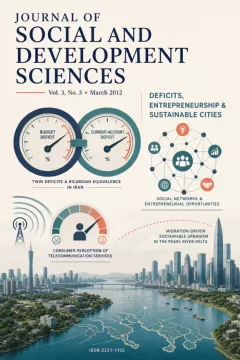 Vol. 3 No. 3 (2012)
Deficits, Entrepreneurship & Sustainable Cities
View issue contents
Published
Submissions
Have research to publish? Journal of Social and Development Sciences welcomes submissions.
Make a Submission