Abstract
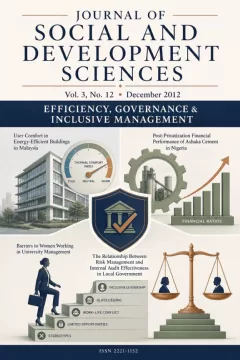
Privatization as a reform policy package has been adopted by both developed and developing countries’ economies. Nigeria as a developing country has large public enterprises which has about 57 percent of fixed capital investment and about 66 percent of formal sector employment by 1997. These enterprises performed below expectation due to multiple problems. Technical Committee on Privatization and Commercialization (TCPC) was set up to privatize the enterprises and the privatization have since commenced. The paper reviewed Ashaka cement company performance as a privatized enterprise after privatization. Managers of business organization must have reliable analytical tools for taking a rational decision. Ratio is one of such tools. Time series data from Ashaka Cement Company was used. The performance of the company has improved after privatization.
Keywords
References
- Adam, C., Cavendish, W. & Mistry, P. (1992). Adjusting privatization. Case studies from developing countries. James Curry: London.
- Ariyo, A. & Jerome, A. (1999). Privatization in Africa: An appraisal. World Development, 27(1), 201–13.
- Bernstein, L. A. (1974). Understanding corporate report: A guide to financial statement analysis, New-York.
- Boubakri, N. & Cosset, J. (1998). The financial and operating performance of newly privatized firms: Evidence from developing countries. The Journal of Finance, LIII(3), 1081–110.
- D’Souza, J. & Megginson, W. L. (1999). The financial and operating performance of newly privatized firms during the 1990s. Journal of Finance , 54, 1397–438.
- Dewenter, K. & Malatesta, P. H. (2001). State-owned and privately-owned firms: An empirical analysis of profitability, leverage, and labor intensity. American Economic Review , 91(1), 320 – 35.
- Federal Government of Nigeria. (1986). Structural Adjustment Program July 1986 – June 1988. Federal Government Information Memorandum, November.
- Higgins, R. C. (2004). Analysis for financial management. The McGraw-Hill Companies Inc.: New York.
- Jerome, A. (2004). Technical efficiency in some privatized enterprises in Nigeria. African Journal of Economic Policy , 11(1), 17–34.
- Jerome, A. (2005). Privatization and regulation in South Africa: An evaluation. Chapter 6 in Edmund Amann, ed., Regulating Development Evidence from Africa and Latin America. Northampton, Massachusetts, and Cheltenham, UK: Edward Elgar Publishing Ltd.
- Jerome, A. (2008). Privatization and enterprise performance in Nigeria: Case study of some privatized enterprises: African economic research consortium (AERC).
- La Porta, R. & López-de-Silanes, F. (1997). Benefits of privatization: Evidence from Mexico NBER Working Paper No 6215. National Bureau of Economic Research, Cambridge, Massachusetts.
- Magaji, A. M. (2007). Privatization as an alternative development strategy for Nigeria (1986 – 2003). Unpublished M.Sc. Thesis, A.B.U. Zaria.
- Megginson, W. L., Nash, R. & Van Randenborgh, M. (1994). The Financial and Operating Performance of Newly Privatized Firms: An International Empiric Analysis. Journal of Finance, 49, 403-52.
- Okwoli, A. A. (2009). The use of ratios in financial statement analysis and prediction of financial crisis in financial management and control, Edited, (ANAN, 2009).
- Pandey, I. M. (1995). Essentials of finance management, Vikas Publishing House PVT Ltd.: New-Delhi.
- Simon, J. (1988). Interpretation of financial statements: The use of ratios, ACCA students’ Newsletters, October.
- Technical Committee on Privatization and Commercialization (TCPC). (1993). Final report, one & two. The Presidency, Abuja.
- World Bank. (1995). Bureaucrats in business: The economics and politics of government ownership. New York: Oxford University Press.orld.
- White, O. C. & Bhatia, A. (1998). Privatization in Africa. The World Bank : Washington, D.C. Zayyad, H. R. (1990). Privatization and commercialization in Nigeria: TCPC report, 1998.
Downloads
No downloads have been recorded for this article yet. Figures appear here once readers begin downloading the full text.
How to Cite
Share this article
License
Copyright (c) 2012 Abubakar Muhammed Magaji, Sallahuddin Hassan (Author)

This work is licensed under a Creative Commons Attribution 4.0 International License.
Author (s) should affirm that the material has not been published previously. It has not been submitted and it is not under consideration by any other journal. At the same time author (s) need to execute a publication permission agreement to assume the responsibility of the submitted content and any omissions and errors therein. After submission of revised paper in the light of suggestions of the reviewers, the editorial team edits and formats manuscripts to bring uniformity and standardization in published material.
This work will be licensed under Creative Commons Attribution 4.0 International (CC BY 4.0) and under condition of the license, users are free to read, copy, remix, transform, redistribute, download, print, search or link to the full texts of articles and even build upon their work as long as they credit the author for the original work. Moreover, as per journal policy author (s) hold and retain copyrights without any restrictions.
Keywords
Section
Published
Submissions
Have research to publish? Journal of Social and Development Sciences welcomes submissions.
Make a Submission