Abstract
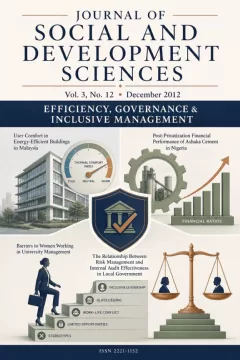
Risk management can play important role in ensuring objective achievement of organizations. Therefore, the aim of this paper is to examine the relationship between risk management and internal audit effectiveness at local government level. The paper is a literature review paper and the paper concluded that risk management can influence the effectiveness of internal auditors at local level. The paper needs to be validated empirically.
Keywords
References
- Abushaiba, I. A. & Zainuddin, Y. (2012). Performance measurement system design, competitive capability, and performance consequences - A conceptual like . International Journal of Business and Social Science, 3(11), 184-193.
- Aguolu, O. (2009). Designing an effective internal audit group. Association of Accountancy Bodies in West Africa, 1(4), 60-76.
- Ahmad, N., Othman, R. & Jusoff, K. (2009). The effectiveness of internal audit in Malaysian public sector. Journal of Modern Accounting and Auditing, 5(9), 784-790.
- Alberta, A. G. (2005). Examination of internal audit departments. Internal Audit Report. Retrieve on 12/09/2012 from http://www.oag.ab.ca/files/oag/Examination_IAD.pdf
- Albrecht, W. S., Howe, K. R., Schueler, D. R. & Stocks, K. D. (1988). Evaluating the effectiveness of internal audit departments , Institute of Internal Auditors.
- Al-Twaijry, A. A. M., Brierley, J. A. & Gwilliam, D. R. (2003). The development of internal audit in Saudi Arabia: An Institutional Theory perspective. Critical Perspective on Accounting, 14, 507-531.
- Anderson, R. J. (2012). What should directors ask about risk management? Strategic finance , 2, 14 -20.
- Anuntaakalakul, A. (2010). The achievement in risk management and governance of public sector organizations in Thailand: The Empirical Evidence of Internal Auditing efforts. EABR & ETLC Conference Proceedings Dublin, Ireland, 99 –104.
- Arena, M. & Azzone, G. (2009). Identifying organizational drivers of internal audit effectiveness. International Journal of Auditing, 13, 43–60.
- Arena, M. & Azzone, G. (2010). Internal audit effectiveness: Relevant drivers of auditees’ satisfaction1-35.
- Ayman, R., Chemers, M. M. & Fiedler, F. (1995). The contingency model of leadership effectiveness: Its levels of analysis. Leadership Quarterly, 6(2), 147-167.
- Baltaci, M. & Yilmaz, S. (2006). Keeping an eye on Subnational Governments: Internal control and audit at local levels. World Bank Institute Washington, D.C
- Beasley, M. S., Clune, R. & Hermanson, D. R. (2006). The impact of enterprise risk management on the internal audit function. Institute of Internal Auditors (IIA) Research Foundation and the assistance. 1- 28.
- Beckmerhagen, I. A., Berg, H. P., Karapetrovic, A. & Willborn, W. O. (2004). On the effectiveness of quality management system audits. The TQM Magazine, 16(1), 14 – 25.
- Belay, Z. (2007). A Study on effective implementation of internal audit function to promote good governance in the public sector. Presented to the Achievements, Challenges, and Prospects of the Civil Service Reform program implementation in Ethiopia Conference Ethiopian Civil Service College Research, Publication & Consultancy Coordination Office.
- Bota, C. & Palfi, C. (2009). Measuring and assessment of internal audit’s effectiveness. Economic Science Series , 18(3), 784-790.
- Cahill, E. (2006). Audit committee and internal audit effectiveness in a multinational bank subsidiary: A case study. Journal of Banking Regulation, 7, 160-179.
- Cassandra, S. L., Yee, A. S., Kieran, J. & Jenny, K. S. (2008). Perceptions of Singaporean internal audit customers regarding the role and effectiveness of internal audit. Asian Journal of Business and Accounting, 1(2), 147-174.
- Coetzee, P. & Fourie, H. (2009). Perceptions on the role of the internal audit function in respect of risk. African Journal of Business Management, 3(13), 959-968.
- Cohen, A. & Sayag, G. (2010). The Effectiveness of internal auditing: An empirical examination of its determinants in Israeli organizations. Australian Accounting Review, 54(20), 296-307.
- Chaveerug, A. (2011). The role of accounting information system knowledge on audit effectiveness of CPAS in Thailand . International journal of business strategy, 11, 78 – 89.
- Chenhall, R. H. (2003). Management control systems design within its organizational context: Findings from contingency-based research and directions for the future. Accounting Organizations and Society, 28, 127–168.
- Crawford, M. & Stein, W. (2004). Risk management in UK local authorities: The effectiveness of current guidance and practice. International Journal of Public Sector Management, 17(6), 498 – 512.
- De Smet, D. & Mention, A. (2011). Improving auditor effectiveness in assessing KYC/AML practices: Case study in a Luxembourgish context. Managerial Auditing Journal, 26(2), 182 – 203.
- Dittenhofer, M. (2001). Internal auditing effectiveness: An expansion of present methods. Managerial Auditing Journal, 16(8), 443 – 450.
- Dominic, S. B. S. & Nonna, M. (2011). The internal audit function: Perceptions of internal audit roles, effectiveness and evaluation. Managerial Auditing Journal, 26(7), 605 – 622.
- Donaldson, L. (2001). The contingency theory of organizations. Thousand Oaks, CA: Sage Publications London.
- Dhamankar, R. & Khandewale, A. (2003). Effectiveness of Internal Audits. The Chartered Accountant , 1, 275 – 279 .
- Drazin, R. & Van de Ven, A. H. (1985). Alternative forms of fit in contingency Theory. Administrative Science Quarterly, 30, 514-539.
- Eden, D. & Moriah, L. (1996). Impact of internal auditing on branch Bank Performance: A field experiment, Organizational Behavior and Human Decision Performance , 68, 262–71.
- Feizizadeh, A. (2012). Strengthening internal audit effectiveness. Indian Journal of Science and Technology, 5(5), 2777- 2778.
- Fraser, I. & Henry, W. (2007). Embedding risk management: Structures and approaches. Managerial Auditing Journal, 22(4), 392 – 409.
- Froot, K. A., Scharfstein, D. S. & Stein, J. C. (1992). Risk management: Coordinating corporate investment and financing policies. Working Paper No. 4084. National bureau of economic research, 2, 1-33.
- Gordon, L. A., Loeb, M. P. & Tseng, C. (2009). Enterprise risk management and firm performance: A contingency perspective. J. Account. Public Policy, 28, 301–327.
- IAG. (2008). Internal Audit Guidelines Department of Local Government Alternative Media Publications.
- IAG. (2010). Internal Audit Guide. The Division of Local Government, Department of Premier and Cabinet. Sydney South.
- Johnsen, A. & Vakkuri, J. (2001). Performance auditing in local government: an exploratory study of perceived efficiency of municipal value for money auditing in Finland and Norway. The European Accounting Review, 10(3), 583–599.
- Karapetrovic, S. & Willborn, W. (2000). Quality assurance and effectiveness of audit systems. International Journal of Quality & Reliability Management, 17(6), 679 – 703.
- Krishnamoorthy, G. (2002). A multistage approach to external auditor’s evaluation of the internal audit function. Auditing: A journal of practice and theory, 21(1), 95 –122.
- Mihret, D. G. & Yismaw, A. W. (2007). Internal audit effectiveness: An Ethiopian public sector case study. Managerial Auditing Journal, 22(5), 470-484.
- Mihret, D. G., James, K. & Joseph, M. M. (2010). Antecedents and organizational performance implications of internal audit effectiveness: some propositions and research agenda. Pacific Accounting Review, 22(3), 224 – 252.
- Mikes, A. (2009). Risk management and calculative cultures. Management Accounting Research, 20, 18–40.
- Mizrahi, S. & Ness-Weisman, I. (2007). Evaluating the effectiveness of auditing in local municipalities using analytic hierarchy process (AHP): A general model and the Israeli example. International Journal of Auditing, 11, 187–210.
- McPhee, I. (2006). Public sector governance and risk forum risk and risk management in the public sector. Australian Institute of Company Directors, in conjunction with the Institute of Internal Auditors Australia, 1-25.
- Nickmanesh, S., Seyedabrishami, S. Z., Gheshmi, R., Manafi, M., Fotoohnejad, S. & Hojabri, R. (2011). The Relationship between risk management and performance of new product development in Malaysia. Interdisciplinary Journal of Contemporary Research in Business, 3(3), 1040 –1048.
- Olga, S. (2007). Internal audit efficiency evaluation principles. Journal of Business Economics and Management, 8(4), 275–284.
- Page, M. & Spira, L. F. (2004). The Turnbull report, internal control and risk management: The developing role of internal audit. Published by The Institute of Chartered Accountants of Scotland, 1-30.
- Pilcher, R., Gilchrist, D. & Singh, I. (2011). The Relationship between internal and external audit in the public sector – A Case Study, 1-23.
- Pungas, K. (2003). Risk assessment as part of internal auditing in the government institutions of the Estonian Republic. EBS Review summer , 3, 42-46.
- Reid, G. C. & Smith, J. A. (2000). The impact of contingencies on management accounting system development. Management Accounting Research, 11, 427– 450.
- Sarens, G. & De Beelde, I. (2006). Internal auditors' perception about their role in risk management: A comparison between US and Belgian companies. Managerial Auditing Journal, 22(1), 63 – 80.
- Sauser, B. J., Reilly, R. R. & Shenhar, A. J. (2009). Why projects fail? How contingency theory can provide new insights – A comparative analysis of NASA’s Mars Climate Orbiter loss. International Journal of Project Management, 27, 665–679.
- Sobel, P. (2011). Internal auditing roles in risk management. Institute of Internal Audit Research Foundation, 1-18.
- Sudsomboon, S. & Ussahawanitchakit, P. (2009). Professional audit competencies: the effects On Thai’s CPAS audit quality, reputation, and success. Review of Business Research, 9(3), 66 – 85.
- Sumritsakun, C. & Ussahawanitchakit, P. (2009). Internal audit innovation and firm stability of Thai listed company: how do implement in an organization? Journal of Academy of Business and Economics, 9(4) , 1 – 23.
- Schneider, G. P., Sheikh, A. & Simione, K. A. (2011). Managing risk in uncertain times: How internal audit can help . Proceedings of the Academy of Accounting and Financial Studies, 16(1), 29- 32.
- Schoonhoven, C. B. (1981). Problems with contingency theory: Testing assumptions hidden within the Language of Contingency Theory. Administrative Science Quarterly, 26, 351-377.
- Stoneburner, G., Goguen, A. & Feringa, A. (2002). Risk Management guide for Information Technology Systems. Recommendations of the National Institute of Standards and Technology, Special Publication 800-30, 54.
- Umanath, N. S. (2003). The concept of contingency beyond It depends illustrations from IS research stream. Information & Management, 40, 551–562.
- Unegbu, A. O. & Kida, M. I. (2011). Effectiveness of internal audit as instrument of improving public Sector management. Journal of Emerging Trends in Economics and Management Sciences (JETEMS), 2(4), 304-309.
- Ussahawanitchakit, A. & Intakhan, A. (2011). Audit professionalism, audit independence and audit effectiveness of CPAs in Thailand. International Journal of Business Research, 11(2) , 1-11.
- Valanciene, L. & Gimzauskiene, E. (2009). Dimensions of performance measurement system in changes research. Engineering Economics 4 , 41-48.
- Vasile, E., Croitoru, I. & Mitran, D. (2012). Risk management in the financial and accounting activity. Internal auditing & risk management Annul, 1 (25) , 13 –24.
- Verdina, G. (2011). Risk management as a tool for securing internal control in the process of study program implementation at higher education institutions. Economics and management, 16, 987991.
- Vijayakumar, A. N. & Nagaraja, N. (2012). Internal control systems: Effectiveness of internal audit in risk management at public sector enterprises. BVIMR Management Edge , 5(1), 1-8.
- Woods, M. (2009). A contingency theory perspective on the risk management control system within Birmingham City Council. Management Accounting Research, 20, 69–81.
Downloads
No downloads have been recorded for this article yet. Figures appear here once readers begin downloading the full text.
How to Cite
Share this article
License
Copyright (c) 2012 Mu’azu Saidu Badara, Siti Zabedah Saidin (Author)

This work is licensed under a Creative Commons Attribution 4.0 International License.
Author (s) should affirm that the material has not been published previously. It has not been submitted and it is not under consideration by any other journal. At the same time author (s) need to execute a publication permission agreement to assume the responsibility of the submitted content and any omissions and errors therein. After submission of revised paper in the light of suggestions of the reviewers, the editorial team edits and formats manuscripts to bring uniformity and standardization in published material.
This work will be licensed under Creative Commons Attribution 4.0 International (CC BY 4.0) and under condition of the license, users are free to read, copy, remix, transform, redistribute, download, print, search or link to the full texts of articles and even build upon their work as long as they credit the author for the original work. Moreover, as per journal policy author (s) hold and retain copyrights without any restrictions.
Keywords
Section
Published
Submissions
Have research to publish? Journal of Social and Development Sciences welcomes submissions.
Make a Submission