Abstract
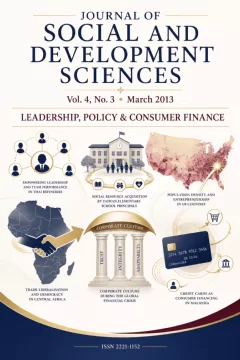
This paper documents that trade liberalization and democracy contribute positively to economic development. A panel of 11 Central Africa countries with 176 observations from 1995 to 2010 was used to econometrically verify this assertion. Estimation using the general least square (GLS) with the overall R-square ( R__2 = 0.0325) shows that there is a relationship between the economic development captured here with Human development indicators (HDI), democracy, importations, exportations, inflation and regional integration. Inflation and exports negatively affect the well-being of the population. An increase in inflation rate causes a reduction in purchasing power. An increased in exports commodities tends to decrease the quantity of goods available for the country of origin. Imports have a positive effect on HDI probably because this variable tends to increase the quantity of goods available. Imports and democracy have a positive effect on the level of development among Central African countries. The paper’s findings are important to Central Africa policy makers towards creation and increasing trade within, between and with other democratic countries.
Keywords
- Trade Search this journal for Trade (opens in a new tab)
- Democracy Search this journal for Democracy (opens in a new tab)
- Development Search this journal for Development (opens in a new tab)
- Well-Being Search this journal for Well-Being (opens in a new tab)
- Regional Integration Search this journal for Regional Integration (opens in a new tab)
- Central Africa Search this journal for Central Africa (opens in a new tab)
References
- Acemoglu, D., Simon Johnson, D., Robinson, J. A. & Yared, P. (2008). Income and Democracy. American Economic Review , 98(3), 808-42.
- Acemoglu, D. & Robinson, J. A. (2006). Economic Origins of Dictatorship and Democracy. Cambridge University Press, Cambridge.
- Aidt, T. S. & Gassebner, M. (2010). Do Autocratic States Trade Less? The World Bank Economic Review , 24(1), 38-76 doi: 10.1093/wber/lhp022
- Arnfred, S. & Utas, M. (2007). Re-thinking Africa. A Contribution to the Swedish Government White Paper on Africa, The Nordic Africa Institute, Uppsala.
- Balassa, B. (1961). Towards a Theory of Economic Integration. Irwin, Homewood, Illinois.
- Baldwin, R. R. (2006). The Euro’s Trade Effects. European Central Bank Working Paper WPS/594, Frankfurt, Germany.
- Barbierie, K. (1996). Economic Interdependence: A path to peace or source of interstate conflict? Journal of Peace Research , 33(1), 29-49.
- Barbierie, K. (2003). The Liberal Illusion: Does trade promote peace? The University of Michigan Press.
- Barro, R. (1999). Determinants of Democracy. Journal of Political Economy , 107(S6), S158-83.
- Boockmann, B. & Dreher, A. ( 2003). The Contribution of the IMF and the World Bank to Economic Freedom. European Journal of Political Economy , 19(3), 633-49.
- Brunetti, A. & Weder, B. (1995). Political Sources of Growth: A Critical Note on Measurement. Public Choice , 82(1-2), 125-34.
- Burkhart, R. E. & Lewis-Beck, M. S. (1994). Comparative Democracy: The Economic Development Thesis. American Political Science Review , 88(4), 903-10.
- Coppedge, M. & Wolfgang, R. (1990). Measuring Polyarchy. Studies in Comparative International Development , 25(1), 51-72.
- Daumal, M. (2008), Federalism, Separatism and International Trade. European Journal of Political Economy , 24(3), 675-87.
- Draper (2010). Rethinking the (European) Foundations of Sub-Saharan African Regional Economic Integration: A Political Economy Essay. Working Paper, 293, OECD.
- Dreher, A. & Rupprecht, S. (2007). IMF Programs and Reform-Inhibition or Encouragement? Economics Letters , 95(3), 320-26.
- Durham, J. B. (1999). Economic Growth and Political Regimes. Journal of Economic Growth , 4(1), 81-111.
- Dzaka-Kikouta, T. & Tchouassi, G. (2012). Intégration régionale en Afrique Centrale: Une analyse des théories, des contraintes et des perspectives. In Fau-Nougaret M. (sd), La concurrence des organisations régionales en Afrique, L’Harmathan, Paris.
- Fedderke, J. & Klitgaard, R. (1998). Economic Growth and Social Indicators: An Exploratory Analysis. Economic Development and Cultural Change , 46(3), 455–90.
- Feng, Y. (1996). Democracy and Growth: The Sub-Saharan African Case, 1960–1992. Review of Black Political Economy , 25(1), 95-126.
- Freedom House (2010). Annual Survey of Freedom Country Scores. http://www. freedomhouse.org.rankings.pdf/.
- Gasiorowski, M. J. (2000). Democracy and Macroeconomic Performance in Underdeveloped Countries. Comparative Political Studies , 33(3), 319-49.
- Giavazzi, F. & Tabellini, G. (2005). Economic and Political Liberalizations. Journal of Monetary Economics , 52(7), 1297-1330.
- Goldsmith, A. A. (2001). Foreign Aid and Statehood in Africa. International Organization , 55(1), 123-148
- Helliwell, J. F. (1994). Empirical Linkages between Democracy and Economic Growth. British Journal of Political Science , 24(2), 225-48.
- Hettne, B. (2000). The new regionalism and the future of security and development. MacMillan, London. IMF. (2012). World Economic Outlook. Growth Resuming, Dangers Remain, http://www.imf.org
- Isard, W. (1954). Location Theory and Trade Theory: Short-Run Analysis. Quarterly Journal of Economics , 68, 305-322.
- Hugon, P. (1993). Les économies en développement { l’heure de la régionalisation. Karthala, Paris.
- Krueger, A. O. (1974). The political economy of the rent-seeking society. American Economy Review , 64(3), 291-303.
- Krugman, P. R. (1991). Geography and Trade. MIT Press, Cambridge.
- Krugman, P. R. (1996). Pop internationalism. MIT Press, Cambridge.
- Krugman, P. R. & Obstfeld, M. (2006). International economics: theory and policy. 7th edition, Pearson/Addison-Wesley, Boston.
- Kwa A. (2007), Rethinking the Trading System, Dialogue on Globalization. Occasional Papers, 32, Friedrich-Ebert-Stiftung (FES), Geneva.
- Leblang, D. A. (1997).Political Democracy and Economic Growth: Pooled Cross-sectional and Time-series Evidence. British Journal of Political Science , 27(3),-453-72.
- Li, Q. & Reuveny, R. (2003). Economic Globalization and Democracy: An Empirical Analysis. British Journal of Political Science , 33(1), 29-54.
- Lipsey, R. G. (1957). The Theory of Customs Unions. Economica, Paris.
- Little, I. M. D., Scitovsky, T. & Scott, M. (1970). Industry and Trade in Some Developing Countries. Oxford University Press, Oxford.
- Long, A. G. (2008). Bilateral Trade in the Shadow of Armed Conflict. International Studies Quarterly , 52, 81-101.
- Lopez-Cordova, J. E. & Meisner, M. C. (2008). The Impact of International Trade on Democracy: A Longrun Perspective. World Politics , 60(4), 539-75.
- Mansfield, E. D., Milner, H. V. & Rosendorff, B. P. R. (2000). Free to Trade: Democracies, Autocracies, and International Trade. American Political Science Review , 94(2), 305–321.
- Martin, P., Mayer, T. & Thoenig, M. (2008). Make trade not war? Review of Economic Studies , 75(3), 865900
- Mbaku, J. M. (1994). The Political Economy of Development: An Empirical Analysis of the Effect of the Institutional Framework on Economic Development. Studies in Comparative International Development , 29, 3-21.
- Meade, J. E. (1956). The Theory of Customs Unions. Amsterdam, North Holland.
- Milner, H. V. & Kubota, K. (2005). Why the Move to Free Trade? Democracy and Trade Policy in the Developing Countries. International Organization , 59(1), 107-143.
- Morrow, J. D., Siverson, R. M. & Tabares, T. E. (1998). The Political Determinants of International Trade: The Major Powers, 1907-90. American Political Science Review , 92(3), 649-61.
- Mousseau, M. (2000). Market Prosperity, Democratic Consolidation, and Democratic Peace. Journal of Conflict Resolution , 44(4), 472-507.
- Myrdal, G. (1971). Asian Drama, an Inquiry into the Poverty of Nations. Penguin Books, London.
- Nelson, M. A. & Singh, R. D. (1998). Democracy, Economic Freedom, Fiscal Policy, and Growth in LDCs: A Fresh Look. Economic Development and Cultural Change , 46(4), 677-96.
- Oneal, R. J. & Russet, B. (1999). Assessing the Liberal Peace with Alternative Specifications: Trade Still Reduces Conict. Journal of Peace Research , 36(4), 423-442.
- Oneal, R. J. & Russet, B. (2003). Clear and Clean: The Fixed Effects of Liberal Peace. International Organization , 55(2), 469-485.
- Ohno, K. (2009). Ethiopia: Political Regime and Development Policies. GRIPS Development Forum, Tokyo.
- Perroux, F. (1961). L’économie du XXe siècle. Presses Universitaires de Grenoble, Grenoble.
- Perroux, F. (1972). Masse et classe. Casterman, Paris.
- Polachek, S. W. (1980). Conflict and Trade. Journal of Conflict Resolution , 1, 55-76.
- Polachek, S. W. (2007). Trade, Peace and Democracy: An analysis of dyadic dispute. In Sandler Todd and Hartley Keith Handbook of Defense Economics, 2, 31.
- Przeworski, A. & Limongi, F. (1997). Democracy and Development. In Democracy’s Victory and Crisis, edited by Axel Hadenius, 163-94. Cambridge University Press, Cambridge.
- Rigobon, R. & Rodrik, D. (2005). The Rule of Law, Democracy, Openness and Income: Estimating the Interrelationships. Economics of Transition , 13(3), 533-64.
- Rodriguez-Clare, A. (1996). Multinationals, Linkages, and Economic Development. American Economic Review , 86(4), 852-73.
- Romer, P. (1994). New Goods, Old Theory, and the Welfare Costs of Trade Restrictions. Journal of Development Economics , 2, 5-38.
- Rostow, W. W. (1960). The stages of economic growth: a non-communist manifesto. Cambridge University Press, Cambridge.
- Sachs, J. D. & Warner, A. M. (1995). Economic Reform and the Process of Global Integration. Brookings Papers on Economic Activity, 1-95.
- Sen, A. (1999). Development as freedom. Oxford University Press, Oxford.
- Sen, A. (2000). Un nouveau modèle économique. Développement, justice, liberté. Odile Jacob, Paris.
- Serieux, J. (1999). Democratization and Structural Adjustment in Africa: An Empirical Investigation. Canadian Journal of Development Studies , 20 (3), 521-544.
- Smith, A. (1776). The Wealth of Nations. ed. Andrew Skinner, Penguin Books, Harmondsworth.
- Stiglitz, J. E. (1997). Trade and Technology: Links and Problems. Paper presented to the Annual World Bank Conference on Development in Latin America and the Caribbean. Montevideo, Uruguay.
- Stiglitz, J. E. (1998). Towards a New Paradigm for Development: Strategies, Policies, and Processes, Prebisch Lecture at UNCTAD, Geneva.
- Sturm, J. E. & de Haan, J. (2003). Does More Democracy Lead to Greater Economic Freedom? New Evidence for Developing Countries. European Journal of Political Economy , 19(3), 547-63.
- Tinbergen, J. (1962). Shaping the World Economy: Suggestions for an International Policy. The Twentieth Century Fund.
- UNDP. (2010). Human Development Report 2010. 20th Anniversary Edition, the Real Wealth of Nations: Pathways to Human Development. http://hdr.undp.org UNDP (2012). The Human Development concept. UNDP, Retrieved 7 April 2012.
- Van de Walle, N. (1999). Economic Reform in a Democratizing Africa. Comparative Politics , 32(1), 21-41.
- Viner, J. (1950). The Customs Union Issue. Carnegie Endowment for International Peace, New York
- Wade, R. H. (2008). How to change the WTO and global policy on trade and investment: gaining acceptance of open economy industrial policy by hoisting neoliberalism on its own petard, Note for Princeton conference on Normative and empirical evaluation of global governance, February 1618.
- Wade, R. H. (2003). What strategies are viable for developing countries today? The WTO and the shrinking of ‘development space. Review of International Political Economy , 10(4).
- Wickrama, K. A. S. & Mulford, C. L. (1996). Political Democracy, Economic Development, Disarticulation, and Social Well-being in Developing Countries. Sociological Quarterly , 37(3), 375-90.
- Williamson, J. (1990). Latin American Adjustment: How Much Has Happened?, Institute for International Economics, Washington D.C.
- World Bank. (2008). World Development Indicators 2008. Oxford University Press, New York.
Downloads
No downloads have been recorded for this article yet. Figures appear here once readers begin downloading the full text.
How to Cite
Share this article
License
Copyright (c) 2013 Tchouassi, Gérard (Author)

This work is licensed under a Creative Commons Attribution 4.0 International License.
Author (s) should affirm that the material has not been published previously. It has not been submitted and it is not under consideration by any other journal. At the same time author (s) need to execute a publication permission agreement to assume the responsibility of the submitted content and any omissions and errors therein. After submission of revised paper in the light of suggestions of the reviewers, the editorial team edits and formats manuscripts to bring uniformity and standardization in published material.
This work will be licensed under Creative Commons Attribution 4.0 International (CC BY 4.0) and under condition of the license, users are free to read, copy, remix, transform, redistribute, download, print, search or link to the full texts of articles and even build upon their work as long as they credit the author for the original work. Moreover, as per journal policy author (s) hold and retain copyrights without any restrictions.
Keywords
- Trade Search this journal for Trade (opens in a new tab)
- Democracy Search this journal for Democracy (opens in a new tab)
- Development Search this journal for Development (opens in a new tab)
- Well-Being Search this journal for Well-Being (opens in a new tab)
- Regional Integration Search this journal for Regional Integration (opens in a new tab)
- Central Africa Search this journal for Central Africa (opens in a new tab)
Section
Published
Submissions
Have research to publish? Journal of Social and Development Sciences welcomes submissions.
Make a Submission