Abstract
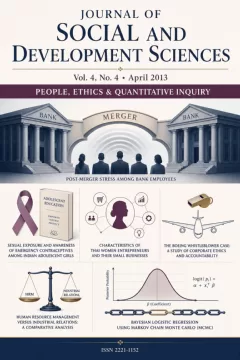
In India pre-marital sex although is taboo, interplay of multitude of factors exposes adolescent girls to pre-marital sex leading to unwanted pregnancy and further intricacies. Awareness of emergency contraceptive pills (ECP) can shield girls against such predicaments and associated social stigmas. Hence, this paper assesses the sexual exposure and awareness of ECP among the never married adolescent girls in India by taking the National Family Health Survey 2005-06 (NFHS-3) data. Out of the total sample, 15,320 adolescent girls of the age group 15-19 years, who are never married and de jure residents are retained for this study. Levels are found out through percentage distribution; associations are assessed through cross tabulation and logistic regression is applied to find out the determinants. It is found that in India, about 0.6 percent of never married adolescent girls have already experienced sex, out of whom 22.4 percent were active during four weeks prior to the survey. Multi-variate result shows that with the increase in age, probability of having pre-marital sex also increases, whereas with the improvement in household wealth index, probability goes down. Overall merely 4.9 percent of adolescent girls are aware of ECP. Age, education, religion and exposure to sexual intercourse exert significant effect on the awareness of ECP. Older, better educated, richer and sexually experienced girls are more likely to be aware of ECP, whereas rural and Muslim girls are less likely to be aware of ECP.
Keywords
- Pre-marital Sex Search this journal for Pre-marital Sex (opens in a new tab)
- Unwanted Pregnancy Search this journal for Unwanted Pregnancy (opens in a new tab)
- Emergency Contraceptive Pills Search this journal for Emergency Contraceptive Pills (opens in a new tab)
- Unmarried Adolescent Girls Search this journal for Unmarried Adolescent Girls (opens in a new tab)
- Emergency Contraception Search this journal for Emergency Contraception (opens in a new tab)
References
- Alexander, M., Garda, L., Kanade, S., Jejeebhoy, S. & Ganatra, B. (2007). Correlates of premarital relationships among unmarried youth in Pune District, Maharashtra, India. International Family Planning Perspective, 33(4), 150-159.
- Ghule, M. & Donta, B. (2011). Correlates of sexual behavior of rural college youth in Maharashtra, India. Eastern Journal of Medicine , 16, 122-132.
- Hossain, S. M. I. (2009). ECP handbook: Introducing and mainstreaming the provision of emergency contraceptive pills in developing countries, FRONTIERS Manual . Washington, DC: Population Council.
- International Institute for Population Sciences (IIPS) & Macro International (2007). National family health survey (NFHS-3), 2005-06: India: Volume I. Mumbai: IIPS.
- Jena, M. (2010). Rising Use of Emergency Contraceptives Raises Alarm. http://ipsnews.net/news.asp?idnews=51529 (accessed 07/09/2011).
- Joshi, B. & Chauhan, S. (2011). Determinants of youth sexual behavior: program implications for India. Eastern Journal of Medicine , 16, 113-121.
- Kumar, S., Shekhar, C., Gupta, N. K. & Roy, M. (2007). Provision of Emergency Contraceptive Services through Paraprofessionals in India. Indian Council of Medical Research (ICMR), Frontiers in Reproductive Health (FRONTIERS), Population Council, and Human Reproduction Research Centers (HRRCs), ICMR.
- Mir, A. S. & Malik, R. (2010). Emergency contraceptive pills: Exploring the knowledge and attitudes of community health workers in a developing Muslim country. North A J Med Sci , 2, 359-364.
- Ministry of Health & Family Welfare. (2008). Guidelines for administration of Emergency Contraceptive Pills by Health Care Providers. MoHFW, Govt. of India, New Delhi.
- Narzary, P. K. (2009). Knowledge and use of contraception among currently married adolescent women in India. Stud Home Comm Sci , 3(1), 43-49.
- Nayyar, A. (2000). Increasing access to emergency contraception in India, Health and Population, Perspectives and Issues , 23(3), 123-133 .
- Parey, B., Addison L., Mark, J. K., Maurice, B., Tripathi, V., Wahid, S., Antoine, R. & Sahai, A. (2010). Knowledge, attitude and practice of emergency contraceptive pills among tertiary level students in Trinidad: a cross sectional survey. West Indian Med. J., 59(6), 650-55.
- Parker, C. (2005). Adolescents and emergency contraceptive pills in developing countries. Working Paper No. WP05-01, Family Health International.
- Puri, S., Bhatia, V., Swami, H. M., Singh, A., Sehgal, A. & Kaur, A. P. (2007). Awareness of emergency contraception among female College students in Chandigarh, India. Indian J Med Sci., 61(6), 338-346.
- Sebastian, M. P., Khan, M. E., Kumar, S., Shekhar, C. & Gputa, N. K. (2005). Studying the use of emergency contraceptive services through paramedics in India. Research Update No. 5, September 2005. New Delhi: Population Council/FRONTIERS.
- Shashikumar, R., Das, R. C., Prabhu, H. R. A., Srivastava, K., Bhat, P. S., Prakash, J. & Seema, P. (2012). A cross sectional study of factors associated with adolescent sexual activity. Indian Journal of Psychiatry, 54 (2), 138-143.
- Sujay, R. (2009). Premarital sexual behavior among unmarried college students of Gujarat, India. Health and Population Innovation Fellowship Program Working Paper, No. 9. New Delhi: Population Council.
- Tripathi, R., Rathore, A. M. & Sachdeva, J. (2003). Emergency contraception: knowledge, attitude, and practices among health care providers in North India. J Obstet Gynaecol Res, 29(3), 142-46.
- Trussell, J. & Raymond, E. G. (2012). Emergency Contraception: A last chance to prevent unintended pregnancy. (Accessed 11/09/2012, http: //ec.princeton.edu/questions/ec-review.pdf).
Downloads
No downloads have been recorded for this article yet. Figures appear here once readers begin downloading the full text.
How to Cite
Share this article
License
Copyright (c) 2013 Pralip Kumar Narzary (Author)

This work is licensed under a Creative Commons Attribution 4.0 International License.
Author (s) should affirm that the material has not been published previously. It has not been submitted and it is not under consideration by any other journal. At the same time author (s) need to execute a publication permission agreement to assume the responsibility of the submitted content and any omissions and errors therein. After submission of revised paper in the light of suggestions of the reviewers, the editorial team edits and formats manuscripts to bring uniformity and standardization in published material.
This work will be licensed under Creative Commons Attribution 4.0 International (CC BY 4.0) and under condition of the license, users are free to read, copy, remix, transform, redistribute, download, print, search or link to the full texts of articles and even build upon their work as long as they credit the author for the original work. Moreover, as per journal policy author (s) hold and retain copyrights without any restrictions.
Keywords
- Pre-marital Sex Search this journal for Pre-marital Sex (opens in a new tab)
- Unwanted Pregnancy Search this journal for Unwanted Pregnancy (opens in a new tab)
- Emergency Contraceptive Pills Search this journal for Emergency Contraceptive Pills (opens in a new tab)
- Unmarried Adolescent Girls Search this journal for Unmarried Adolescent Girls (opens in a new tab)
- Emergency Contraception Search this journal for Emergency Contraception (opens in a new tab)
Section
Published
Submissions
Have research to publish? Journal of Social and Development Sciences welcomes submissions.
Make a Submission